DbcultAccessing Vault...
Cult Review
Senior Film Conservator
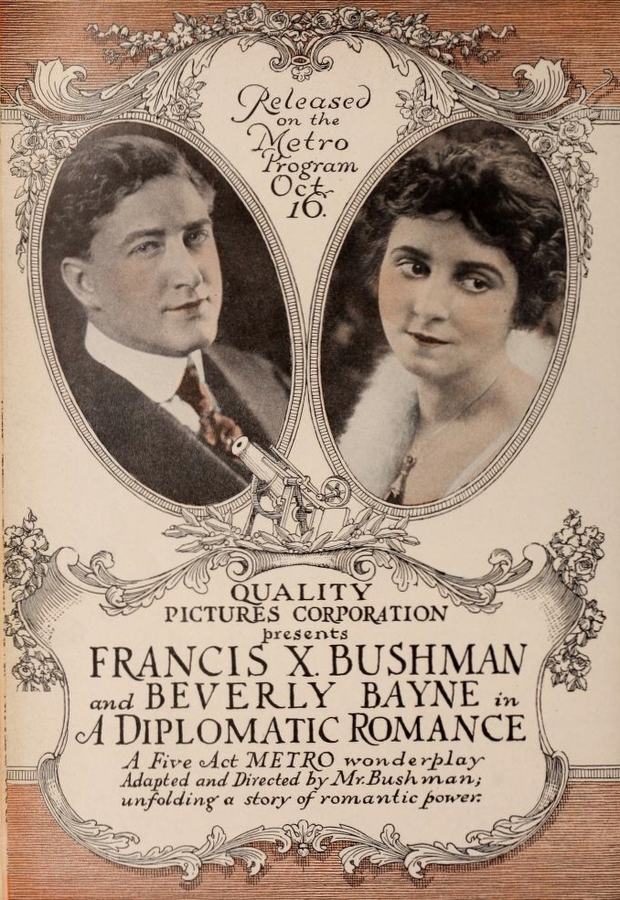
The flickering grandeur of early cinema often presented narratives with an earnest simplicity, yet every so often, a picture emerged that demonstrated a surprising sophistication in its construction of suspense and character. "In the Diplomatic Service," a 1914 offering, stands as a compelling testament to this burgeoning artistry, delivering a tale of international intrigue that, even a century later, retains a certain captivating charm. It’s a fascinating glimpse into the nascent stages of the spy thriller genre, showcasing how silent film, through clever plotting and expressive performances, could weave a complex web of deception and patriotism.
At its heart, the film introduces us to Dick Stansbury, portrayed with a dashing insouciance by Francis X. Bushman. Stansbury is initially presented as an archetype of the idle rich, a gentleman whose peregrinations across foreign lands have been driven more by hedonistic pursuits than any discernible sense of purpose. This initial characterization, however, serves as a masterful misdirection, setting the stage for a compelling transformation. His uncle, Major Blaine, a figure of stern rectitude, deftly redirects Dick's considerable, if previously misapplied, talents towards a cause of national import: the unmasking of Doctor Montell, a foreign diplomat whose ethical transgressions threaten to destabilize delicate international relations. Montell, a shadowy figure adept at navigating the labyrinthine corridors of power, has thus far eluded capture, his network of contacts in Washington's Secret Service rendering him seemingly untouchable. Dick's prior acquaintance with Montell, forged during his years of continental dalliance, positions him uniquely for this perilous undertaking, adding a layer of personal history to the unfolding drama.
Bushman's portrayal of Stansbury is remarkably nuanced for the era. He imbues Dick with an underlying intelligence and a playful cunning that belies his initial frivolous demeanor. One can almost see the gears turning behind his charming smile as he accepts the challenge, transforming from a dilettante into a strategic operator. This evolution is crucial, as it provides the audience with a protagonist who is not merely reactive but proactive, orchestrating events rather than simply responding to them. The film, in this regard, anticipates later cinematic tropes of the gentleman spy, a figure who uses wit and charm as effectively as any weapon. This character arc provides a fascinating counterpoint to more straightforward heroic narratives prevalent at the time, such as those seen in something like The Golden West, where heroism is often more overtly displayed.
The narrative's stage is set against the glittering backdrop of high society, a milieu ripe for both superficial pleasantries and clandestine machinations. The Diplomats' Ball, a scene of opulent display and social maneuvering, brings together the principal players. Here we encounter Beverly Ryerson, portrayed by Beverly Bayne, a woman whose discerning intelligence and quiet dignity make her a compelling romantic interest. Her friend, Helen Wardlow, an eccentric young authoress played by Belle Bruce, provides a delightful meta-commentary on the film's own dramatic aspirations, lamenting the perceived lack of originality in contemporary life. Little does she know, she is about to become an unwitting observer of a plot teeming with narrative potential. The social fabric is further complicated by Mrs. Ryerson, Beverly's step-mother, whose crippling bridge debts render her susceptible to the manipulative machinations of her nephew, Lyna Hardi. Hardi, portrayed by Harry Blakemore, is a character driven by a potent cocktail of ambition and jealousy, aiming to leverage his financial hold over Mrs. Ryerson to advance his own suit with Beverly, all while harboring a deep-seated antagonism towards Dick.
The elegance of the ball quickly transitions to the more intimate, yet equally treacherous, confines of Mrs. Ryerson's country-house. This shift in setting is crucial, allowing for a more concentrated and intense development of the plot. Dick, with a calculated brilliance, seizes this opportunity to ensnare Doctor Montell. His ingenious ruse involves a fabricated "machine gun," a supposed marvel of destructive engineering capable of delivering a bomb that asphyxiates airship occupants with poisonous gas. The sheer audacity of this invention, a purely fictitious device, is a stroke of narrative genius, highlighting Dick's sharp intellect. He strategically discusses this "invention" within Montell's earshot, planting the seeds of temptation. The ensuing proposition from Montell—to betray his own government and sell the model to a foreign power—is precisely the trap Dick had meticulously laid. This sequence showcases the film's commitment to building suspense through psychological warfare, a technique that would become a hallmark of the spy genre. It’s a more cerebral approach than the overt action often found in Westerns of the period, for instance, in Colorado, where conflicts are resolved through direct confrontation.
The escalating tension at the country house is masterfully orchestrated. Montell, desperate to acquire the "invention," enlists Lyna Hardi in a clumsy attempt to steal it. Hardi’s motivations are dual-layered: to aid Montell and, more significantly, to discredit Dick in Beverly's eyes by painting him as a traitor. This subplot adds a fascinating layer of personal rivalry to the broader espionage narrative. However, Hardi's amateurish attempt is swiftly foiled by a vigilant Secret Service operative, a subtle reminder of the unseen forces at play in this intricate game. The film cleverly uses the eavesdropping trope, arranging for Beverly to overhear Montell and Dick discussing the supposed weapon. Misinterpreting Dick's strategic refusal to immediately sell as a sign of wavering loyalty, and fearing he might succumb to Montell's lucrative inducements, Beverly takes matters into her own hands. In a misguided act of protection, she surreptitiously removes the model to her own room, a poignant demonstration of her growing affection and concern for Dick, despite her lingering doubts about his true allegiances. This moment of misdirection and earnest, albeit misplaced, intervention adds a compelling emotional depth to the plot, showcasing Beverly's strength and independent spirit, a departure from more passive female roles often seen in early cinema, such as some of the depictions in The Ventures of Marguerite.
The narrative builds to a thrilling crescendo as Montell, accompanied by two accomplices, makes a direct and forceful attempt to steal the model. Dick, forewarned of their impending arrival by his network of informants, meticulously prepares for their confrontation. In a stroke of inventive genius, he extends a wire from one of the house-lights to the "machine gun" model, instructing the janitor to operate a magneto at a predetermined signal. This setup transforms the seemingly innocuous country house into a high-voltage trap. The sequence where the three malefactors step onto a wet rug, their hands grasping the electrified model, is a moment of pure, visceral silent film drama. The sudden shock, the visual portrayal of their immobilization, and their subsequent capture by Dick is both ingenious and satisfyingly cinematic. This climax is a testament to the film's ability to generate genuine suspense and deliver a powerful resolution without relying on overt violence, instead favoring wit and clever engineering. It's a remarkably innovative use of technology within the narrative itself, predating many similar "gadget" sequences in later spy films.
With Montell and his accomplices apprehended, the diplomatic fallout is swift and inevitable. The doctor's ignominious recall by his own country serves as a stark warning against international malfeasance. Dick, demonstrating a magnanimity that elevates his character beyond mere victor, spares Hardi. His reasoning is acutely observed: Hardi's machinations, though detrimental, were primarily motivated by romantic rivalry rather than genuine treason against the state. This distinction adds a layer of moral complexity to Dick's character, showcasing his ability to differentiate between personal vendettas and threats to national security. Such a nuanced portrayal of justice and mercy is quite advanced for the period, offering a more sophisticated resolution than the clear-cut good-versus-evil narratives prevalent in many contemporary productions, including some moralistic tales like Traffic in Souls, which often focused on explicit societal evils.
The film's true emotional resolution, however, hinges on Dick's efforts to dispel Beverly's lingering doubts. To unequivocally prove his unwavering loyalty to the nation and, by extension, his integrity, Dick orchestrates a final, wonderfully theatrical gesture. He invites Beverly to accompany him to a junk dealer, where he attempts to sell his "wonderful invention." The bewildered junk dealer, after much deliberation, finally consents to offer a paltry twenty-five cents for the elaborate contraption. This moment is a brilliant stroke of irony and a powerful symbol. It visually dismantles the very object that fueled so much intrigue and misunderstanding, exposing its true worthlessness and, by extension, Dick's unblemished patriotism. Beverly, now fully comprehending the depth of Dick's clever deception and his genuine commitment to his country, is moved by sentiment. She buys back the now-meaningless prop for a princely twenty-five dollars, a gesture that transcends its monetary value, symbolizing her complete trust and affection. This exchange beautifully encapsulates the transition from suspicion to certainty, from strategic deception to heartfelt understanding. It's a romantic resolution built on intellectual understanding as much as emotional connection, making it particularly resonant.
The narrative culminates in a deeply satisfying denouement. Dick and Beverly's future together is assured, their bond forged in the crucible of international espionage and personal misunderstanding. And Helen Wardlow, the authoress who once bemoaned life's lack of originality, finds herself with an embarrassment of riches. The very events she witnessed, the elaborate plot, the double-crosses, the romantic entanglements, provide her with ample material. We see her, pen in hand (or perhaps fingers flying across a typewriter, a symbol of modernity), busily crafting her new story, a delightful meta-narrative twist that brings the film full circle. Her initial skepticism is replaced by a newfound appreciation for the dramatic possibilities inherent in human endeavor, a testament to the film's own successful narrative construction. This ending offers not just personal resolution for the protagonists but also a charming commentary on the power of storytelling itself, acknowledging the very craft that brought "In the Diplomatic Service" to life. It’s a sophisticated touch that elevates the film beyond a simple spy story.
From a technical perspective, "In the Diplomatic Service" demonstrates a commendable grasp of early cinematic language. The use of intertitles is effective, not merely conveying dialogue but also adding layers of exposition and character thought, crucial for silent storytelling. The pacing, especially in the latter half, is brisk and engaging, maintaining a palpable sense of urgency as Dick’s intricate plan unfolds. The direction, likely a collaborative effort given the era, manages to balance the grandiosity of the social scenes with the intimacy of the more conspiratorial moments. The performances, particularly Bushman’s, are expressive without veering into overt melodrama, a common pitfall of early silent films. His subtle gestures and knowing glances convey much of Dick’s strategic thinking, allowing the audience to feel privy to his ingenious machinations. The supporting cast, including Liza Miller and Edmund Elton, contribute effectively to the ensemble, grounding the high-stakes plot in believable human interactions. The film’s ability to create a sense of peril and ultimate triumph, largely through visual storytelling and the actors’ nuanced expressions, is a testament to the burgeoning sophistication of the medium. For instance, comparing the dramatic tension here to the more straightforward action of The Bargain, one can appreciate the differing approaches to suspense in the early 1910s.
The thematic undercurrents of the film are also noteworthy. Beyond the surface-level espionage, "In the Diplomatic Service" explores themes of duty versus pleasure, the nature of patriotism, and the deceptive appearances of high society. Dick’s journey from idler to national hero, driven by a cunning intellect rather than brute force, offers a compelling model of heroism. The film subtly critiques the superficiality of social circles while simultaneously using them as fertile ground for intrigue. It suggests that true worth lies not in inherited status or wealth, but in intelligence, integrity, and a willingness to serve a greater cause. The contrast between Montell’s venal self-interest and Dick’s selfless, albeit playful, dedication to his country forms the moral backbone of the narrative. This thematic depth, combined with its innovative plot, positions "In the Diplomatic Service" as more than just an entertaining diversion; it's a significant early example of a genre that would captivate audiences for decades to come. It showcases the foundational elements of the spy thriller long before the likes of James Bond or Jason Bourne graced the silver screen, demonstrating that the allure of secret agents and cunning deceptions has a rich and enduring cinematic history. Its narrative complexity and character development set it apart from many contemporary films, making it a valuable piece for understanding the evolution of storytelling in motion pictures.
In conclusion, "In the Diplomatic Service" is a delightful and surprisingly intricate silent film that deserves more recognition. It’s a testament to the ingenuity of early filmmakers, demonstrating their capacity to craft sophisticated narratives with compelling characters and genuine suspense. For enthusiasts of early cinema, and indeed for anyone interested in the origins of the spy genre, this film offers a richly rewarding experience, proving that even over a century ago, the silver screen was capable of delivering stories that were both thrilling and thought-provoking. It's a vibrant illustration of the period's cinematic ambitions and a testament to the timeless appeal of a clever hero outwitting a nefarious villain amidst the glamorous backdrop of international diplomacy. The intricate dance of loyalty and betrayal, the clever use of a fabricated invention, and the satisfying resolution make this a standout feature from its era, a true gem in the annals of silent film history.
IMDb —
1919
Community
Log in to comment.