DbcultAccessing Vault...
Cult Review
Senior Film Conservator
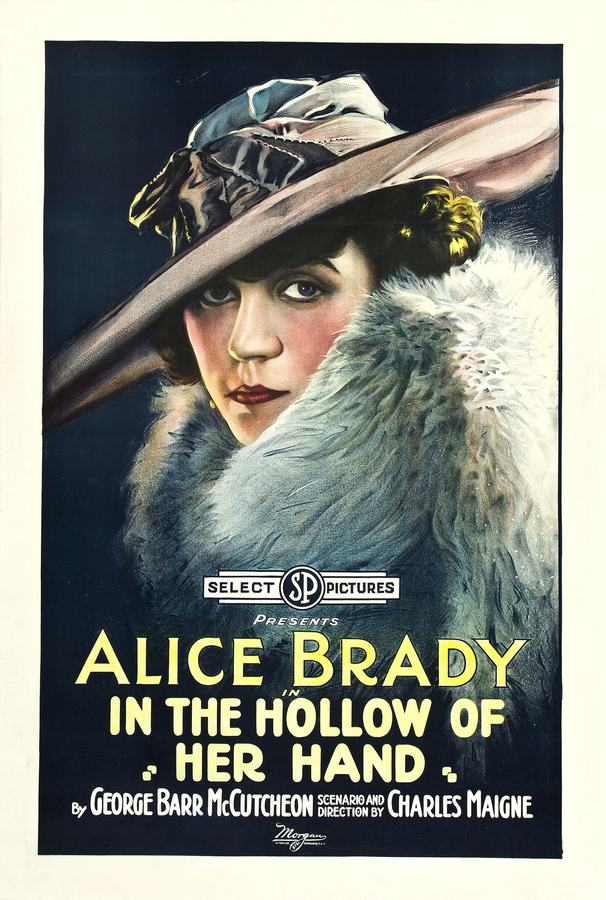
Imagine, if you will, a society portrait cracked by moonlight—pearls scattering, chandeliers trembling, a woman’s smile sharper than any paper-knife in the library of the very rich. That is the after-image left by In the Hollow of Her Hand, a 1919 silent that treats marriage like a blood-sport and revenge like embroidery on a shroud.
Director Charles Maigne, translating George Barr McCutcheon’s acidic novel, stages the opening death as a chiaroscuro fever: wet roads mirror a bruised sky, and the roadhouse signboard flickers like a bad conscience. The corpse of Challis Wrandall is revealed not with melodramatic swoon but with forensic chill—camera tilting from polished boots to the crimson bloom at his collar, an indifferent waiter still clutching a half-empty highball. In that single tableau the film announces its thesis: among the monied, violence is simply another form of redecorating.
Alice Brady’s Sara glides into this carnage wrapped in sable, eyes glittering with a calculation so glacial it feels reptilian. Brady, Broadway royalty exported to flickers, plays every muscle in her face like a concertina: nostrils flare in imperceptible disgust, the left corner of her mouth lifts a millimetre to signal a mind rifling through stratagems. Silent-era acting is often caricatured as semaphore; Brady proves it can be chamber music. When she cradles the suicidal Hetty—an unknown girl with cracked boots and river-weed in her hair—there is no maternal softness, only the instinct of a chess master pocketing a captured queen.
That river rescue, shot on location along the Hudson’s winter shoreline, feels mythic. Cinematographer William Marshall keeps his lens low so black water laps the lower frame while Sara’s chauffeured limousine looms behind, headlamps carving ivory tunnels through mist. Hetty’s emergence is baptism and abduction rolled into one, a visual prophecy that she will exchange one abyss for another.
Once inside the Wrandall manse—a mausoleum of ancestral daguerreotypes and elephant-foot umbrella stands—Maigne’s camera begins a slow minuet of spatial irony. Doorframes slice characters into fractions; mirrors double and triple them until we sense no conversation is private. Sara’s revenge scheme seems almost architectural: she positions Hetty in parlours where Leslie, the diffident brother-in-law, cannot help but brush against her. Note the recurring motif of gloved hands: Sara stripping hers off before a confrontation, Hetty nervously tugging at kid leather, Leslie drumming fingers inside lambswool. The film whispers that touch—desired, denied, forced—is the real currency of this class.
Percy Marmont’s Leslie is a marvel of weak-chinned charm; you can practically smell the starch wilting from his collar when Hetty’s glance lingers. The actor lets a vein pulse at his temple whenever desire clashes with dynasty, a tiny metronome of panic. In contrast Harold Entwistle’s Brandon Booth, the painter, strides through drawing rooms as though splattering them with turpentine; his cape, his undone cravat, his cigarette coiling smoke like a manifesto—each detail proclaims art’s insurgency against capital. When Booth and Hetty share a rooftop assignation, the city behind them becomes a Cubist playground of chimneys and water towers, a hint that modernity is eavesdropping on this Victorian melodrama.
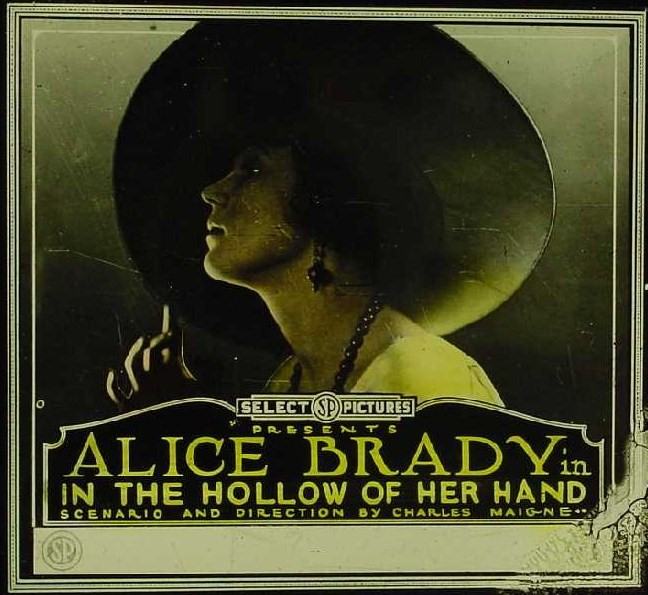
McCutcheon’s source novel was infamous for flipping the fallen-woman trope: here the man falls—literally, onto a dagger—while the woman survives to narrate her own trauma. The film preserves that inversion, but adds a layer more caustic. Sara, the wronged wife, seeks not justice but curatorship of scandal; she wants to exhibit Hetty’s shame like a rare stamp. Yet the narrative denies her that curatorial climax. When the detective’s gloved finger swivels toward Sara herself, the film indicts the culture that equates respectability with virtue. The final confession, delivered by Hetty in a parlour crammed with funerary lilies, plays like a courtroom drama compressed into a single close-up: Anne Cornwall’s pupils tremble, her voice-plate intertitles appear with staccato tremor, and for a moment the spectator is jury, executioner, confessor.
Compare this moral cartography to that of contemporaries like The Black Sheep of the Family or Her Greatest Love, where penitence usually ends in exile or death. Hollow allows Hetty not merely to live but to depart arm-in-arm with her artist, unscathed by the moral tariffs that silents so loved to exact. The camera watches them ascend a hillside path as dawn ignites the sky—an optimism that feels almost radical against the era’s taste for punitive finales.
Though technically black-and-white, the existing prints are tinted the way emotion might stain memory: amber for interiors, viridian for exteriors, a bruised lavender for the roadhouse nocturne. These chromatic interventions function like chords underscoring leitmotifs. Notice how Hetty’s first appearance in the Wrandall household is bathed in amber, the shade of hearth and prison bar; by the rooftop tryst with Booth she is awash in cerulean, a hue that whispers liberty. Such tinting strategies anticipate the symbolic palettes of Il gioiello di Khama and even late-silent masterworks like To the Death.
Texture, too, carries signification. Sara’s wardrobe progresses from glossy mink to matte wool as suspicion coils tighter around her; the loss of sheen equals the erosion of authority. Conversely Hetty’s garments gain embroidery, filigree, pigment—visual evidence of self-possession returning.
Modern viewers, weaned on Dolby thunder, often forget how sonic absence can intensify drama. Here every creak of parquet, every hiss of carbide lamps, every rustle of taffeta becomes part of the film’s orchestra. When Sara confronts Hetty in the midnight conservatory, the only audible reality is the soft click of a door latch; yet within that vacuum the actresses conduct a symphony of micro-gestures—Brady’s chin lifts three millimetres, Cornwall’s respiration lifts her lace collar like a tide. Silence weaponizes space.
Original reviewers praised Alice Brady for “speaking with the tilt of a eyebrow,” a hyperbole that proves accurate on viewing. She exploits the 22-fps cadence, letting poses linger just long enough to feel uncanny, never mummified. It is a performance calibrated for the front row of a 1919 picture palace, yet it magnetizes even through the pixel flatness of today’s DCP.
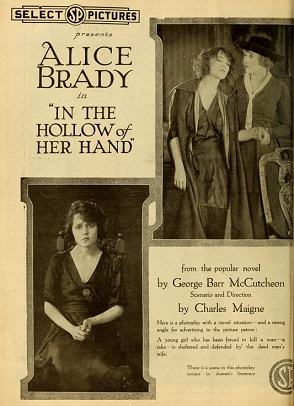
For all its formal bravura, the film is not invulnerable. The eleventh-hour appearance of the detective lands with the thud of studio interference—one senses exhibitors demanding a crime’s resolution more tangible than moral epiphany. The character arrives ex machina via telegram montage, trench coat already buttoned for suspicion. His evidentiary bombshell (a monogrammed glove? a witness in the next cabin?) is elided by jump-cut, leaving modern spectators to supply the lacuna with CSI logic. Such compression may reflect post-production trimming; censorship boards in Chicago and Pennsylvania habitually excised “salacious” backstory, and surviving prints run a brittle sixty-seven minutes.
Likewise, the Wrandall clan’s instant absolution of Hetty feels more utopian than psychologically credible. A single confession melts generations of patrician entitlement? The film wants to believe grace is contagious once hypocrisy is lanced; history suggests otherwise. Still, this very implausibility sharpens the movie’s progressive edge—it posits a society capable of moral learning, a fantasy America sorely needed in the wake of wartime jingoism.
Released months after the Armistice, Hollow vibrates with post-war tremors. Challis embodies a patriarchy gutted by its own appetites; overseas doughboys return to find women driving trams, voting, owning apartments. Sara’s calculated subversion—using another woman as surrogate weapon—captures the era’s shifting gender arsenal. Hetty’s ultimate agency, choosing art over aristocracy, parallels the bohemian exodus toward Greenwich Village garrets. Even the film’s river, a recurrent symbol of oblivion, becomes by finale a conduit of reinvention—water as amniotic fluid for a new social contract.
Compare this to the contemporaneous The Medicine Man, where female virtue is restored through patriarchal rescue, or Martyrs of the Alamo, where women function as allegorical wallpaper. Hollow dares to imagine the survivor’s tale told by the survivor herself.
Why, then, has this picture languished in vaults while Dimples or The Sundowner gained footnotes? Partial blame lies with the McCutcheon brand fading post-1920s; his cocktail novels read as period curios once the Jazz Age roared. Moreover, Paramount’s distribution strategy—slotting the film as a “woman’s picture” on rural circuits—buried it beneath cowboy quickies and slapstick two-reelers. Nitrate decomposition claimed half the negatives, and the 1930s reissue, re-scored with Hawaiian guitar, played for laughs that were never intended.
Salvation arrived via a 2018 Library of Congress 4K restoration culled from two Czech prints and one desiccated American roll. The resultant image—grain like frost on mourning lace—now screens at festivals where audiences gasp at Brady’s proto-film-noir femme pivot. Critics have begun citing Hollow in discussions of female-gaze revenge, placing it beside The Lords of High Decision and Loyalty as early exemplars of gendered insurgency.
Because your Netflix queue is bloated with algorithmic mush. Because In the Hollow of Her Hand offers the illicit thrill of witnessing 1919 confront its own reflection and shatter it. Because Alice Brady will teach you that stillness can be more clamorous than gunfire. Because Anne Cornwall’s river-drenched eyelashes carry more existential weight than a thousand CGI explosions. Because the film argues, ahead of its century, that women need not be collateral in dynastic wars—they can redraw battle lines with a whispered confession and a suitcase of paintbrushes.
Stream it if you can, but better yet, catch a repertory print with live accompaniment; the tremolo of a Wurlitzer will teach your vertebrae what silence meant when ears were virgin to the talkie’s roar. Walk home afterward, and every passing headlamp may feel like a detective’s interrogation. Ask yourself whose hand you currently occupy, and whether you, too, are ready to hollow it out and fill it with something still unnamed.
IMDb 6.2
1932
Community
Log in to comment.