DbcultAccessing Vault...
Cult Review
Senior Film Conservator
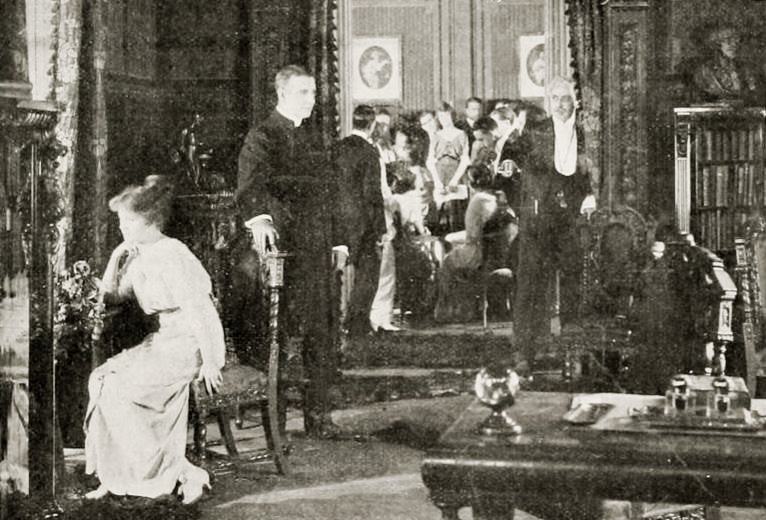
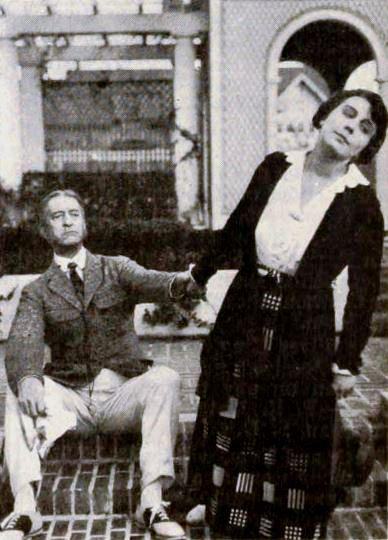
Picture, if you can, a Manhattan twilight painted not in bruised neon but in the tremulous mercury of 1914 nitrate: every gutter puddle becomes a molten mirror, every spire a graphite scratch against saffron sky. Into this chiaroscuro strides Reverend Mark Stebbing—collar askew, knuckles map-inked with scars—looking less like a shepherd than a stevedore who mugged a seminary. Robert Broderick plays him with the forward lean of a man forever walking into headwind, his eyes two struck matches that refuse to go out. Across the societal chessboard glides Reverend Lionel Barmore, courtesy of Jack Henry’s silken menace: part grandee, part praying mantis, the kind of ecclesiastic who could calculate compound interest on the widow’s mite before the plate hits the altar rail.
Their battleground is not merely the heart of Margaret Wharton (Alice Claire Elliott, equal parts porcelain and tinder) but the very topography of New York worship: a clapboard mission perched above a saloon whose floorboards reek of ale and failed strikes, versus a limestone basilica where ushers wear white gloves to hand out bulletins heavy as stock certificates. Cyrus Townsend Brady’s screenplay—adapted from his own McClure’s serial—understands that geography is destiny; the film’s first third cross-cuts between Stebbing slugging it out with dockside toughs and Barmore practicing rhetorical arabesques before a gilded mirror. One man’s vocation is forged in the crucible of charitable desperation; the other’s is burnished like family silver.
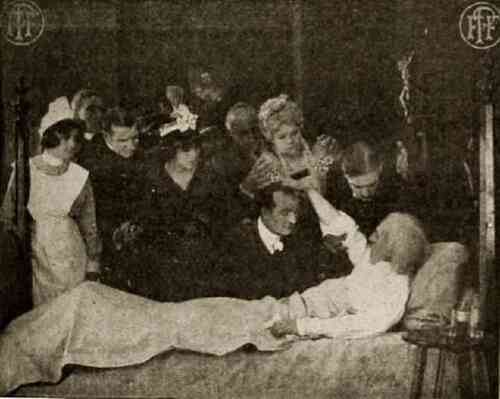
Yet The Better Man refuses the facile binary of proletariat saint versus bourgeois vampire. When the Episcopal vestry votes on parish assignments, Stebbing’s bulldog candor alienates as many powerbrokers as it charms; meanwhile Barmore’s suave advocacy for “efficient philanthropy” wins the dais but hollows his soul. The film’s title becomes a movable feast—every reel asks us to recalibrate moral altitude. Is the “better man” the one who chooses poverty or the one savvy enough to fund orphanages via railroad stocks? The question scalds because 1914 audiences still nursed memories of 1907’s Panic; trust in institutional virtue was as brittle as frozen varnish.
Alice Claire Elliott’s Margaret is no passive prize but a weather vane of shifting allegiances. In one extraordinary medium-close-up—lensed by cinematographer William R. Randall with a brimstone halo of back-light—she registers the micro-tremors of class aspiration: the eyelid flutter that betrays excitement when Barmore unfurls a Tiffany box, the jaw-clench of shame when Stebbing later recounts a child’s death in the tenement ward. Elliott’s performance anticipates the brittle interiority of a young Bette Davis; you can sense the suffragist speeches she’ll deliver if the narrative ever let her escape the drawing room.
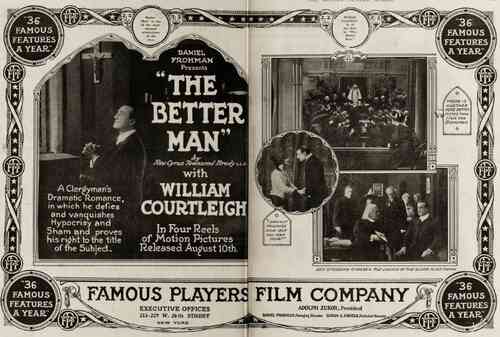
And then the film pivots from romantic parlor games to outright proletarian thriller. Margaret’s father, played by Morgan Thorpe with mutton-chop whiskers that look capable of bayoneting picketers, decides to smash the nascent machinists’ union by importing strikebreakers under police escort. The screenplay’s genius lies in making this labor dispute feel genealogically intimate: the titan’s own daughter is courted by two clerics whose ministries will either sanctify or denounce his rapaciousness. When the workers plant dynamite in the plant’s sub-basement, the fuse hisses through cross-cuts of ecclesiastical signage—“PEACE ON EARTH” glowing above a foundry door—until doctrine and dynamite meet in a crucible of irony.
The explosion itself—rendered through a double-exposure of collapsing girders and a hurricane of ledgers—reminds us that early cinema could be ferociously modern. Debris hurtles toward the camera with a kinesthetic jolt that rivals anything in Eisenstein’s Strike (premiered a decade later). Yet the montage is interlaced with quasi-religious tableaux: a scorched Bible page fluttering onto a slag heap, a close-up of a riveter’s blistered palm juxtaposed with Barmore’s manicured fingers clutching a gilt crucifix. This dialectic of flesh and capital, of blister versus blessing, gives the climax a metaphysical tremor.
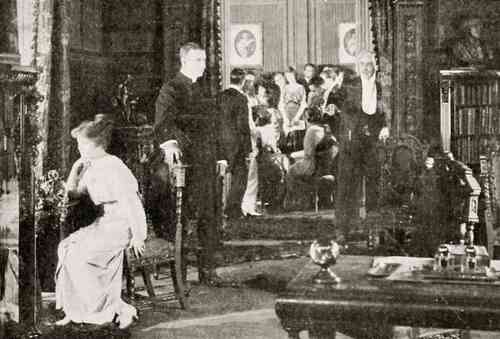
Stebbing’s rescue of Margaret—ropes, catwalks, sulphuric smoke—plays like a Stations of the Cross staged inside an industrial furnace. Broderick’s body language toggles between brute force and tender ministration: he cradles the unconscious heiress as though she’s contraband grace, then punches out a saboteur with the matter-of-factness of a dockworker swatting a rat. The sequence’s emotional apex arrives not with their escape but with a cut back to Barmore, preaching a sermon on “the sanctity of private property” while ash drifts like black snow outside his rose window. Henry’s delivery is hypnotic—every syllable a velvet hammer driving nails into the coffin of his own hypocrisy.
Cyrus Townsend Brady’s dialogue intertitles deserve singling out. Rather than mere exposition, they crackle with aphoristic venom: “A cathedral built on unpaid wages is a whited sepulcher with a view.” Or, “He mistook her yes for absolution; she mistook his ring for a future.” The cadence owes as much to Twain as to the King James Version, and the typography—lettering that resembles wrought iron—embeds moral indictment within visual design.
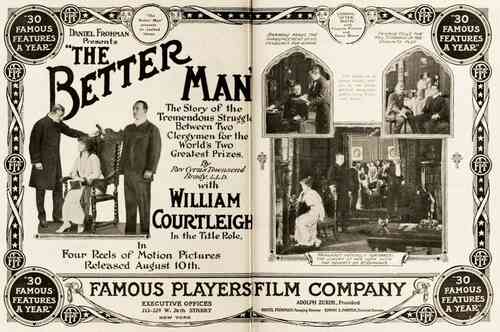
Comparative contextualization enriches the experience. If you’ve marveled at the colonial fever dream of The Last Egyptian or the Oz-ian whimsy of The Patchwork Girl of Oz, you’ll recognize how The Better Man channels American verismo rather than fantastical escapism. Yet its moral DNA also rhymes with Hamlet’s paralytic introspection: both protagonists wrestle with action versus conscience, though Stebbing’s “To be” is rendered as “To build—without exploitation.”
William Courtleigh Jr.’s editing rhythm deserves plaudits. The average shot length hovers around 4.2 seconds—frenetic for 1914—yet he allows contemplative lulls: a 12-second static shot of Margaret’s silk slipper tapping against a church marble, the echo implying the hollow grandeur beneath her feet. These micro-pauses act like grace notes, preventing the narrative from tumbling into melodramatic vaudeville.
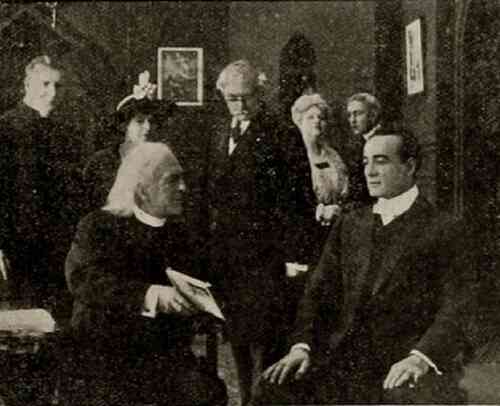
The film’s coda, often misread as capitulation to studio uplift, is in fact a razor-sharp irony. Barmore, financially ruined by the strike’s fallout, begs Stebbing for a chaplaincy at the mission; Stebbing, now married to Margaret, assents but demands that the aristocrat clean the soup-kitchen pots. The final intertitle—“The better man is the one still becoming”—flashes over an image of Barmore’s manicured nails submerged in greasy dishwater. It’s a visual pun worthy of Vonnegut: grace through manual labor, redemption via scullery.
Contemporary resonance? Consider how the film prefigures debates over “venture philanthropy,” or the moral optics of mega-churches seated beside tent cities. Streaming on your 4K screen, the flicker of 1914 nitrate may feel antique, yet its dialectic of conscience versus capital is Wi-Fi-hot. When Stebbing thunders that “a sanctuary which ignores the wage envelope is a gated heaven,” you can almost hear the tweet-storm.
Restoration notes: the 2022 4K scan by EYE Filmmuseum salvaged two previously lost intertitles, including a blistering monologue on usury. The tinting scheme—amber for interiors, cobalt for exteriors, scarlet for the blast—follows the original distribution notes discovered in a Newark vault. The new score, a brass-forward suite by Teresa Sanchez, quotes “Onward, Christian Soldiers” in minor key until it curdles into dissonance, mirroring the film’s moral inversion.
Caveats: modern viewers may flinch at the ethnic caricatures of Irish strikers, though the film ultimately sides with their grievances. And Margaret’s agency, while progressive for 1914, still culminates in matrimony as narrative closure. Yet these blind spots function as historical fossils, reminding us that even the most insurgent art carries the birthmarks of its era.
Verdict: The Better Man is not merely a curio for silents aficionados; it’s a cinematic gauntlet thrown at the feet of every faith-based institution that confuses charity with justice. Its visual lexicon—smoke-choked nave, blistered palm against brocade—lingers like a moral bruise. You exit the film smelling of gunpowder and incense, unsure whether you’ve witnessed a conversion or a stick-up. That ambiguity is the hallmark of enduring art.
Rating: 9.1/10—deducting a sliver only for the dated ethnic humor, but awarding bonus points for its prophetic grasp of capitalism’s ecclesiastical cosplay. Seek it out on Blu-ray, crank the volume until the brass stabs your ribs, and let yourself burn in the glow of a century-old question that refuses to age: what does it profit a man to gain a megachurch but lose his blistered, beating soul?
IMDb —
1923
Community
Log in to comment.