DbcultAccessing Vault...
6.4/10
Senior Film Conservator
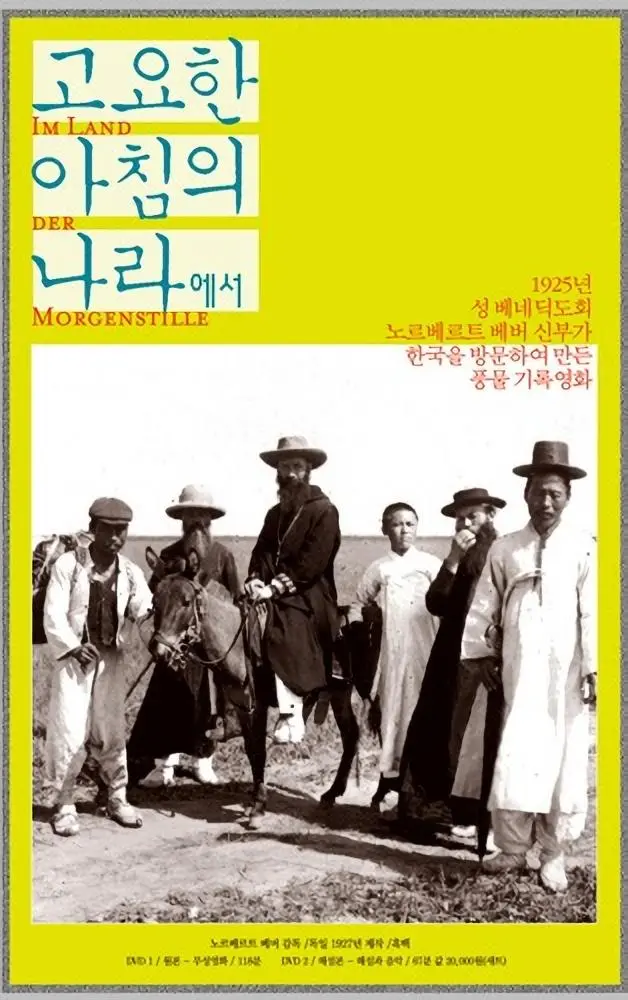
A definitive 6.4/10 rating for a film that redefined the boundaries of cult cinema. In the Land of Morning Calm remains a cornerstone of transgressive art.
Is 'In the Land of Morning Calm' worth watching today? Short answer: absolutely, but with significant caveats that demand a conscious viewing. This isn't a film for passive entertainment; it's a profound historical artifact best suited for scholars, cultural anthropologists, and anyone deeply interested in early 20th-century Korean life and the complexities of missionary ethnography. It is decidedly not for those seeking conventional narrative cinema, an uncritical celebration of its era, or a purely objective historical account.
Father Norbert Weber’s 1925 documentary, In the Land of Morning Calm, is less a film in the modern sense and more a preserved window into a moment in time. It is a cinematic relic, a silent testament to a Korea under colonial rule, viewed through the lens of a German Benedictine abbot. To engage with it is to embark on an archaeological dig, unearthing layers of history, intent, and unavoidable colonial subtext.
The film's primary purpose, as stated by Weber himself, was to promote Korean culture and missionary work in Germany. This dual agenda—cultural preservation and religious proselytization—forms the very bedrock of its construction and, simultaneously, its most enduring tension. It is a work of immense historical value, capturing scenes and practices that have long since vanished or evolved beyond recognition. Yet, it is also a product of its time, imbued with a perspective that modern audiences must critically dissect.
This film works because it offers an unparalleled visual record of a lost Korea, a sincere (if sometimes misguided) attempt by Weber to convey his affection for the land, and possesses the sheer, undeniable weight of historical documentation.
This film fails because its colonial gaze is undeniable, the indigenous Korean voice is largely absent, and it is inherently limited by the technological and ideological constraints of early documentary filmmaking.
You should watch it if you prioritize raw historical documentation, appreciate the nascent stages of ethnographic film, or have a specific, deep interest in early 20th-century Korean cultural history or the narrative of missionary endeavors in East Asia.
The most immediate and profound impact of In the Land of Morning Calm lies in its capacity to transport the viewer back to 1925. Weber, an artist and man of letters, clearly understood the power of the moving image as a historical record. We are presented with meticulously framed vignettes of daily life: the rhythmic motion of artisans crafting their wares, the communal effort of agriculture, the intricate details of traditional customs, and the vibrant spectacle of holidays and religious ceremonies. These are not merely static images; they are fragments of a living, breathing culture, albeit one observed from a distinct distance.
Consider the scenes depicting Korean handicrafts. We don't just see the finished product; Weber's camera lingers on the hands, the tools, the focused expressions of the craftspeople. This level of detail, captured almost a century ago, is extraordinary. It offers an invaluable resource for understanding pre-industrial Korean techniques, providing visual data that text alone could never fully convey. The film becomes a silent masterclass in traditional Korean artistry, from pottery to weaving, each frame a testament to generations of skill.
Similarly, the portrayal of agricultural practices is a stark reminder of a world intimately connected to the land. The cycles of planting and harvest, the simple yet effective tools, the communal spirit—these elements are captured with a certain reverent honesty. It's a stark contrast to the rapid industrialization that would sweep through Korea in later decades, making these visual archives all the more precious. This is history, not just written, but performed before our eyes, however brief the glimpse.
Father Weber’s stated intention was to "promote Korean culture and Korean missionary work." This dual mission is central to understanding the film’s narrative—or lack thereof. Weber was clearly enamored with Korea, confessing, "South Korea, the country I couldn't help but fall in love with so quickly." This personal affection permeates the film, giving it a warmth and curiosity that elevates it beyond mere academic cataloging.
However, the benevolent intent does not erase the inherent power dynamics at play. The film, by its very nature, is an outsider's perspective. It frames Korean culture through a European lens, selecting what is deemed exotic, beautiful, or worthy of documentation for a German audience. While Weber's gaze appears respectful, it is undeniably a gaze of observation, not participation. The Korean people are subjects, not co-creators of their own cinematic representation.
The segments dedicated to the St. Benedictine Missionaries in Seoul, North Korea, and Manchuria are particularly telling. Here, the camera shifts from ethnographic observation to promotional documentation. We see the missionaries interacting with the local populace, often in settings that imply a civilizing or educational role. This juxtaposition—traditional Korean life alongside the burgeoning presence of Western influence—is a powerful, if uncomfortable, historical record. It forces the viewer to grapple with the complex legacy of missionary work, acknowledging both its potential for genuine aid and its undeniable role in cultural transformation and, at times, erosion.
One could argue that Weber’s film, despite its colonial context, was a genuine attempt to bridge cultural divides. He was, after all, introducing Korea to Germany at a time when such exchanges were rare and often filtered through imperialistic narratives. Yet, the film also serves as an unwitting testament to the era's prevalent Eurocentric worldview, where "promotion" often implied a narrative crafted by the dominant culture. This is not a judgment of Weber's character, but an unavoidable analysis of the historical forces shaping his work.
To critique In the Land of Morning Calm purely on modern cinematic terms would be anachronistic and unfair. This is a film from 1925, a period when the language of documentary filmmaking was still in its infancy. There is no complex narrative structure, no dramatic arc in the conventional sense. Instead, it operates as a series of meticulously composed visual essays, strung together by the overarching theme of Korean life and missionary activity.
The cinematography, while rudimentary by today's standards, is remarkably effective for its time. Weber, or his camera operator, demonstrates an eye for composition, often framing subjects centrally and allowing actions to unfold within the frame. The use of natural light is paramount, lending an authentic, almost raw quality to the footage. We are reminded that this was a world without sophisticated lighting rigs or digital stabilization. The imperfections—the occasional flicker, the graininess—add to its charm and its authenticity as a historical document.
Pacing, in this context, refers less to dramatic tension and more to observational rhythm. Scenes are allowed to play out, sometimes for extended durations, inviting the viewer to simply observe and absorb. There’s a contemplative quality to this approach, a stark contrast to the rapid-fire editing prevalent in contemporary documentaries. It’s a meditative pace, demanding patience but rewarding it with a deeper immersion into the captured moments. The film doesn't rush; it breathes, much like the life it portrays.
The "direction" here is more akin to curation and anthropological framing. Weber's role was not to elicit performances but to select, arrange, and present observations. He chose what to film, how to frame it, and what sequence to present it in. This editorial control is where the film's perspective is most strongly felt. It is a curated reality, reflecting Weber's interests and the message he wished to convey to his German audience. While this might limit its claim to pure objectivity, it significantly enhances its value as a primary source for understanding early 20th-century European perceptions of Korea.
Yes, In the Land of Morning Calm is absolutely worth watching today, but not as a casual viewing experience. It functions primarily as an invaluable historical document. For anyone interested in the tangible realities of early 20th-century Korean life, before the full impact of industrialization and war, this film is an unparalleled visual resource. It’s a direct window into a past that is otherwise only accessible through written accounts or static photographs.
Furthermore, for scholars of ethnography, missionary history, or colonial studies, the film offers a rich text for analysis. It embodies the complexities of cultural exchange and the inherent biases of early cinematic representation. Viewing it critically allows us to understand not just what was filmed, but also why and how it was filmed, revealing as much about the filmmaker and his culture as it does about the subjects.
However, it is crucial to approach this film with a critical and informed perspective. Do not expect a modern documentary with a balanced narrative or indigenous voices. Expect a time capsule, imperfect but profound, that requires active interpretation and a deep understanding of its historical context. Its value isn't in its artistic polish, but its raw, unvarnished existence. It exists. And that is its power.
IMDb —
1920
Community
Log in to comment.