DbcultAccessing Vault...
6.8/10
Senior Film Conservator
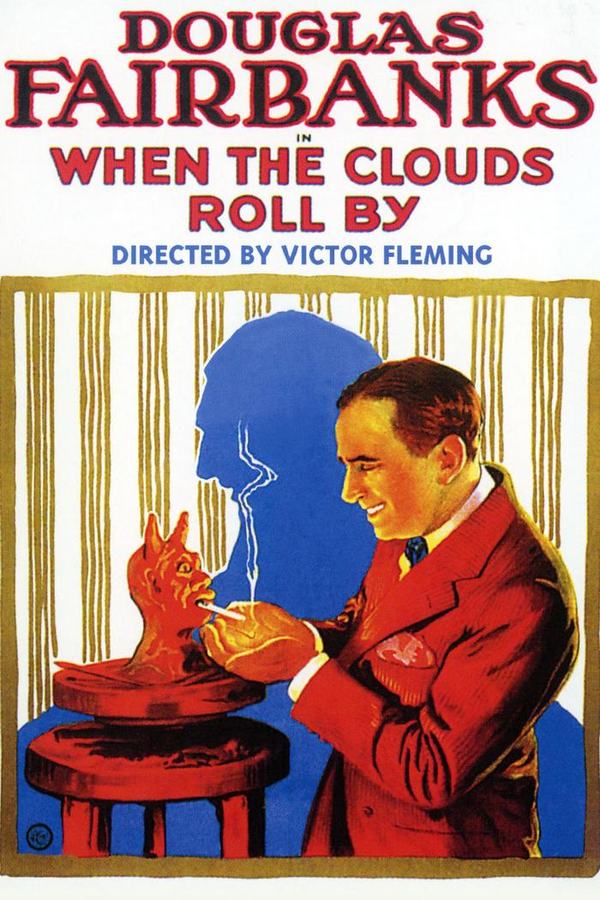
A definitive 6.8/10 rating for a film that redefined the boundaries of cult cinema. When the Clouds Roll by remains a cornerstone of transgressive art.
Victor Fleming’s 1919 phantasmagoria *When the Clouds Roll by* operates on two wildly divergent yet mesmerizing frequencies—a taut psychological thriller wrapped inside a featherlight comedic soufflé. Douglas Fairbanks, flexing creative muscles as co-writer and star, presents Daniel Boone Brown as a neurotic everyman whose nerves jangle like loose change in a tin cup. His vulnerability becomes playground and battleground for Dr. Ulrich Metz (Herbert Grimwood, oily perfection), a psychiatrist exploiting the era’s fascination with Freudian theory for pure predatory sport. Metz isn’t curing Daniel; he’s conducting a malevolent case study in manufactured despair.
The film’s genius lies in this duality: Grimwood’s chillingly restrained performance—all calculating stares and precise gestures—contrasts violently against Fairbanks’ kinetic physical vocabulary. Watch how Daniel’s anxiety manifests not through dialogue (impossible in silents) but through Fairbanks’ bodily seismography—fingers drumming arrhythmias on tabletops, legs jackknifing unexpectedly over sofas, eyebrows performing acrobatics of dread. When Metz orchestrates a supernatural haunting in Daniel’s home, complete with floating objects and ghostly whispers, Fairbanks doesn’t merely react; he somersaults into hysteria, scaling bookshelves like a startled cat and vibrating with such intensity you fear he might spontaneously combust.
Cinematographer William McGann paints this psychological warfare with startling innovation. Shadows elongate like grasping fingers across Daniel’s apartment during Metz’s manipulations, while daytime scenes employ blindingly high-key lighting—visualizing the character’s jarring shifts between paranoid darkness and forced normalcy. One bravura sequence involves Daniel fleeing imagined terrors through geometrically impossible sets, corridors tilting at Dutch angles as Fleming prefigures German Expressionism years before *Der Teufelswalzer* or *Caino* embraced visual distortion. The camera itself becomes Metz’s accomplice, lingering on ominous details—a noose-like curtain tassel, the hypnotic swirl of whiskey in a glass—embedding unease directly into the audience’s retina.
Fairbanks’ athleticism transcends mere spectacle. His escape from a straitjacket isn’t just a stunt; it’s a metaphor for mental liberation, muscles straining against literal and psychological confinement. Similarly, his famed rooftop chase scenes acquire fresh resonance—the cityscape below transforming into a perilous extension of Daniel’s fractured psyche. Compare this to the comparatively grounded athleticism in *Maciste atleta*; Fairbanks uses physicality as existential expression, not just heroic display. Even mundane actions—buttering toast, opening a letter—become frenetic ballets of apprehension.
The supporting ensemble functions as deliberate tonal counterpoints. Kathleen Clifford as the pragmatic love interest Lucette grounds Daniel’s mania with bemused glances, while Babe London’s housemaid provides slapstick relief through gloriously timed pratfalls involving feather dusters and misplaced bananas. Frank Campeau’s skeptical uncle represents societal dismissal of mental anguish—a trenchant commentary in post-WWI America where shell shock remained poorly understood. Their collective normality amplifies Daniel’s isolation; he’s drowning while they sip tea.
Where the film detonates into pure cinematic audacity is its now-legendary dream sequence. Abandoning narrative logic, Fleming plunges us into Daniel’s subconscious via surreal vignettes: Fairbanks wrestles a sofa that transforms into a live alligator, scales impossible staircases that fold like origami, battles anthropomorphic foodstuffs straight from Hieronymus Bosch’s pantry. This sequence, animated by pure id and Fairbanks’ elastic physicality, anticipates Bunuel’s surrealism and the dream logic of later Hitchcock. The use of reverse photography, double exposures, and forced perspective feels shockingly modern—a stark departure from the literal-minded fantasies of contemporaries like *Her Double Life*.
Thomas J. Geraghty’s screenplay cleverly weaponizes early 20th-century pseudoscience. Metz’s manipulations exploit contemporary obsessions with astrology, phrenology, and the burgeoning field of psychiatry itself. His diagnosis of Daniel as a "suicidal neurotic" feels less like medicine and more like a self-fulfilling curse—a critique of authority figures weaponizing jargon for control. This thematic boldness connects it to *The Bells*, another silent exploring guilt’s psychological toll, though Fleming trades that film’s gothic severity for unsettling whimsy.
Fleming’s direction masterfully balances these tonal extremes. He understands that horror gains potency when glimpsed through comedy’s keyhole. A sequence where Metz convinces Daniel he’s swallowed tiny demons thrives on this tension—Fairbanks’ frantic contortions are hilarious, yet the underlying terror of bodily violation resonates deeply. This juxtaposition predates the screwball menace of Ernst Lubitsch or the anxious comedies of *Won on the Post*, offering something uniquely unsettling.
The film’s legacy lies in its prescience. Daniel’s gaslighting feels unnervingly contemporary in an age of digital disinformation and algorithmic manipulation of mental states. Metz, with his tailored suits and veneer of benevolence, is progenitor to every charismatic villain exploiting trust for cruelty—a blueprint for Hitchcock’s charming psychopaths decades later. Fairbanks’ performance transcends comic archetype; his Daniel embodies the fragility of the modern self, susceptible to external narratives. The climactic confrontation at the Hudson River pier avoids simplistic triumph. Daniel doesn’t defeat Metz through strength but through chaotic resilience—a human tumbleweed propelled by survival instinct.
Musically, the film demands a modern reassessment. Original scores often overemphasize jauntiness, but *Clouds* merits compositions embracing dissonance—theremin whispers during Metz’s manipulations, frantic ragtime collapsing into atonal strings as Daniel’s psyche unravels. The dream sequence cries out for avant-garde soundscapes blending carnival music with industrial noise.
Among Fairbanks’ oeuvre, *When the Clouds Roll By* stands apart. While *The Plow Woman* leans into western romanticism and *His Turning Point* explores moral drama, this film is pure cinematic id—a fearless exploration of mental landscapes using the era’s most advanced techniques. Its influence ripples through Keaton’s reality-bending in *Sherlock Jr.*, the paranoid comedies of the Marx Brothers, and even the psychological disintegration depicted in Polanski’s *Repulsion*.
Flaws exist, naturally. Racial caricatures through George Kuwa’s "mystical" servant role reflect dated sensibilities, and the romantic subplot occasionally halts the psychological momentum. Yet these elements remain products of their time rather than fatal distractions. The film’s true power resides in its core nightmare: the terror of losing agency over one’s own mind. Fleming and Fairbanks craft not just entertainment but an unnerving funhouse mirror reflecting the era’s anxieties about science, identity, and the unseen pressures of modern life. Its final shot—Daniel and Lucette embracing against clearing skies—offers surface reassurance, but Metz’s smirk in an earlier scene lingers like poison in the collective memory. The clouds may roll by, the film whispers, but the shadows they cast can still swallow a man whole.
In 1919, this was radical filmmaking—a cocktail of psychology, slapstick, and surrealism that shouldn’t cohere yet absolutely does. Watching it today feels like discovering a proto-*Eternal Sunshine of the Spotless Mind* crafted with the physical bravado of Jackie Chan and the visual invention of Méliès. It remains a testament to silent cinema’s ability to articulate complex inner states without uttering a single word, proving that sometimes the loudest screams are those rendered in exquisite, nerve-shredding silence.
IMDb —
1917
Community
Log in to comment.