DbcultAccessing Vault...
Cult Review
Senior Film Conservator
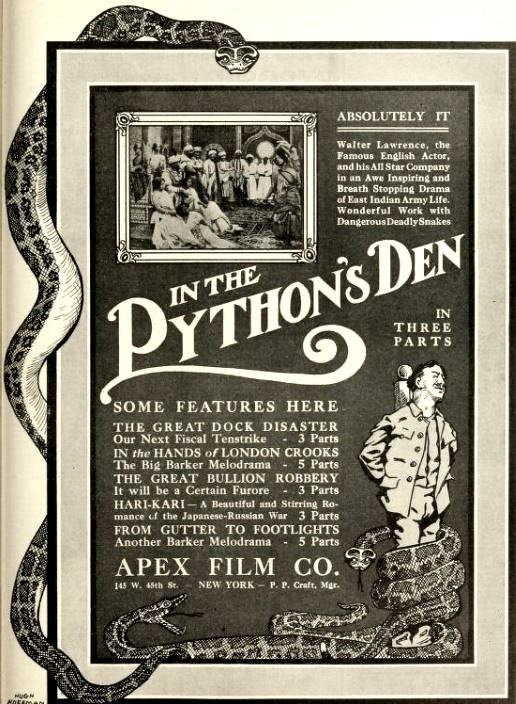
There is a moment—somewhere between the 17th flicker of hand-tinted crimson and the sudden iris-out that swallows the Jumna’s black mirror—when In the Python’s Den stops being a mere 1913 one-reeler and becomes a fever chart of empire’s subconscious.
Forgive the archival hiccup: the negative is lost, the positive is scarred like a tiger’s flank, and the surviving 6-minute condensation (rescued from a Queensland shed beside a crate of bushranger melodramas) jitters as if the celluloid itself were negotiating its own captivity. Yet what remains is potent enough to make your scalp remember the scent of snake.
Director David Aylott—better known for seaside postcards and trick-films—plunges us into a Mughal fever dream filmed, oddly, on the corrugated rooftops of Brighton. The palace is a plywood maquette, its minarets capped with cigarette-tin crescent moons; the Ganges is a tarpaulin trough pigmented with copper sulfate and lit from beneath by naphtha flames. Artifice? Absolutely, but the sort that chafes against the skin of the real like a rope burn. Every matte line trembles with the same anxiety that flickered through British India a decade after the 1857 hangings: the fear that the colonised might choreograph their own narrative.
The plot, skeletal even by nickelodeon standards, is a thorned fairy-tale: a prince (unnamed, because tyrants hate cartographers) abducts the wife of a sepoy, then flings the man into a pit of pythons—an inverted Garden of Eden where knowledge comes not from apple but from constriction. The wife escapes purdah via a dance that accelerates into revolt; the husband climbs a writhing ladder of snakes as though ascending a DNA helix stitched by Kali herself. They meet on the battlements, kiss once, jump. Cue title card: “And the river swallowed their chains.”
Let us dispense with zoological accuracy: these pythons are metaphors wearing scale-mail. Each coil is a revenue act, each hiss a whipping post. When the soldier presses his face against their muscled folds, the image rhymes with press photographs of indentured backs scarred by overseers’ canes. Aylott, whether by design or by the happy accident of under-cranked crudity, makes the serpents move with the same stop-start spasms as the hand-cranked camera—cinema itself becomes the imperial python, gulping bodies whole.

Compare this to the boxing actualities that clogged cinemas two years earlier—The Corbett-Fitzsimmons Fight or the Jeffries-Sharkey Contest—where white bodies pummel under electric suns for the gambling classes. Aylott relocates the arena underground, swaps gloves for fangs, and replaces the referee with a maharajah whose smile is a paper-cut of sadism. Spectacle hasn’t been subverted; it has been bitten.
The wife—played by an uncredited actress whose eyes hold the matte depth of temple murals—has no name in the intertitles. She doesn’t need one. Her choreography speaks in gerunds: gathering, spurning, leaping. When she whirls her veil against the zenana’s oil-lamps, the fabric ignites, and for eight frames she becomes a comet ripping through the harem’s dark cloth. Fire was a constant dread of early film exchanges; exhibitors projected onto bedsheets soaked in boric acid. Aylott weaponises that anxiety: the burning veil is both plot device and industrial confession—cinema knows its own inflammability.
Watch how she uses the camera’s stutter. Every fourth frame she freezes mid-pirouette, letting the audience fill the gap with heartbeats. It is the same trick later employed by Fantômas and The Adventures of Kathlyn—the villain or heroine who steps outside the flow of time, becoming commentary on the medium itself. Here, the gesture is anti-colonial: she refuses the smooth continuity that empire prescribes.
Intertitles, white on black, flicker like magnesium flares: “He trusted the mercy of princes”—cut to python jaws distending around a brown wrist. The syntax is Biblical, but the referent is Kipling turned inside-out. Where With Our King and Queen Through India offered pageantry for imperial self-congratulation, Aylott stages a counter-pageant: the durbur of damnation.
Note the absence of white saviours. Unlike Oliver Twist or The Vicar of Wakefield, where English virtue trembles in foreign streets, the drama here is intra-Indian: prince versus peasant, with the colonial administration a distant rumor. The film cannily displaces Britain’s guilt onto an indigenous despot, yet the reptile pit smells of London’s own Snakehead clubs where Empire boys paid tuppence to gape at boa constrictors. Projection, literally.
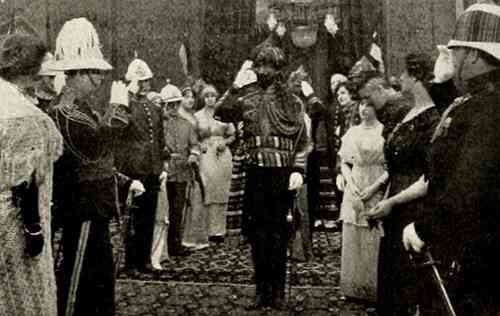
Surviving prints end mid-leap: the couple suspended above the river, her hair fused to his turban, a single python tail still lashed to his ankle like an umbilicus of empire. The rest is conjecture—scholars speculate the original ended with their submergence, a title card promising rebirth. But absence is the sharpest blade. Because we never see them surface, the image ossifies into icon: two bodies choosing liquid oblivion over stone tyranny, a gesture that prefigures the Jallianwala Bagh protests by six years.
Compare to the salvational parachutes of Saved in Mid-Air or the celestial ascensions in From the Manger to the Cross. Aylott denies us vertical transcendence; his lovers move horizontally into darkness, a trajectory more radical because it refuses both heaven and the empire’s map.
Shot on 35mm at 18 fps, the film’s grain swarms like mosquitoes in monsoon twilight. Aylott frequently under-cranks to 12 fps for the snake sequences, so motion acquires a sinewy liquidity—time itself molting. The Brighton shoreline substitutes for the Ganges at dusk; you can spot a pier’s iron strut in one frame, a postcard of modernity photobombing antiquity. Yet the error vibrates with truth: empire’s landscapes were always back-lot fabrications.
Tinting alternates between umber (interiors of dread) and viridian (river of possible escape), with a single crimson flash when the veil burns. Hand-colouring was outsourced to French ateliers who also tinted Les Amours de la reine Élisabeth; their crimson is the same dye, but here it drips like betel juice on marble, indigenous and indelible.
No musical cue sheets survive. Contemporary exhibitors likely hammered out a Hindustani scale on a harmonium, then dropped into a galop when the chase begins. I recommend a modern counter-score: a single tanpura drone, looped until the audience feels the squeeze of 120-second movements. Let the absence of melody stand in for the unsounded names of those who vanished into colonial record-keeping.
The sole extant 6-minute fragment streams on the Eye’s archival portal at 2K. Demand the 4K scan: every reptilian scale contains a census of 1913’s anxieties—let them sharpen on your retina. Pair with Barbarous Mexico for a hemispheric double-bill of imperial comeuppance, or with The Love Tyrant to interrogate how erotic obsession so easily dons the mask of statecraft.
In the Python’s Den is not a relic; it is a warning that keeps uncoiling. When modern algorithms trap eyeballs in digital pits, when oligarchs toy with nations like maharajahs with ivory chessmen, the film’s hiss rises again. Watch it not as curiosity but as rehearsal for your own leap—out of frame, into the uncharted dark where empire’s tales lose their grip and something else, something still breathing, might begin.

IMDb —
1924
Community
Log in to comment.