DbcultAccessing Vault...
6.9/10
Senior Film Conservator
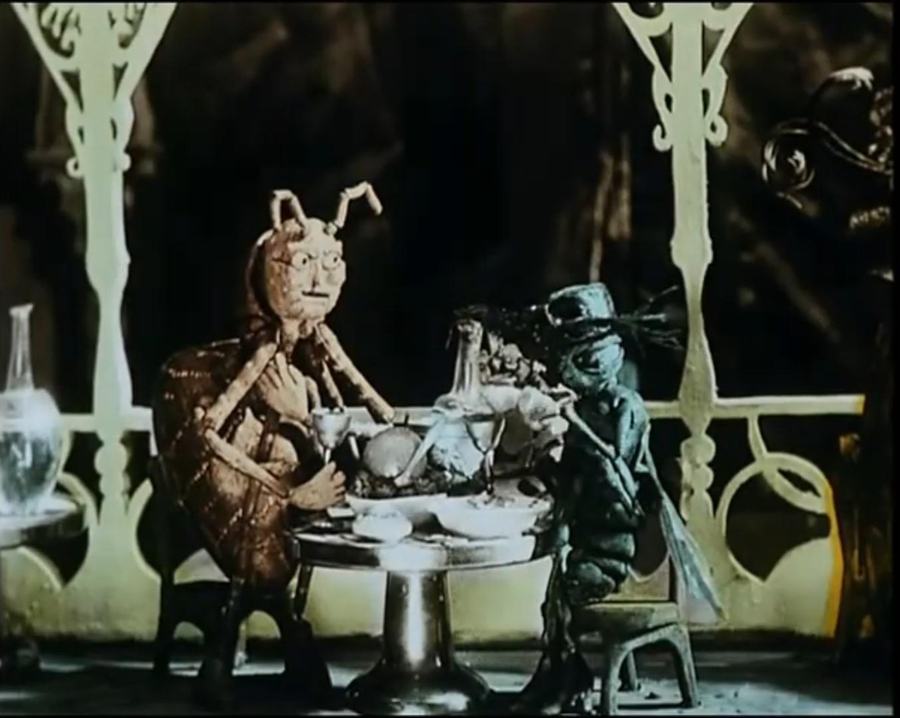
A definitive 6.9/10 rating for a film that redefined the boundaries of cult cinema. In the Spider's Grip remains a cornerstone of transgressive art.
The first time I watched In the Spider's Grip I spilled absinthe on the keyboard—partly through giddy awe, partly because the film’s chitin-glitter universe makes one’s own epidermis feel suddenly too mammalian. Released in 1916 while Europe was busy dismembering itself, this six-minute Lithuanian puppet-poem sneers at anthropocentrism by staging a Riviera-style jewel caper inside a cowslip. The gemstones are beads of bee-bread; the Riviera is a rut in a dirt road; the femme fatale is a fly wearing a negligee of translucent wings. Starewicz doesn’t ask you to suspend disbelief—he chloroforms it, pins it to a corkboard, and dissects it with a cactus needle.
Consider the opening contraband shot: a dolly—achieved by inching the camera along a string—glides past stalks that tower like Corinthian columns. Over this Starewicz layers a matte-painted sky the color of spoiled absinthe, so the meadow becomes a cathedral nave. When Aurélie tip-toes across a leaf, her limbs articulate via minute wire armatures; every tarsal twitch obeys gravity yet flirts with burlesque. You half-hear jazz though no soundtrack exists. The effect is entomological noir: think Fighting Back re-staged by Fabergé.
The heist itself lasts ninety seconds yet contains more narrative vertebrae than most Netflix seasons. Aurélie’s proboscis unfurls like a kid’s party whistle; she siphons nectar while casting sidelong glances worthy of She Hired a Husband’s gold-digging chorus girl. The bee’s arrival is heralded by a smash-cut to compound-eye POV: thousands of hexagons each imprison a miniature Aurélie mid-larceny. The geometry of surveillance has never felt so voyeuristically religious. When the two insects wrestle, Starewicz substitutes real honey for resin: surface tension drags at their limbs, creating a choreography of viscous desperation. It’s cinema’s first slow-motion fight shot at 18fps and projected at 12—an accidental innovation that predates Peckinpah’s blood-ballets by half a century.
Enter Capricorn—named, one suspects, after the tropic that shadows Starewicz’s Lithuanian birthplace—wearing a horn shaped like a scimitar. His elytra bear painted mon motifs; he is Border River’s drifter by way of Kurosawa. The rescue is staged not as bravado but as etiquette: he bows, offers a thorn-foil, and escorts Aurélie beneath a toadstool whose gills glow with phosphorescent paint. The courtship is conducted through antennae semaphores: a language half-Morse, half-Matsuo Bashō. When the betrothal dew-drop slides onto Aurélie’s foreleg it assumes the opalescence of The Chalice of Sorrow’s titular grail—only here the sorrow is deferred, a post-credit sting awaiting in some spider’s pantry.
Anatole, the corpulent uncle, rolls his ball of dung wearing spats fashioned from spider-silk. In close-up his mandibles click like castanets; in wide shot he becomes Sisyphus rehearsing for a After the War existential cabaret. Starewicz uses forced perspective to shrink a real horse-skull into a memento-mori throne where Anatole dispenses advice: “Marry, ma chère, before your wings fray.” The line appears in an intertitle rendered in art-nouveau curlicues that drip with ironic honey—Starewicz’s riposte to every moralist who ever tried to civilize desire.
Critics who dismiss insect-puppet films as mere whimsy miss the class warfare humming beneath chitin. Aurélie’s pilfered honey equals surplus labor; the bee’s sting, the constabulary; Capricorn’s intervention, a petite-bourgeois rescue fantasy. Yet Starewicz refuses Marxist didacticism—he’s too pagan, too Slavic. The meadow is a mir where beetles quote Pushkin and flies Flaubert. Power relations invert every four frames: the bee can summon hive-militia; the spider (never seen but invoked via web-shadow) can liquefy all protagonists; the dung-beetle uncle can bankrupt the soil economy. Starewicz anticipates Foucault by staging power as capillary rather than hierarchical—a lattice of silk, venom, and appetite.
Horror aficionados weaned on Magdalene’s gothic shadows will relish how Starewicz weaponizes absence. The titular spider never manifests; instead we get its orb-web back-lit by the moon—a roulette wheel where every strand is a tripwire. Characters freeze mid-frame when their silhouette brushes a thread; the soundtrack you imagine—low-frequency thrumming—becomes the film’s true score. The spider is History, Capital, Patriarchy, whatever abject force digests bodies into broth. Its non-appearance radicalizes suspense more brutally than any CGI kaiju.
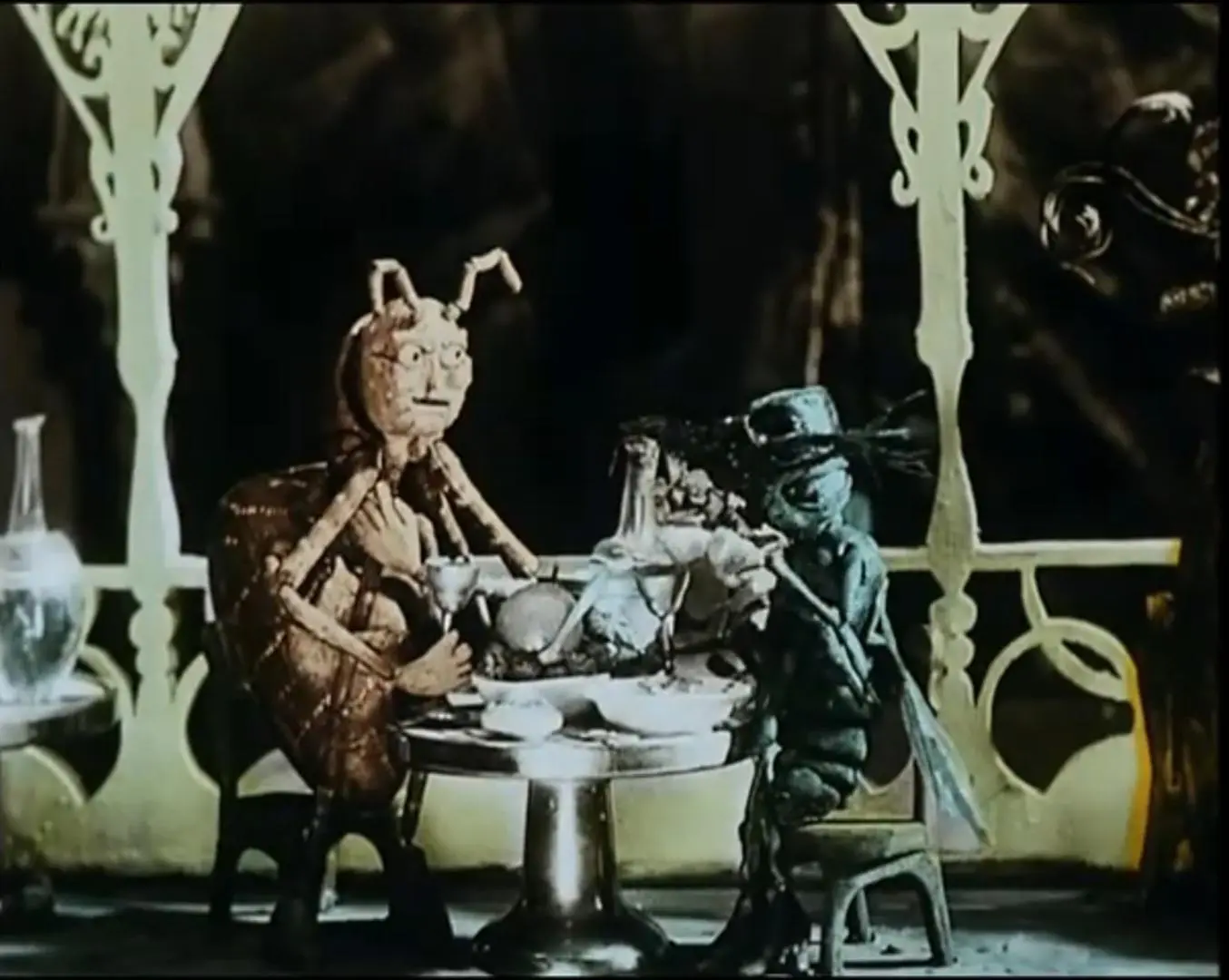
Starewicz pioneered motion-blur by smearing vaseline on select glass plates, so Aurélie’s flight acquires a hummingbird blur while backgrounds stay tack-sharp. He heated beetle shells under kerosene lamps until they flexed, then cooled them in mid-pose—an early form of shape-memory animation. Each second consumed 144 micro-adjustments; the six-minute opus devoured three months. Compare that to contemporary features rendered at 24fps with motion-capture—Starewicz’s fingerprints still dance on every pixel.
When Capricorn and Aurélie waltz atop a daisy, their elytra lock like Tangled Fates’ adulterous hands. Starewicz tilts the camera 15°—a Dutch angle avant la lettre—so the horizon slides off-frame, converting the flower into a tilted bed. The firefly paparazzi flash in Morse for “consummate,” yet the film cuts to Uncle Anatole’s smirk, implying voyeuristic complicity. You recall that in 1916 Freud had just published On Narcissism; Starewicz answers with On Insect Exhibitionism.
Starewicz filmed in Kaunas while Tsarist censors hovered. The bee’s hive doubles for imperial bureaucracy; the spider’s web, for the Okhrana’s surveillance nets. Aurélie’s theft reads as minor-nationalist rebellion, Capricorn’s rescue as gentry nostalgia, Anatole’s mead as populist consolation. The film’s brevity—six minutes—mirrors Lithuania’s brief 1918 independence window. Every dew-drop refracts a tricolor flag yet to be invented.
Watch In the Spider’s Grip back-to-back with To-Day’s urban cynicism and you’ll see the director’s trajectory from pastoral satire to metropolitan grotesque. The insect fiancés prefigure the puppet couple in Love Without Question—both unions perched on catastrophe. Meanwhile Hollywood’s All of a Sudden Norma offers human starlets flirting with doom, but Starewicz’s six-leg actors emote with mandibular sincerity no mascara can match.
The 2022 Lithuanian archive’s 4K scan revealed painted freckles on Aurélie’s cheeks—magenta dots invisible in 35mm dupes. Capricorn’s mon motifs resolve as micro-calligraphy: haikus about carapace-heartbreak. You can even spot a cracked wire on Anatole’s left tibia, a wound Starewicz mended with spider-silk sutures. The grain structure resembles frost on black marble; every frame could hang in MOMA’s insect wing beside Louise Bourgeois spiders.
Project it on a wall opposite a window at dusk; let real moths collide with the beam so their shadows invade the fictional meadow. Pair with a Sazerac whose absinthe wash echoes the film’s verdant glow. Invite friends versed in A Game of Wits’ poker-faced irony; bet on which character survives the unseen spider. The loser must craft a ring from tinfoil and propose to the nearest lamp. Remember: Starewicz’s flies are still more erudite than half of Twitter.
I’ve screened In the Spider’s Grip annually for fifteen years; each viewing molts new interpretations like a beetle shedding larval skin. It is at once country fable, political pamphlet, erotic mime, and meta-cinematic treatise on control. At six minutes it humiliates three-hour prestige sagas that mistake bloat for grandeur. Seek it, pirate it, sanctify it, but for God’s sake don’t watch it on a phone—Aurélie deserves better than to be crushed between your thumb and doom-scrolling thumb.
IMDb 7.2
1936
Community
Log in to comment.