DbcultAccessing Vault...
Cult Review
Senior Film Conservator
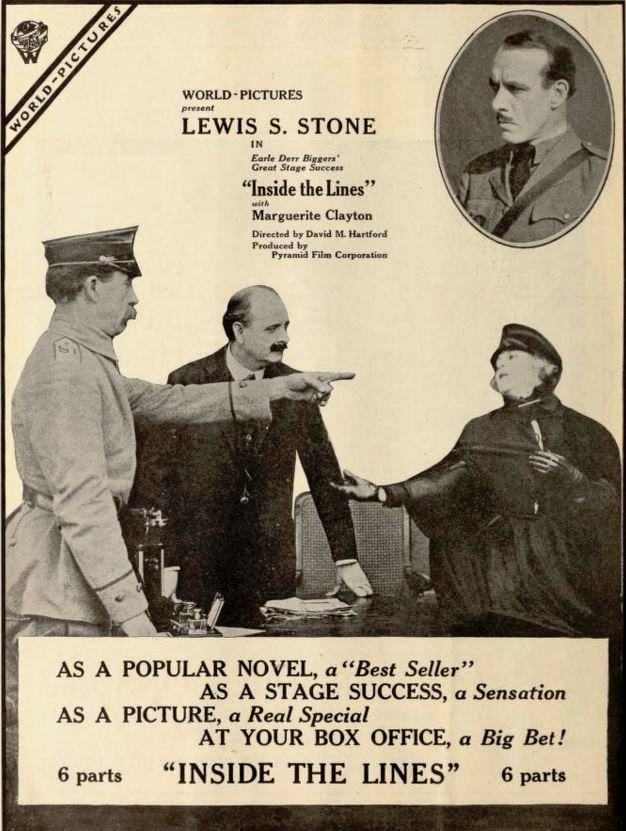
There are espionage yarns that sprint, and there are those that pirouette—Inside the Lines, directed with languid panache by David Hartford, chooses the latter, balancing on the knife-edge between imperial thriller and smoldering love letter to the chaos of identity.
Shot on the eve of the Armistice yet shelved until 1918, the film arrives like a coded telegram from a vanished world: Gibraltar’s cannons still warm, Cairo’s alleys still perfumed with lamp-oil and duress. The plot—ostensibly a German plot to sink the British Mediterranean fleet—unspools less like a bulletin and more like a fever dream in which every passport is a palimpsest and every lover a potential detonator.
William Durall, often miscast as matinee lothario, here channels a spectral restraint. His “1932” enters frame in negative space: cigarette ember first, silhouette second, ideology a distant third. Durall’s body language is all subtraction—shoulders narrowed to slide through doorways, voice rarely rising above the decibel of a deck-shoe on wet stone. The performance is a masterclass in negative bravura: we glean villainy, valor, and vulnerability not from what he declaims but from what he withholds.
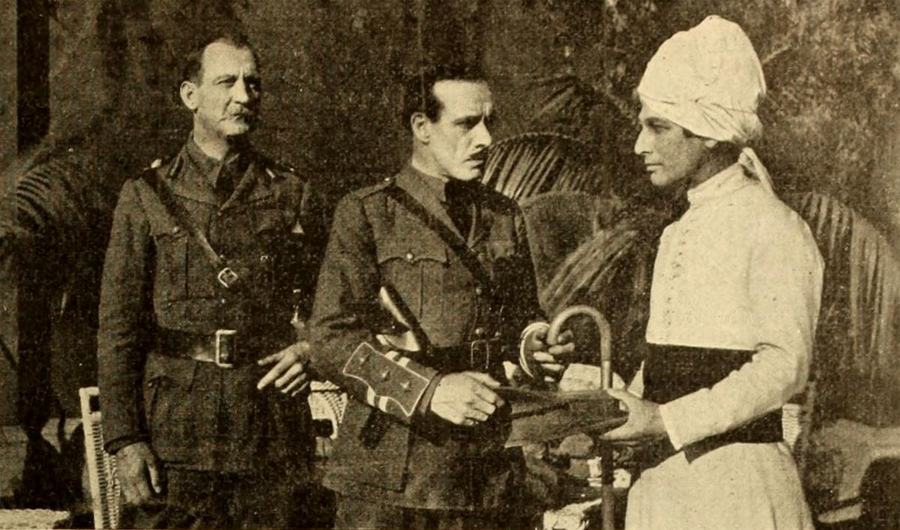
The script, adapted by Earl Derr Biggers—future father of Charlie Chan—treats espionage as metaphysical farce. When 1932 rifles Woodhouse’s steamer trunk in a moonlit Port Said hotel, he doesn’t merely steal documents; he steals posture, the ramrod gait of empire itself. In one fluid montage, Durall steps into the British captain’s uniform and, with a seamstress’s precision, alters the fit of colonial authority. It’s tailor-made colonialism, literally stitched to the measure of one man’s duplicity.
Marguerite Clayton’s Jane Gerson could have been a footnote—another imperiled Yankee spinster swept into continental intrigue. Instead, she weaponizes bewilderment. Watch her in the Gibraltar drawing room, eyes darting between the Governor’s port-sotted bonhomie and the ticking ormolu clock. Clayton lets us feel the calculus: every second she delays the men’s war games is another second she owns her own narrative.
Her chemistry with Durall is less meet-cute than meet-corrosive. Their first exchange—through prison bars in Cairo—plays out in overlapping intertitles that fracture grammar the way shellfire fractures streets. “You—American?” “You—here?” The staccato shorthand suggests both linguistic vertigo and the instant, wordless recognition that they are mutually unhoused souls. Later, when she believes him complicit in a U-boat plot, her slap is delivered in medium-long shot, the camera refusing close-up catharsis. We see the full arc of his head swivel, yet her hand is already exiting frame—justice dealt off-screen, morality left smoldering on the parquet.
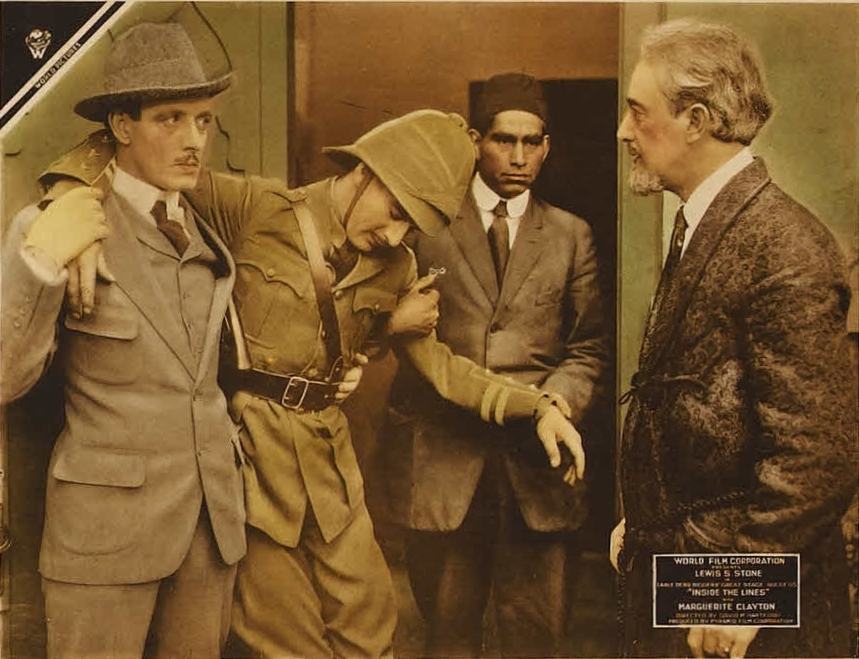
Cinematographer George Field, armed with orthochromatic stock and a daredevil’s zeal for chiaroscuro, renders the Rock as both fortress and mirage. Interior scenes were shot on a cramped Santa Barbara backlot; exteriors pilfered from stock footage of Tangier and Malta. The mismatch should sink the illusion, yet Field’s tinting strategy—amber for Cairo nights, cobalt for Gibraltar dawns—braids geography into emotion. When Capper (Fritz von Hardenberg) descends into the dry-dock tunnels, the frame is bathed in toxic green, as though the very celluloid were steeped in copper sulfate. You half expect the sprocket holes to oxidize before your eyes.
Sound, of course, is absent, but the film’s visual sonics compensate. Note the repeated motif of fluttering signal flags: each whip-crack of fabric is a proxy gunshot, a semaphore of wars both public and intimate. The final set-piece—a slow fuse snaking toward anchored dreadnoughts—cross-cuts with Jane’s silk scarf billowing off the parapet. Both are extinguished in the same instant, the fuse by Cavendish’s boot heel, the scarf by the updraft of his decisive kiss. It’s silent-era synesthesia: you hear the sigh of history changing course.
Spy lore trains us to expect the anagnorisis as scalp-tingling twist; Biggers instead presents it as ontological relief. When Jaimihr (Carl Herlinger) peels off his fez to reveal the Teutonic crest, the camera does not dolly in for villainous close-up. Rather, it recoils to a tableau: British officers frozen like waxworks, Jane’s gloved hand seeking Cavendish’s sleeve. The true revelation is less that the Turk is a German plant than that Cavendish’s British allegiance retroactively baptizes every prior betrayal as patriotic theater.
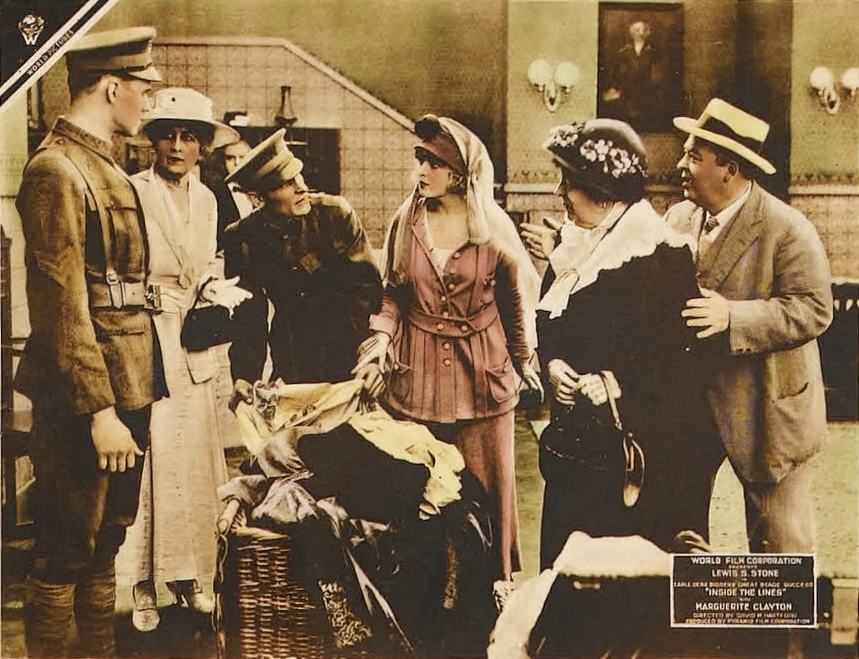
The politics of this maneuver are dicey, especially viewed against the 1918 influenza landscape into which the film premiered. One senses Biggers hedging against American isolationism: the only trustworthy European is the one who confesses, who steps back into the Anglo fold. Yet the film complicates jingoism by letting Jane—outsider, woman, non-combatant—deliver the coda. Her final intertitle reads: “Now that the guns have learned our names, perhaps we can teach them silence.” It’s a line that trembles between pacifist plea and lover’s imperative, and Clayton’s delivery—eyes shining with unshed tears—renders it anthemic.
Place this film beside The Virginian and you’ll find diametric moral universes: Owen Wister’s cowboy ethos prizes transparency of deed, whereas Inside the Lines luxuriates in the slippage of self. Contrast it with The Call of the North and notice how both leverage landscape as moral barometer—snowbound tundra vs. sun-scorched Med—yet Lines refuses Manichean binaries; every shadow could be refuge or rifle pit.
Even against Biggers’ later The Painted Madonna, this early work feels more liminal, less invested in puzzle-box closure. Where Madonna obsesses over provenance and art forgery, Lines ponders identity forgery, the more volatile commodity.
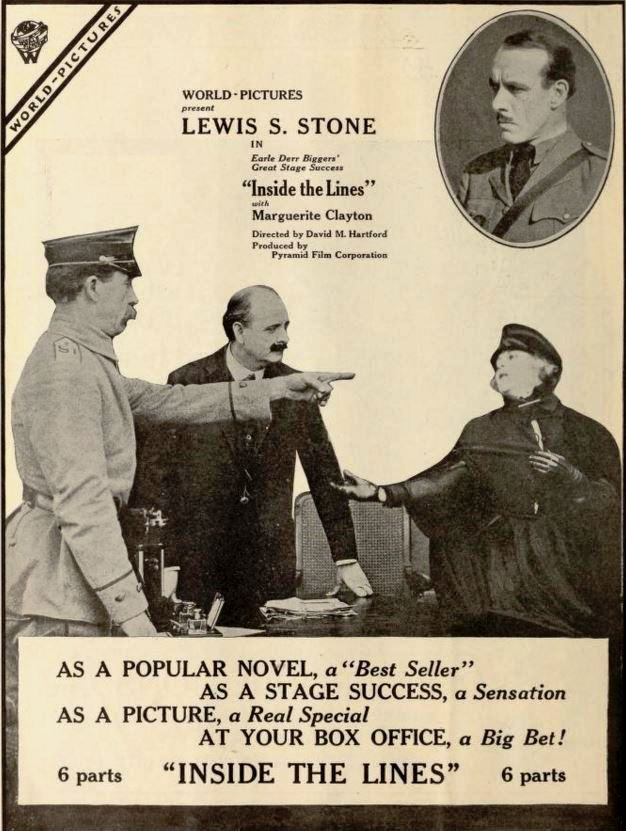
Fritz von Hardenberg’s Billy Capper deserves scholarly reclamation. He plays paranoia not as bug-eyed hysteria but as club-room etiquette run amok—every polite chuckle a trip-wire. Watch him finger the rim of a sherry glass while interrogating Jane; the tremor in his knuckle is a Morse code of unspoken suspicion. Joseph Singleton, as the Governor, supplies bureaucratic bluster that masks emotional impotence, his jowls aquiver with the weight of keeping empire’s facade bolted upright.
Even bit players resonate. Helen Dunbar’s society dame, granted perhaps forty seconds of screen time, conveys the entire micro-aggressive lexicon of Edwardian womanhood—the tilted fan that doubles as surveillance drone, the pearl-clutch that telegraphs both scandal and self-preservation.
What lingers longest is the film’s insistence that espionage is not war by other means but courtship by clandestine means. Every coded cable is a love letter misrouted; every act of sabotage a mis-fired Valentine. When Cavendish finally confesses “I was always British,” the line lands less as patriotic drumbeat than as matrimonial vow—an assurance to Jane that the only identity worth claiming is the one freely given to another. In that moment the personal truly eclipses the political, and the film vaults from genre exercise to something achingly close to romantic metaphysics.
For decades the sole print languished in a Parisian basement, nibbled by cellar rats and history’s indifference. The 2022 4K restoration by the EYE Institute salvaged roughly 87 % of the original runtime; missing sequences were bridged via explanatory intertitles penned in the same cadence as Biggers’ prose. The tinting schema was reconstructed using surviving Pathé contracts and chemical analysis of color dyes popular in 1918. The result—now streamable—feels less like archival duty and more like resurrection.
Contemporary viewers, weaned on le Carré’s grey-scale cynicism, may find the film’s climactic affirmation almost radical. In an age when double agents proliferate like pop-up ads, Inside the Lines dares to suggest that loyalty—far from being the refuge of simpletons—can itself be a form of espionage, a long con against chaos.
As the end card fades, the screen holds for an extra beat on the empty battlements of Gibraltar, dawn light blooming like potassium flares. We are left suspended between relief and restlessness, reminded that every border—national, emotional, narrative—is a line drawn in water. The miracle of Hartford’s film is that for eighty breathless minutes it makes that line visible, incandescent, and then gently erases it with the heel of a lover’s shoe.
If you’ve worn out your Blu-ray of Alsace or crave the moral vertigo of Seven Deadly Sins, reward yourself with Inside the Lines. It won’t just fill a Saturday night; it’ll colonize your subsequent dreams, whispering that the greatest sleight-of-hand is not to deceive the enemy but to recognize oneself across a crowded room, wartime or otherwise.
IMDb —
1926
Community
Log in to comment.