DbcultAccessing Vault...
Cult Review
Senior Film Conservator
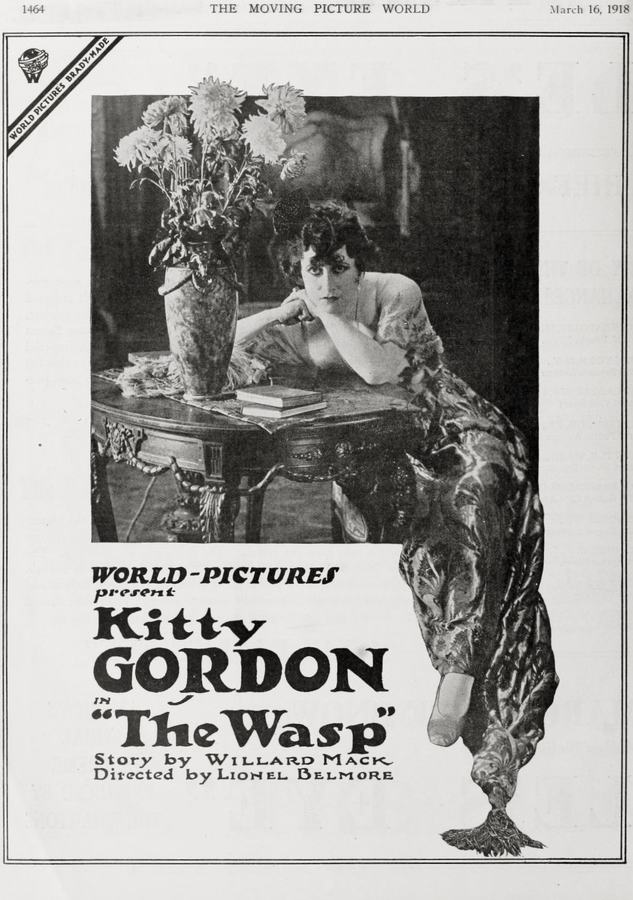
The lights drop like a guillotine, the iris-in contracts around Kitty Gordon’s kohl-sharp gaze, and suddenly the nickelodeon of 1918 becomes a hive of silk insults and TNT. The Wasp is a nitrate fever-dream where the stinger is female, the fuse is German, and the hero wears a livery as camouflage for old-money muscle. Viewed today, it crackles like a relay station between Victorian parlor wars and jazz-age flippancy—its intertitles venomous, its tints the color of bruised peaches and cordite.
Willard Mack’s screenplay detonates the drawing-room melodrama from the inside: the canning king John Culver, all pork-pie arrogance, tries to seal a corporate merger with matrimony, but Grace—nicknamed the Wasp for her ability to leave welts on egos—refuses the sacrificial altar. Her defiance is not some quaint suffragette pamphlet but a live cartridge; she hurls her engagement ring like a hand-grenade and commandeers the family Packard, chauffeur Tim Purcell at the wheel. The camera, starved of sync sound, nevertheless hears the screech of tires and propriety.
Enter Brazsos, a name that slithers off the tongue like absinthe. Played by Edward Roseman with cheekbones sharp enough to cut code, he is the Kaiser’s gift to American cinema: a spy who tunnels under patriotism itself. The sabotage plot—blow the Culver munitions works, cripple the war effort—could have been a footnote in a propaganda newsreel, but Mack stages it as an underworld opera. The excavation set, a labyrinth of timber struts and sweating close-ups, anticipates the Expressionist corridors that would bloom in German silents the following year.
What rescues the film from mere jingoism is its serrated sexual politics. Grace is never a damsel waiting for extraction; she is the engineer of her own chaos. When ropes bite her wrists, she gnaws back. When darkness suffocates the tunnel, she strikes matches with her teeth. Kitty Gordon, a Broadway ornament making her screen apex, plays her like a chandelier in an earthquake—every crystal rattling yet still throwing light. Watch the moment she unknots Tim’s bindings: the camera lingers on her fingers, not his gratitude, turning the cliché of rescue into a transaction of power.
Ah, Tim—alias Harry Cortland—embodied by Edmund Burns with shoulders that seem borrowed from the Yale bulldog itself. The masquerade of wealth as servitude is older than class, yet Burns gives it a wounded swagger. His confession of love, whispered in a tomb of rubble, is shot in chiaroscuro: faces half-lit by the failing carbide lamp, eyes glittering like spent shell casings. The premature explosion that entraps them is rendered with a double-exposure inferno, orange nitrate blooming against sea-blue tinting—a chromatic contradiction that feels like breathing fire underwater.
The rescue arrives not with bugles but with the maid Miller—Hazel Washburn in a performance so brisk she seems to sprint through the celluloid—leading a Keystone-ish battalion of bobbies and union foremen. The coda, where Grace learns Tim’s pedigree and her father’s approval ricochets from apoplexy to obsequity, could have curdled into Taming-of-the-Shrew conservatism. Yet Gordon’s final smile is less surrender than checkmate: she has secured love and leverage, the factory intact, the patriarch humbled.
Visually, director William Calhoun orchestrates a dialectic of claustrophobia and release. Interiors are staged in deep focus: parlors recede like coffins, mirrors reflecting conspirators. Exteriors, by contrast, burst into wide orchard vistas where the Packard barrels down lanes of white dust—each frame hand-tinted, the sky sea-blue, the foliage a dark orange that seems to hiss. The tinting is not mere ornament; it is narrative syntax, warning us that the pastoral is always one spark away from combustion.
Compare this chromatic anxiety to Schuldig, where guilt is washed in monochrome penumbra, or the apocalyptic palette of Destruction. The Wasp’s hues sting precisely because they feign innocence—peach, teal, buttercup—before the gun-metal truth erupts. Even the film’s own contemporaries, such as the urban gothic Lost in Darkness, lack this volatile pastels-versus-powder keg tension.
The score, lost to time, survives in cue sheets: “Mystery,” “Hurry,” “Love—Pathétique.” One imagines a lone pianist hammering out chromatic scales while the projector clatters like a Maxim gun. Silent exhibition was always half-haunted memory; The Wasp doubly so, because its subject is the thin membrane separating cocktail chatter from shrapnel. Every intertitle—Mack’s staccato couplets—feels like a telegram from the front: “You can cage a wasp, but the venom stays volatile.”
Restorationists at EYE and MoMA have salvaged a 35 mm print, though two reels remain vinegar-brittle. The available version circulates among cine-clubs with Dutch intertitles, forcing anglophone viewers into a bilingual pas de deux. Yet even in translation, Gordon’s performance transcends semantics; her shrug at film’s end—half triumph, half eyeroll—is a proto-feminist meme before the internet, before Betty Boop, before Beyoncé.
Critics in 1918 praised the film’s “vim and vinegar,” dismissing its politics as mere escapism. A century on, the escapism looks like prophecy: heiresses weaponizing inheritance, foreign agents burrowing into domestic bedrock, class anxiety disguised as courtship comedy. The Wasp is the missing link between Edith Wharton’s drawing-room scalpels and Hitchcock’s Saboteur—a bridge built of gun-cotton and lace.
So, should you chase this ghost down? Absolutely, if only to witness how thoroughly 1918 could skewer the patriarchy while pretending to save it. The film stings, swells, then sings—a nitrate lullaby whose final note is neither major nor minor, but the unmistakable buzz of a woman who refuses to be smoked out of her own hive.
Stream it if you can find it, project it if you’re brave, but above all—swat carefully. Wasps, after all, remember faces.
IMDb 7.1
1936
Community
Log in to comment.