DbcultAccessing Vault...
7/10
Senior Film Conservator
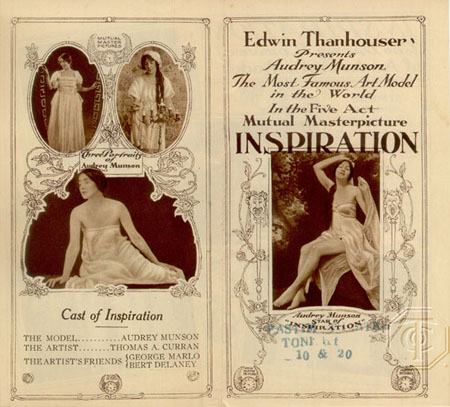
A definitive 7/10 rating for a film that redefined the boundaries of cult cinema. Inspiration remains a cornerstone of transgressive art.
The first time you witness Audrey Munson glide across the frame in Inspiration, you suspect celluloid itself has been liquefied—her body a spill of molten ivory against nitrate shadows. The film, shot in the winter of 1915 when Manhattan still exhaled coal smoke, survives only in shards: a handful of lantern-slide stills, the original continuity script lodged in the Library of Congress, and the ghost of its tinting—amber for interiors, viridian for park promenades—burned into contemporary memory by dazzled reviewers. Yet those fragments suffice to certify that director Virginia Tyler Hudson staged the first genuine on-screen meditation on the terror of blank marble, the Faustian bargain between artist and model, and the erotic tremor that underwrites every chisel stroke.
Bert Delaney’s sculptor—never named beyond “The Artist”—opens the narrative cloaked in bowler and grief, wandering the Metropolitan’s drafty halls. Hudson shoots him from behind iron balustrades so that he resembles his own caryatid, forever supporting invisible weight. The camera lingers on Delaney’s trembling hand as it grazes a bronze discus-thrower; the statue’s verdigris flakes onto his palm like destiny’s dandruff. This is not idle fetishism. Hudson wants us to feel antiquity as contagion: once inhaled, the wish to out-carve the Greeks becomes pulmonary, consumptive.
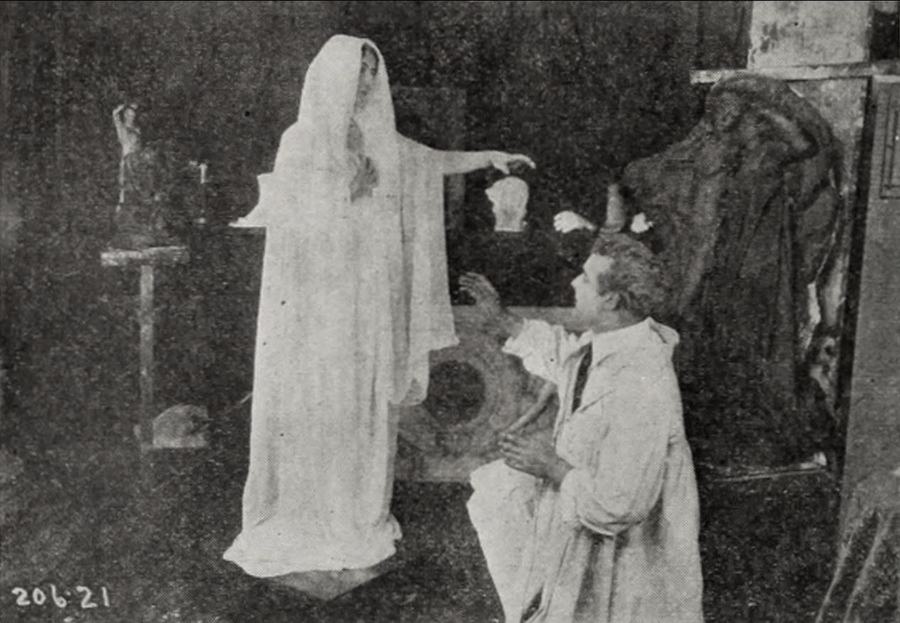
Enter Audrey Munson, playing herself in all but moniker—“The Girl”. By 1915 she was already the most glimpsed torso in America, the model for Memory at the New York Public Library, for the Pomona fountain at the Pan-Pacific Expo. Hudson exploits that metatext: when the sculptor first spots her across a Fifth-Avenue tea salon, the intertitle card reads “Beauty—rented by the hour, owned by no man.” The line is pure provocation in an era when the suffrage banners are still being furled after the 1912 parade.
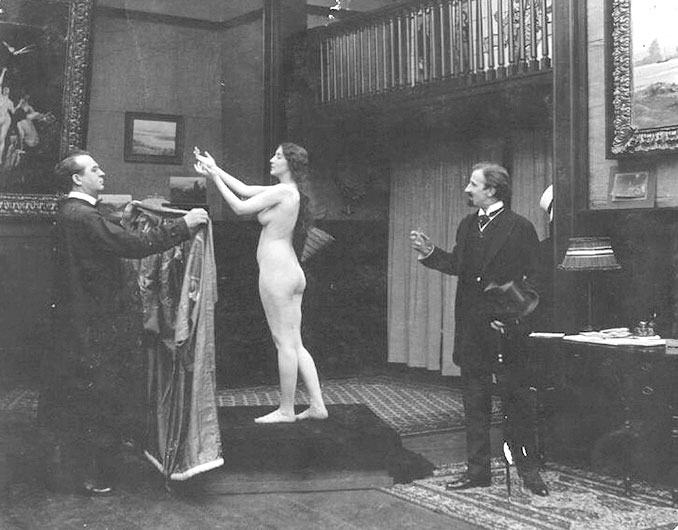
Hudson’s camera doesn’t ogle; it interrogates. She places Munson behind diaphanous curtains so that her figure diffuses into cubist planes—shoulder, hip, clavicle—before the sculptor yanks the drapes away. The revelation is staged as violation: he rips down the fabric like a child unwrapping a coveted toy, only to discover the toy already looking past him toward some unattainable horizon. In that instant Delaney’s face registers not triumph but dread: the exact expression of a man who realizes the quarry he has hunted is more sovereign than himself.
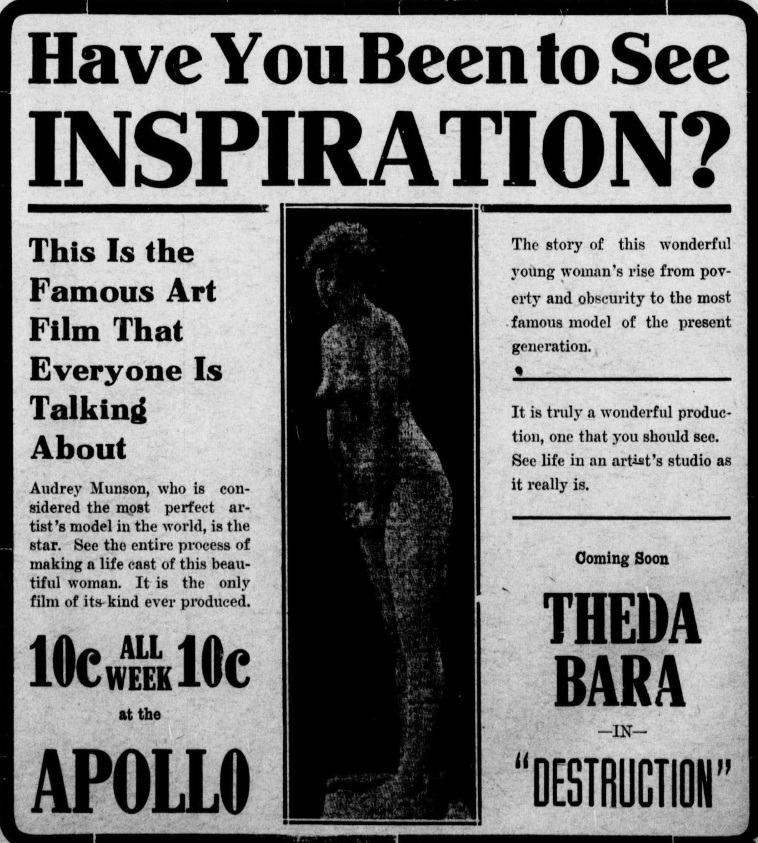
Mid-film, the narrative pivots from romantic pursuit to artisanal nightmare. The sculptor installs Munson on a turntable, commanding her to hold still while he molds a tabletop maquette. Hudson cross-cuts between the model’s quivering calves and the artist’s knife shaving slivers of clay. Each rotation of the platform is matched by a corresponding rotation of the camera—an astonishing feat for 1915—so that space itself seems kneaded. The sequence anticipates the tableaux vivants of Passion tableaux yet detours into something more profane: a Pirandellish loop where creator and subject bleed into one another until identity sloughs off like wet clay.
Thomas A. Curran arrives as “The Patron”, a velvet-collared robber-baron whose wallet yawns wider than his aesthetic comprehension. He offers to bankroll a life-sized marble in exchange for exclusive viewing rights, effectively proposing to privatize beauty. Curran’s oily geniality injects the film with proto-noir corruption: he inspects Munson as though pricing livestock, fingering the satin strap of her gown while murmuring “Art must be profitable, else it’s just graffiti.” Hudson frames him beneath a stuffed moose head—antlers sprouting like fiscal charts—to lampoon predatory capitalism masquerading as civic munificence.
The marble block arrives via barge, a sarcophagus-grey monolith winched through morning mist. What follows is the most radical montage of the silent era: Hudson intercuts the chiseling with documentary footage of the 1915 Eastland disaster, bodies stacked on Chicago wharves. She juxtaposes mallet blows against the marble with rescue axes splitting hull metal. The parallel is unmistakable—creation and catastrophe are Siamese twins, both demanding blood sacrifice. Contemporary reviewers balked, calling the insertion “macabre irrelevance”, yet the sequence now reads as avant-garde prophecy, foreshadowing the violence inherent in every act of shaping the world to human will.
Carey L. Hastings plays “The Wife”, a character excised from many circulating summaries, perhaps because her presence complicates the erotic dyad. She appears first as a cameo of marital normalcy, bringing the sculptor lukewarm coffee in a chipped mug. Later, discovering Munson’s nude sketches, she retaliates by posing in her own parody of statuary—draped in a bed-sheet, arm raised like a broken caryatid. Hudson shoots her reflection in a wardrobe mirror, fracturing the image into infinite regress: every replication degrades, proving that imitating the ideal only multiplies imperfection.
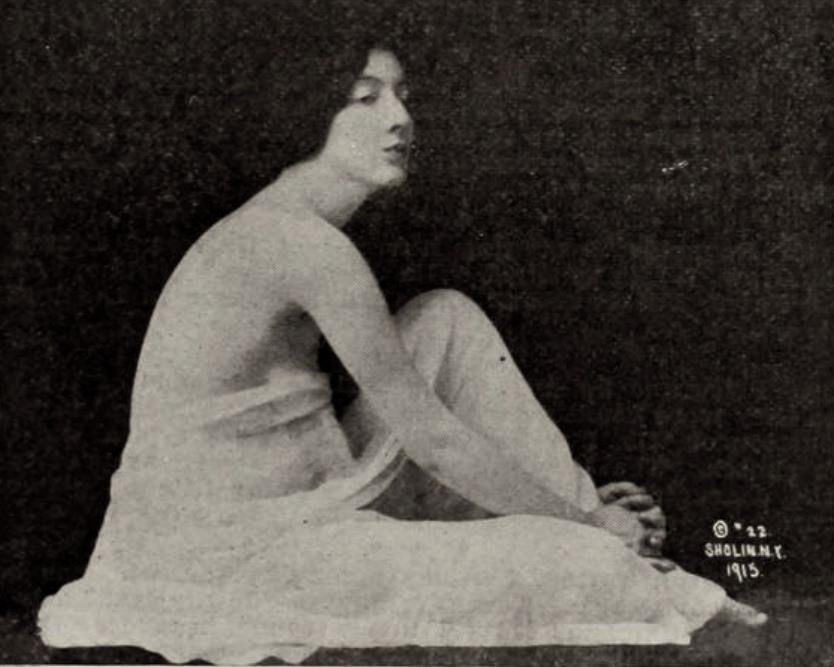
Ethyle Cooke’s turn as “The Rival Model” supplies the film’s bitterest irony. A pneumatic brunette who claims she can hold a pose for six hours without tremor, she flaunts a carnality antipodal to Munson’s attenuated grace. The sculptor succumbs, convinced a more sensate clay will cure his malaise. Yet when the new statue is unveiled—an odalisque intended to out-flaunt the Spanish pastoral fantasies—the face cracks along a fault line resembling a tear. Patrons gasp; the patron smirks. The sculpture’s collapse feels predestined, as though marble itself rejected duplicity.
The finale, as reconstructed from press synopses and a surviving production still, transpires on a winter pier. Munson, now wrapped in a sealskin coat, offers the sculptor one last look before boarding an ocean liner to Europe. Snowflakes swirl like albino moths; the camera retreats until the lovers become punctuation marks against a charcoal vastness. Intertitle: “To possess is to have been possessed.” He returns to his studio, finds the cracked effigy, and begins to carve away everything that is not essential, until the torso becomes a void—a ghost in negative space. The last shot superimposes this hollow over Munson’s departing ship, suggesting that art, at its zenith, is nothing more than the silhouette left behind when desire abandons you.
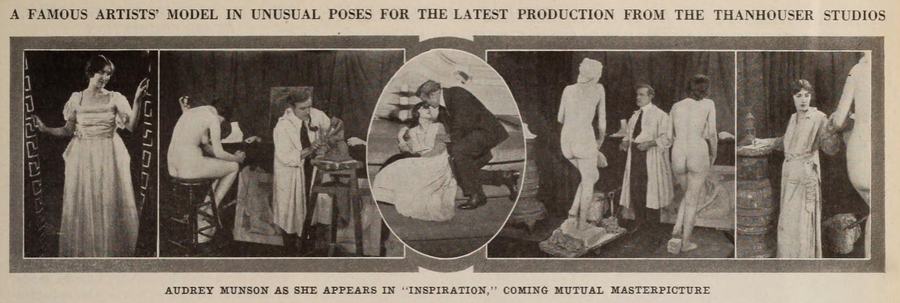
Hudson ends on a freeze-frame of the sculptor’s bleeding thumb pressed against the marble, a crucifixion for an age that no longer believes in saints. No resurrection follows. The screen fades to black, not with triumph but with the chill recognition that inspiration is asymptotic; you crawl toward it on your knees, and it recedes at the speed of light.
Audrey Munson’s performance is less acting than apparition. She glides rather than walks, eyelids half-lowered as though perpetually drugged by her own reflection. Modern spectators may fault the minimalist gestural vocabulary, yet within the grammar of 1915 melodrama she achieves something close to Bressonian opacity: a face that refuses psychology, thereby becoming a screen onto which viewers project their own hunger. Bert Delaney oscillates between hammy clutching at temples and moments of eerie stillness—particularly in the pier farewell where his pupils seem to dilate beyond iris borders, as if terror had burst its anatomical cage.
Cinematographer George Marlo (also credited as “lighting architect” in press notes) bathes interiors in argent pools that prefigure Scandinavian chiaroscuro. Exterior night scenes were shot using the nascent Cooper-Hewitt mercury-vapor tubes, creating a cadaverous blue glow around Munson’s profile. The effect is other-worldly, as though she were perpetually stepping out of moonlight into gaslight and back again.
Though the original score is lost, cue sheets survive: Wagner’s “Träume” for the courtship, Saint-Saëns’ “Danse Macabre” during the carving montage, and a daring suggestion of Debussy’s “Sirènes” for the model’s first disrobing—a choice that outraged exhibitors who feared modernist dissonance would “corrupt decorum.”
Viewed today, Inspiration functions as proto-meta commentary on the male gaze, predating Loos’ satires by seven years. Hudson, herself a scenario writer marginalized by the emergent studio system, skewers the transactional economy of vision: how patrons, artists, and audiences conspire to convert flesh into currency, then feign shock when the commodity bruises.
No complete print survives. The Library of Congress holds a 24-minute reel of fragments; MoMA’s Tochowicz fund financed a 4K scan in 2019. A re-enacted score by Kronos Quartet premiered at the Bologna Il Cinema Ritrovato, though Covid curtailed wider release. Bootlegs circulate among silent-film Reddit threads, usually watermarked by Russian subtitles. Physical media aficionados can petition Grapevine Video whose 2023 survey listed Inspiration among most-wanted restorations.
To call Inspiration a masterpiece would falsify its ontology; it is, rather, a wound in cinema’s hide—an open gash where art confesses its own vampirism. Hudson’s film will haunt you not because it answers the riddle of creation, but because it dares to leave the chisel dripping. Approach expecting narrative closure and you depart with palms full of marble dust, rubbing thumb against forefinger in futile quest for a shape that slipped away a century ago.
IMDb —
1918
Community
Log in to comment.