DbcultAccessing Vault...
Cult Review
Senior Film Conservator
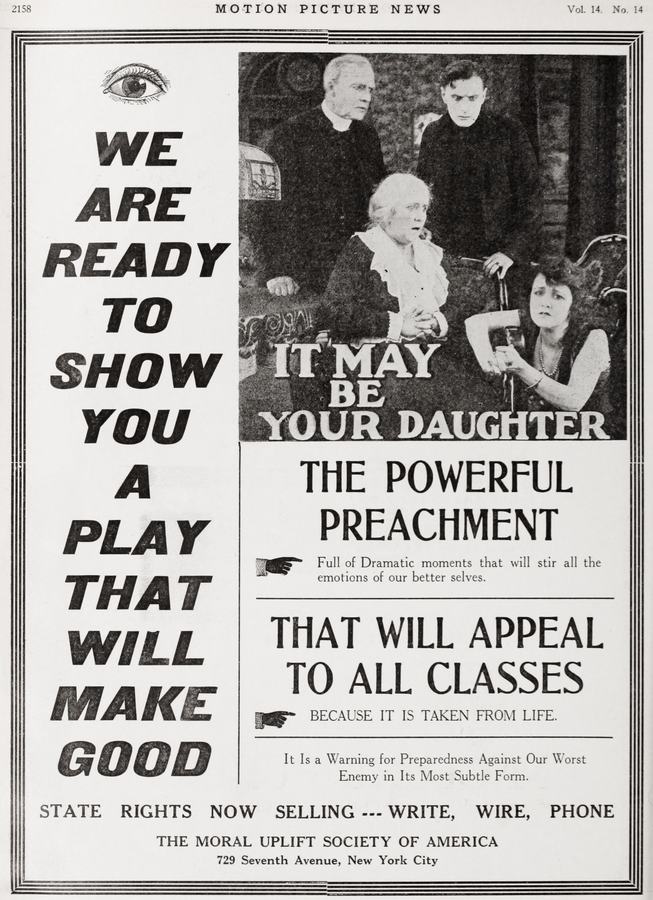
In the annals of early cinema, certain films, even those shrouded in the mists of time, possess an uncanny ability to resonate with enduring human dilemmas. George M. Merrick's "It May Be Your Daughter" stands as one such cinematic artifact, a potent melodrama that, despite its vintage, speaks volumes about societal expectations, individual sacrifice, and the relentless pursuit of truth. It's a film that eschews easy answers, instead plunging its audience into the murky waters of moral ambiguity and the profound consequences of choices made under duress. To merely label it a 'drama' would be to diminish its intricate layers; it is a profound character study, an indictment of hypocrisy, and ultimately, a testament to the resilient spirit of those caught in its intricate web.
At its heart, "It May Be Your Daughter" is a meticulously crafted narrative of a secret that refuses to remain buried. We are introduced to Elara Vance, brought to life with an arresting intensity by Peggy Sweeney. Elara is a woman carved from the finest societal clay, yet beneath her polished exterior lies a soul scarred by a past she has desperately tried to inter. Her youthful indiscretion with Julian Thorne, portrayed by Hugh Thompson with a nuanced blend of artistic temperament and inherent weakness, resulted in a child, Lily. The film masterfully depicts the era's unforgiving social strictures, where the stain of illegitimacy could irrevocably tarnish a family's standing. Elara's family, prioritizing reputation above all else, compels her to relinquish Lily, a decision that haunts her every waking moment, transforming her into a woman of quiet strength but profound sorrow. This initial setup immediately draws parallels with other films exploring the plight of women in restrictive societies, such as the thematic undercurrents found in 'A bánat asszonya', where female suffering is often a direct consequence of societal judgment.
Years later, the threads of fate begin to intertwine with a cruel precision. Lily, embodied by the remarkable Carolyn Lee, has grown into a young woman forced to navigate a challenging existence, completely unaware of her true parentage. Her journey is one of resilience, a quiet defiance against the odds. The film avoids painting her as a mere victim, instead showcasing her burgeoning spirit and resourcefulness. Simultaneously, Julian Thorne, though older and perhaps wiser, remains a figure grappling with his past demons, his artistic endeavors a flimsy veil over his unresolved guilt. The genius of Merrick's writing lies in the gradual, almost imperceptible way these lives begin to intersect. It's not a grand, theatrical reunion but a series of chance encounters and lingering glances that slowly peel back the layers of deception. This subtle build-up of dramatic tension creates an almost unbearable anticipation, a testament to the film's narrative prowess.
The introduction of Arthur Sterling, played with dignified sincerity by Harold West, adds another crucial dimension to the unfolding drama. Arthur represents stability, kindness, and an unwavering admiration for Elara. His presence acts as a catalyst, inadvertently pushing Elara towards a confrontation with her past. His genuine affection for her, and eventually for Lily, underscores the film's exploration of different forms of love – the passionate but irresponsible love of youth, the enduring and protective love of a mother, and the steadfast, redemptive love of a true partner. This complex interplay of relationships elevates the film beyond a simple tale of hidden identity, transforming it into a meditation on human connection and the possibility of healing.
The success of "It May Be Your Daughter" rests heavily on the shoulders of its exceptional cast. Peggy Sweeney as Elara Vance delivers a performance that is nothing short of masterful. Her portrayal of a woman torn between societal expectations and maternal instinct is deeply affecting. Sweeney conveys Elara's internal turmoil through subtle gestures, haunted eyes, and a quiet dignity that speaks volumes. It's a performance that evokes empathy without resorting to overt histrionics, reminding one of the understated power seen in leading roles of films like 'Innocent', where a character's inner life is paramount. Her journey from a heartbroken young woman to a formidable, yet still vulnerable, matriarch is the emotional anchor of the film.
Hugh Thompson's Julian Thorne is equally compelling. Thompson avoids the pitfall of making Julian a one-dimensional villain. Instead, he presents a man burdened by his own artistic temperament and moral failings, yet not entirely devoid of humanity. His eventual reckoning, though perhaps too late for some, is portrayed with a raw honesty that adds significant depth to the film. The subtle shifts in his demeanor as the truth slowly dawns on him are particularly noteworthy. Carolyn Lee, as Lily, is a revelation. She imbues her character with a quiet strength and an inherent goodness that makes her plight all the more heart-wrenching. Her interactions with both Elara and Julian are charged with an unspoken tension, her innocence a stark contrast to the weight of their secrets. The supporting cast, including Virginia Campbell, Edith Thornton, Charles Hallock, Doris Jordan, and Dorothy Gwynne, each contribute to the film's rich tapestry, creating a believable world where every character, no matter how minor, plays a crucial role in the unfolding drama.
George M. Merrick, credited as the writer, demonstrates an astute understanding of human psychology and social dynamics. The screenplay for "It May Be Your Daughter" is a masterclass in pacing, allowing the story to unfold organically, building suspense not through cheap thrills but through the slow, agonizing reveal of deeply buried truths. Merrick's dialogue, though reflective of its era, is sharp and purposeful, each line contributing to character development or plot progression. His ability to craft complex characters with believable motivations is a testament to his skill. The thematic resonance of the film – exploring themes of identity, social stigma, maternal love, and the possibility of redemption – is largely due to Merrick's insightful writing. This depth of character and thematic exploration can be seen as a precursor to more modern dramas that delve into familial secrets, echoing the intricate relationships found in films like 'The Painted Lie', where deception forms the crux of the narrative.
While specific directorial credits for such early films can sometimes be elusive or shared, the overall direction of "It May Be Your Daughter" is remarkably cohesive and emotionally impactful. The visual storytelling, characteristic of the period, relies heavily on expressive acting and carefully composed shots to convey emotion and narrative beats. The film utilizes close-ups effectively to capture the nuances of the actors' performances, particularly Sweeney's, allowing the audience to truly connect with the characters' internal struggles. The setting, often reflecting the stark social divisions of the time, is used to great effect, contrasting the opulent yet suffocating world of Elara's past with Lily's more challenging, yet ultimately more authentic, present. This careful attention to environmental detail and character blocking contributes significantly to the film's immersive quality.
"It May Be Your Daughter" is far more than a simple melodrama; it's a profound commentary on the societal anxieties and moral codes of its time. The film unflinchingly examines the double standards imposed upon women, where a moment of weakness could lead to lifelong ostracization, while men often escaped with far fewer consequences. Elara's sacrifice of her child is not just a personal tragedy but a poignant reflection of a society that valued appearances above genuine human connection and compassion. This theme of societal pressure and its devastating impact on individual lives is a recurring motif in cinema, resonating with the struggles depicted in films like 'The Co-respondent', which similarly dissected the ramifications of social scandal.
The film also delves into the complex nature of identity. Lily's journey to uncover her true parentage is a universal quest, exploring what it means to belong and to understand one's origins. Her struggle highlights the importance of truth, even when it is painful, and the inherent human need for connection. Julian's arc, though less sympathetic, explores themes of responsibility and the possibility of redemption, albeit a redemption hard-won and perhaps incomplete. The title itself, "It May Be Your Daughter," serves as a stark reminder, not just to Julian, but to the audience, of the unforeseen consequences of actions and the inescapable bonds of family, whether acknowledged or denied.
Moreover, the film subtly critiques the hypocrisy prevalent in high society, where moral failings were often swept under the rug as long as outward appearances were maintained. The Vances' initial decision to force Elara to give up Lily is driven by a fear of scandal, a concern for their social standing, which the film presents as a cold, unfeeling force. This examination of social facades and hidden truths offers a compelling parallel to the intricate social criticisms often found in narratives like 'Who's Who in Society', where the veneer of respectability often conceals a multitude of secrets.
While "It May Be Your Daughter" might not be as widely recognized as some of its more celebrated contemporaries, its thematic richness and powerful performances ensure its enduring appeal to those who seek out the gems of early cinema. It stands as a testament to the fact that compelling storytelling, intricate character development, and profound emotional resonance are timeless qualities, transcending technological advancements and shifting cinematic trends. The film's ability to tackle sensitive subjects with both delicacy and unflinching honesty makes it a valuable piece of cinematic history. It reminds us that the human heart, with its capacity for love, loss, and the arduous journey towards forgiveness, remains the most compelling subject matter for any art form.
Watching "It May Be Your Daughter" today is not merely an exercise in historical appreciation; it is an immersive experience that allows us to connect with universal human experiences. The film's exploration of maternal love, paternal responsibility, and the search for identity continues to resonate, proving that while the costumes and settings may change, the fundamental struggles of the human condition remain constant. It invites viewers to ponder the nature of truth, the weight of secrets, and the enduring power of family, in all its complicated forms. Much like the profound loyalty explored in 'Damon and Pythias' or the innocent struggles in 'The Apple-Tree Girl', this film taps into deep emotional wellsprings that define our shared humanity.
In conclusion, "It May Be Your Daughter" is a film that deserves to be rediscovered and celebrated. It is a powerful, emotionally charged drama that speaks to the enduring strength of the human spirit in the face of adversity. Its legacy lies not just in its historical significance but in its timeless ability to move, provoke, and inspire reflection on the intricate dance between individual fate and societal decree. It is a crucial piece of the cinematic puzzle, offering insights into both the craft of early filmmaking and the perennial struggles that define the human experience. A true cinematic gem, it leaves an indelible mark, prompting introspection long after the final frame fades to black.

IMDb —
1934
Community
Log in to comment.