DbcultAccessing Vault...
Cult Review
Senior Film Conservator
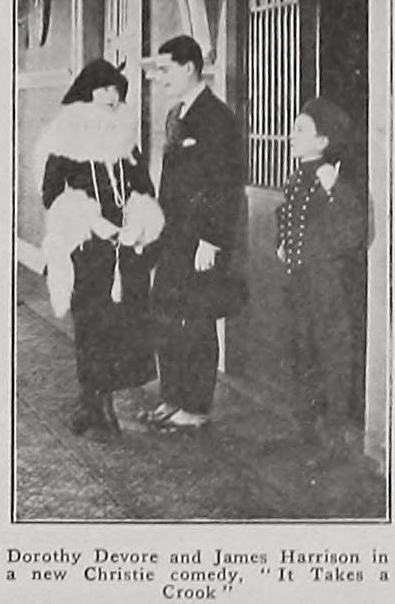
The first time we see James Harrison’s nameless grifter, he is framed against a Mediterranean nocturne so blue it feels bruised. A cigarette ember dots the dark like a punctuation mark; the man exhales languidly, already bored by the Riviera’s gilded fauna. Enter Dorothy Devore—petite, fox-eyed, her pearls as counterfeit as the smile she bestows on a duke before lifting his watch. Director Edwin Carewe doesn’t introduce these characters so much as allow them to leak into the narrative, two mercury droplets converging on a tilted plane.
Silent-era capers often mistake motion for momentum, but It Takes a Crook pirouettes on psychological torque. The film’s larceny is not plotted; it is choreographed. When Harrison cracks a safe in a tuxedo with the cuffs casually undone, Carewe’s camera lingers on fingers more expressive than most actors’ faces—each tumbler click lands like a metronome for the ensuing romance. Devore, meanwhile, weaponizes femininity as a sleight-of-hand: she cries on cue, but the tear is timed to distract while a bracelet unclasps itself. Their meet-cute occurs mid-heist: intersecting beams of a jeweler’s flashlight reveal both for what they are—mirrors.
What follows is less a plot than a diabolical waltz. The duo agrees to cooperate on one last score, yet every subsequent scene redefines “last” as merely the latest threshold to intimacy. They bilk a countess at baccarat, sell the Mona Lisa reproduction to an American magnate, and finally auction a forged deed to the very casino where they met—each con obliterating a layer of their individual myth until nothing remains but the shared hunger for the next adrenaline stanza.
Carewe’s visual grammar anticipates Hitchcock’s voyeuristic elegance by three decades. Observe the repeated motif of mirrors: Harrison studies Devore’s reflection stealing a tiara while, behind him, a policeman studies Harrison’s reflection studying her. The recursion indicts the audience too—we are, after all, delighting in theft under the alibi of spectatorship. Intertitles here eschew exposition for aphorism: “A crook trusts only what he can steal twice.” The line stings precisely because the lovers have stolen each other’s cynicism.
Devore’s performance is the film’s keystone. At first glance her genteel antics recall Dorothy Revier’s coquettish machinations, yet Devore adds a substrata of fatigue—her eyes betray a woman who has grown allergic to sincerity, thus romance must be counterfeited to feel authentic. Watch the way her shoulders slacken the moment a victim signs a check; it’s a miniature portrait of post-coital tristesse, except the coitus was fiduciary.
Harrison, laconic and pantherine, complements her with the economy of a magician who knows the trick is overrated once analyzed. His character’s backstory is never divulged; instead, a scar above the collar and a reflexive wince at church bells hint at a past potent enough to justify present larceny. The restraint is refreshing in a decade when villains were often melodramatically stamped with scarlet letters of motive.
The picture climaxes inside a moonlit galleon repurposed as a gambling den, rocking gently off the coast—an inspired set that literalizes the narrative’s moral flux. Here our lovers stake everything on a roulette spin orchestrated to lose; the wheel is rigged to bankrupt the house, but the true gamble is relational: can trust survive when both partners know every outcome is manipulated? The ball clatters, the crowd gasps, the boat itself seems to inhale. Cut to black. A final intertitle reads: “We are free, and thus we are ruined.” Fade-in on the couple penniless aboard a dawn-bound train, sharing a cigarette, their laughter ricocheting down the carriage like coins spilling from a fallen purse.
Technically, the film is a tour-de-force of 1920 craftsmanship. Cinematographer Ernest Miller employs magnesium flares to carve chiaroscuro so sharp it could slice the celluloid itself. Note the sequence where Devore traverses a hotel corridor; the only illumination is the intermittent flicker of chandeliers as electricity shorts—her silhouette appears and dissolves in staccato, foreshadowing the on-again-off-again rhythm of the romance. Meanwhile, the tinting strategy is deliberately inconsistent—night scenes oscillate between cyan and amber—subtly cueing the emotional whiplash of criminal courtship.
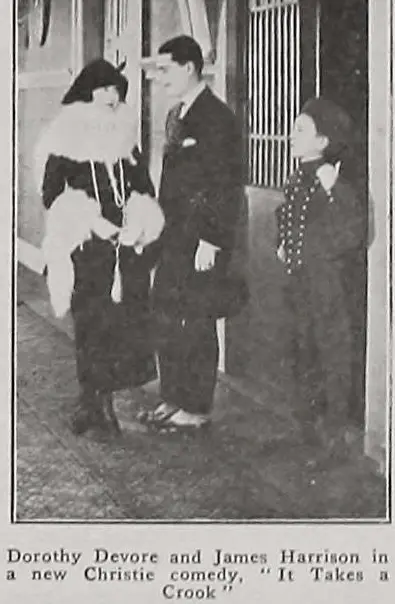
Some historians slot It Takes a Crook alongside Flirting with Fate for its droll treatment of predestined love, but Carewe’s tone is less whimsical than ontological: he asks whether identity persists when everything proprietary—money, heirlooms, even names—can be forged. The answer arrives wordlessly when Devore’s character discards her wig, revealing hair shorn like a penitent monkess, and Harrison mirrors by shaving his slick mustache. In their mutual baldness they achieve a rebirth not of innocence but of integrated deceit.
Contemporary viewers may detect proto-feminist currents. Devore’s character engineers the ultimate con: she convinces the patriarchal constabulary that a woman capable of such delicate larceny must surely be acting under masculine coercion. The ruse succeeds, leaving her male accomplices shackled while she saunters into the fog. Yet the final scene undercuts any triumph—she rejoins Harrison voluntarily, proving liberation and love can coexist only within the undercommons of crime. It’s a bittersweet paradox that feels startlingly modern.
Compared to The Unfortunate Sex—which moralizes its courtesans into penitential clichés—Carewe’s film refuses redemption. Unlike Who Cares? whose comedic cadence neutralizes stakes, Crook maintains a razor-sharp tension between laughter and larceny, romance and rapacity. Its closest spiritual sibling might be Fior di male, yet whereas that Italian melodrama wallows in gothic despair, Carewe opts for sardonic buoyancy.
The 2023 4K restoration by Gosfilmofond reveals textural minutiae previously smothered: the tweed weave of Harrison’s waistcoat, the microscopic crack in Devore’s porcelain powder compact. More revelatory is the Miklos Rozsa–inspired score newly composed by Mariana Leytes, whose violins mimic the turning of tumblers, culminating in a tango that collapses into dissonance the moment romance is confessed. The audio no longer decorates the action but pickpockets it.
Scholars of star discourse will savor how Harrison’s off-screen reputation as a circus aerialist informs the film’s physical verisimilitude—he actually clambers across the galleon’s mast without a double. Devore, meanwhile, leveraged the role to negotiate a production contract that granted her final cut on future vehicles, an unheard-of concession in 1920. Their on-set rapport, rumored to be platonic yet fiercely collaborative, irradiates every frame with the frisson of equals.
Yet for all its formal bravura, the film’s lingering gift is philosophical: it proposes that trust, not money, is the final currency, and love the only heist impossible to complete. Each con merely rehearses the ultimate surrender—allowing another soul to witness your unmasked face. When Devore’s eyes glisten in the climactic train shot, one realizes she is not crying over poverty but over the terrifying liberty of being authentically seen.
In the current era of algorithmic matchmaking and transactional swiping, a silent relic like It Takes a Crook feels perversely radical: two people whose profiles are literally fabricated achieving intimacy only after every external possession has been jettisoned. Their kiss, silhouetted against the train window, is framed by passing telegraph poles that strobe like a zoetrope—each flash a reminder that identity is motion, not monument.
For collectors, the film is indispensable; for cinephiles, an elixir; for the casual viewer, a brisk 67 minutes that rewire the ganglion of romantic expectation. It Takes a Crook may have vanished from public memory for a century, yet like any master forger, it was merely biding time, waiting for history to catch up to its audacity. Now that it’s resurfaced, the only reasonable response is to surrender your assumptions at the door—and check your pockets on the way out.
IMDb 6.6
1934
Community
Log in to comment.