DbcultAccessing Vault...
Cult Review
Senior Film Conservator
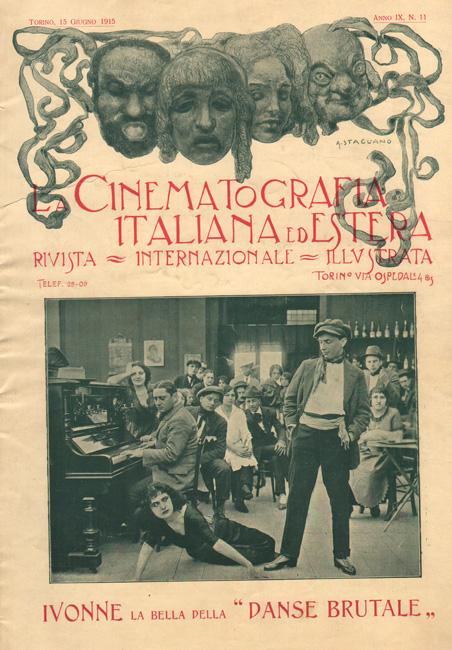
There are films that merely tell a story, and then there are cinematic experiences that etch themselves into the very fabric of one's consciousness, challenging perceptions and lingering long after the final frame flickers into darkness. Renzo Chiosso's 'Ivonne, la bella danzatrice' belongs firmly in the latter category, a silent era masterpiece that, even today, pulsates with an astonishing vivacity and an intellectual depth rarely matched. This isn't just a film; it's a profound treatise on identity, societal strictures, and the eternal, often agonizing, duality of the feminine spirit. To view it through a modern lens is to be transported to a time when cinema was raw, visceral, and utterly fearless in its ambition, particularly in its exploration of human nature.
At the heart of 'Ivonne, la bella danzatrice' lies the incandescent, almost mythological performance of Francesca Bertini. To simply call it 'acting' feels reductive; it is an embodiment, a possession. Bertini tackles the monumental task of portraying two diametrically opposed facets of womanhood with a breathtaking subtlety and power. On one hand, she is Ivonne, the 'beautiful dancer' of the tavern, a whirlwind of uninhibited passion and sensual defiance. Her movements are a language of their own, each gesture a provocative whisper, each turn a challenge to the rigid morality of the era. She is raw, vulgar by societal standards, yet undeniably authentic and intoxicatingly alive. Her Ivonne embodies a primal energy, a refusal to be tamed, a spirit that dances on the precipice of scandal and liberation. This portrayal resonates with the untamed spirit seen in films like The Pretty Sister of Jose, where passion often overrides societal expectations, but Bertini elevates it to an almost mythic degree.
Conversely, Bertini also embodies Countess Edith, an ethereal vision of aristocratic elegance, a creature sculpted by the most refined societal expectations. Edith is all grace, decorum, and delicate beauty, an 'angelic' presence whose every movement speaks of breeding and exquisite taste. She is the embodiment of the idealized woman, the one society places upon a pedestal, admired but perhaps never truly known. The genius of Bertini's performance lies not just in her ability to switch between these personas, but in her capacity to suggest the fragile, often painful, thread that connects them. The film, through her nuanced portrayal, argues that these are not merely two different women, but two sides of the same woman, a profound exploration of the internal conflict faced by women navigating a world that demands both wildness and restraint, passion and purity.
Renzo Chiosso's screenplay is a marvel of thematic construction. It doesn't merely present a binary; it intricately weaves a narrative that forces characters, and indeed the audience, to confront the uncomfortable truths about these dualities. The plot, while seemingly straightforward in its premise, becomes a complex psychological drama. We follow, for instance, a character (perhaps played by Alberto Albertini, whose earnest intensity is palpable, or Gustavo Serena, whose dramatic flair often anchored silent narratives) who is drawn into the orbit of both Ivonne and Edith. This individual serves as a proxy for the viewer, experiencing the intoxicating allure of Ivonne's raw vitality and the serene, almost unattainable perfection of Edith. The conflict isn't just external; it's an internal struggle within this character, reflecting society's own grapple with these opposing ideals. Carlo Benetti, often a presence of quiet strength or conflicted morality in his roles, would have brought a fascinating layer to such a character, embodying the societal man caught between two worlds.
The film's strength lies in its refusal to simplify. It doesn't explicitly demonize one side or unequivocally champion the other. Instead, it asks: what does it mean to be whole when society demands fragmentation? What is the cost of living authentically when authenticity is deemed 'vulgar'? This nuanced approach elevates 'Ivonne, la bella danzatrice' beyond a mere melodrama, positioning it as a significant piece of social commentary. It echoes the profound societal dilemmas explored in films like Down with Weapons, which, though dealing with war, also critiques the established order and its impact on individual lives. The narrative challenges the very notion of 'good' and 'bad' women, suggesting these labels are often constructs of a patriarchal society desperate to categorize and control.
The visual storytelling in 'Ivonne, la bella danzatrice' is nothing short of breathtaking. The cinematography, a testament to the artistry of the silent era, uses light and shadow to paint emotional landscapes. The tavern scenes, where Ivonne performs, are often bathed in a dramatic, almost expressionistic chiaroscuro, highlighting her fiery presence against the shadowy, anonymous faces of her admirers. These scenes are vibrant, kinetic, and imbued with a palpable sense of danger and excitement. In stark contrast, the sequences featuring Countess Edith are often softly lit, featuring elegant compositions and a serene, almost static beauty that reflects her refined, controlled existence. The use of elaborate costumes and opulent sets further underscores the class distinctions and the different 'stages' upon which these women perform their lives.
The performances, unburdened by dialogue, rely entirely on exaggerated yet deeply felt gestures, facial expressions, and body language. This demands a level of artistry from the actors that is often overlooked in modern cinema. Francesca Bertini, a true master of this craft, conveys entire paragraphs of emotion with a single glance or the subtle tremor of a hand. Her ability to shift from Ivonne's brazen confidence to Edith's demure vulnerability is a masterclass in silent film acting. The supporting cast, including the aforementioned Albertini, Benetti, and Serena, contribute significantly to this emotional tapestry, their reactions and interactions creating a rich, believable world. The film's emotional resonance is so potent that it transcends the decades, speaking directly to contemporary audiences about timeless struggles of identity and societal pressure, much like the enduring power of historical epics such as From the Manger to the Cross, which relies on visual grandeur and evocative performances.
'Ivonne, la bella danzatrice' stands as a testament to the sophistication and artistic ambition of Italian silent cinema. It's a film that dares to tackle complex psychological themes, rather than merely relying on spectacle or simplistic narratives. Renzo Chiosso, as the writer, crafted a story that was ahead of its time in its understanding of female psychology and societal critique. The film's exploration of the 'two sides of a woman' feels remarkably prescient, anticipating feminist discussions about the performativity of gender and the societal pressures that compartmentalize women's experiences. It invites viewers to question the artificial boundaries we create and the masks we wear, both voluntarily and involuntarily.
In an era where female roles were often relegated to caricatures of innocence or villainy, Ivonne and Edith, as embodied by Bertini, represent a more nuanced and challenging vision of womanhood. They are not simply good or bad; they are complex, flawed, and profoundly human. This complexity is what grants the film its lasting power and makes it a vital piece of cinematic history. It reminds us that the 'silent' era was anything but; it was a period of profound artistic expression, where stories were told with a visual eloquence that can still captivate and provoke thought today. Films like The Opened Shutters similarly explored hidden truths and societal facades, but 'Ivonne' goes deeper into the internal landscape.
The film's impact resonates far beyond its historical context. Its themes of authenticity versus societal expectation, the struggle for self-expression, and the inherent contradictions within human nature are universal. It prompts us to consider our own Ivonnes and Ediths, the different facets of our personalities that we present to the world, and the true self that often lies beneath. The societal gaze, ever scrutinizing, still forces many to adopt roles, to suppress parts of themselves deemed 'unacceptable.' In this regard, 'Ivonne, la bella danzatrice' remains remarkably current, a potent reminder that the battles for self-acceptance and genuine expression are ongoing.
For cinephiles and cultural historians alike, 'Ivonne, la bella danzatrice' is an essential viewing experience. It's a journey into the heart of early cinema, a testament to the power of a single actress, and a profound meditation on what it means to be a woman in a world of conflicting demands. Its narrative sophistication and visual artistry solidify its place not just as an important historical artifact, but as a living, breathing work of art that continues to speak volumes. Its exploration of internal conflict and societal pressure shares common ground with the more dramatic struggles depicted in Through Dante's Flames, albeit with a focus on the personal rather than the allegorical.
What truly distinguishes 'Ivonne, la bella danzatrice' is its courage to delve into the unspoken and the unseen. The film suggests that the 'vulgar' Ivonne might possess a deeper, more honest emotional core than the 'angelic' Edith, whose perfection could be a carefully constructed facade. This subversion of expectations is a hallmark of truly great storytelling. It forces us to question our preconceived notions of morality and beauty, urging us to look beyond superficial appearances. The sheer emotional weight carried by Bertini's performance, particularly in moments where the internal turmoil of her character is subtly revealed, is extraordinary. It's in these quiet, contemplative scenes, often devoid of grand gestures, that the film achieves its most profound impact. The film, in its own way, unravels secrets and exposes hidden lives, much like the thematic undercurrents found in Sealed Lips, but here the 'secrets' are internal, psychological.
The societal critique embedded within the narrative is also noteworthy. The film subtly highlights the hypocrisy of a society that simultaneously craves the raw passion embodied by Ivonne (as evidenced by the tavern's patrons) yet condemns it, while simultaneously revering the unattainable purity of Edith. This double standard creates an impossible bind for women, forcing them into a constant performance of self. The film implicitly asks: is there truly a space for a woman to be whole, to integrate her passion with her grace, without fear of judgment? The exploration of class and social expectations, particularly through the stark contrast between Ivonne's world and Edith's, also adds a rich layer of sociological insight, reminiscent of the intricate social tapestries woven in films like Princess Romanoff or The Ragged Earl, where status and reputation are everything.
In conclusion, 'Ivonne, la bella danzatrice' is more than just a historical curiosity; it's a vibrant, emotionally charged work of art that transcends its era. It's a testament to the profound capabilities of silent cinema to communicate complex ideas and emotions with astonishing clarity and power. Francesca Bertini's dual performance remains a towering achievement, a masterclass in screen acting that deserves to be celebrated and studied. Renzo Chiosso's insightful writing provides the intellectual backbone, while the visual storytelling creates an immersive, unforgettable experience. This film is a powerful reminder that the greatest stories are often those that hold a mirror up to our own internal conflicts and the societal forces that shape us. It’s a film that demands to be seen, discussed, and cherished, ensuring its rightful place in the pantheon of world cinema. It navigates complex moral terrains and diverging paths, much like the thematic journey in Where the Trail Divides, but with a uniquely feminine perspective on the choices presented.
IMDb —
1922
Community
Log in to comment.