DbcultAccessing Vault...
Cult Review
Senior Film Conservator
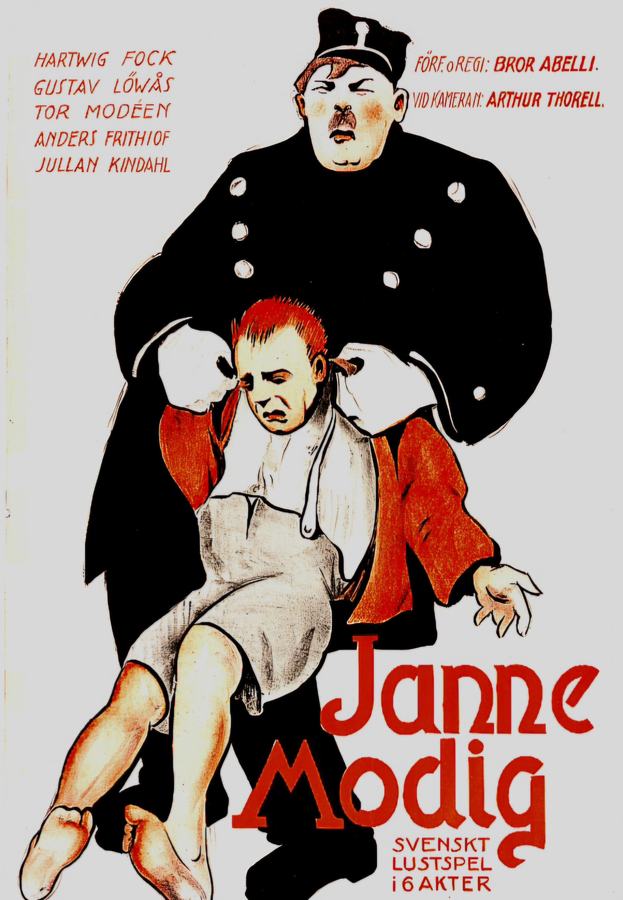
Janne Modig, a 1953 Swedish cinematic gem, offers a vivid portrait of adolescent rebellion and the timeless allure of childhood camaraderie. Directed with a deft hand by Bror Abelli, this film transcends its era, resonating with audiences who cherish the delicate interplay between innocence and the burgeoning complexities of growing up. Set in the quaint village of Småbacka, the story centers on its titular hero, a precocious youth whose mischievous streak borders on the anarchic, yet never strays into moral ambiguity. Thor Modéen breathes life into Janne with a performance that oscillates between the guilelessness of a prankster and the burgeoning awareness of a young soul grappling with societal norms.
Janne’s closest ally, Nisse, portrayed with a quiet intensity by Hartwig Fock, serves as the perfect foil—a loyal companion whose pragmatism tempers Janne’s impulsive daring. Together, they orchestrate a series of pranks and escapades that, while trivial on the surface, reveal deeper layers of social critique. The film’s narrative is punctuated by moments of profound simplicity: a stolen bicycle, a mischievous graffiti campaign, or a daring heist to uncover a hidden treasure. Each episode is rendered with meticulous attention to detail, capturing the textures of rural Swedish life, from the creak of wooden fences to the hush of snowfall.
What elevates Janne Modig beyond a mere string of comedic set pieces is its nuanced exploration of morality. Unlike the amoral tricksters of Hamlet’s brooding nihilism or the scheming antagonists of The Impossible Mrs. Bellew, Janne’s transgressions are rooted in a desire for autonomy. His actions, while disruptive, are never malicious; they are a child’s rebellion against the stifling predictability of adult life. The film’s moral compass is subtle yet unwavering—it does not condemn Janne but rather celebrates his audacity to question authority and carve his own path.
The supporting cast, including the formidable Gullan Ehrenmark as Janne’s long-suffering mother and Gideon Wahlberg as the bemused local constable, adds depth to the film’s social fabric. Their presence underscores the tension between the protagonists’ youthful exuberance and the rigid expectations of their community. The villagers themselves are rendered with a blend of caricature and realism, their reactions oscillating between exasperation and grudging admiration for the duo’s exploits.
Visually, the film is a study in restraint. Abelli’s direction favors long, unbroken takes that allow the natural landscapes of Småbacka to breathe, creating a sense of timelessness. The cinematography, though modest by modern standards, captures the interplay of light and shadow with a painterly grace, particularly in scenes where the boys navigate the forest or the village square at dusk. The soundtrack, a mix of folk melodies and ambient natural sounds, further immerses the viewer in this bygone world.
Comparisons to other Swedish films of the period, such as A Fly in the Ointment, are inevitable. Both films share a preoccupation with the duality of childhood innocence and the shadow of adult responsibilities. However, Janne Modig distinguishes itself through its focus on the male friendship dynamic, a theme also explored in The Western Musketeer, though with far less grandeur. The bond between Janne and Nisse is the film’s emotional core, a relationship built on mutual trust and an unspoken understanding of each other’s strengths and weaknesses.
One of the film’s most compelling aspects is its historical context. Shot during the early years of Sweden’s post-war economic boom, Janne Modig subtly reflects the societal shifts of the time. The protagonists’ defiance of traditional authority figures mirrors a broader cultural movement towards individualism and questioning of established norms. Yet, the film never explicitly comments on these themes; instead, it allows the characters’ actions to speak for themselves, a testament to Abelli’s skill in crafting subtext.
The film’s pacing is brisk, with each episode escalating in complexity until the climax—a grand heist that sees Janne and Nisse attempting to outwit the entire village. This sequence is a masterclass in comedic timing, blending physical humor with clever dialogue. The resolution, while predictable, is satisfyingly cathartic, leaving the audience with a warm sense of nostalgia for an era when mischief was seen as a rite of passage rather than a path to delinquency.
In terms of legacy, Janne Modig occupies a unique space in Swedish cinema. It is neither a highbrow art film nor a slapstick comedy, but something in between—a genre-defying work that has influenced countless filmmakers. Its influence can be seen in later coming-of-age films like That Sort, though those works often lack Janne’s unpretentious charm. For modern audiences, the film may require a suspension of disbelief regarding its historical setting, but its universal themes of friendship, rebellion, and self-discovery remain timeless.
Critics of the film often point to its lack of narrative depth, arguing that the episodic structure prevents it from achieving the emotional resonance of more ambitious projects. While this is a valid critique, it overlooks the film’s primary strength: its ability to capture the fleeting joy of childhood without overindulging in sentimentality. Every scene is infused with a sense of immediacy, a reminder of the simplicity and purity of youthful adventures.
In conclusion, Janne Modig is more than just a charming relic of 1950s cinema. It is a carefully crafted narrative that celebrates the indomitable spirit of youth while offering a gentle critique of the societal structures that seek to constrain it. For those who grew up with Swedish cinema, it is a touchstone of cultural memory; for newcomers, it is an invitation to experience the magic of a world where every day is an opportunity for mischief and every challenge a chance to grow. The film’s enduring appeal lies in its ability to make us believe, even for a brief moment, in the possibility of a world where innocence and audacity coexist without compromise.
IMDb 6
1931
Community
Log in to comment.