DbcultAccessing Vault...
Cult Review
Senior Film Conservator
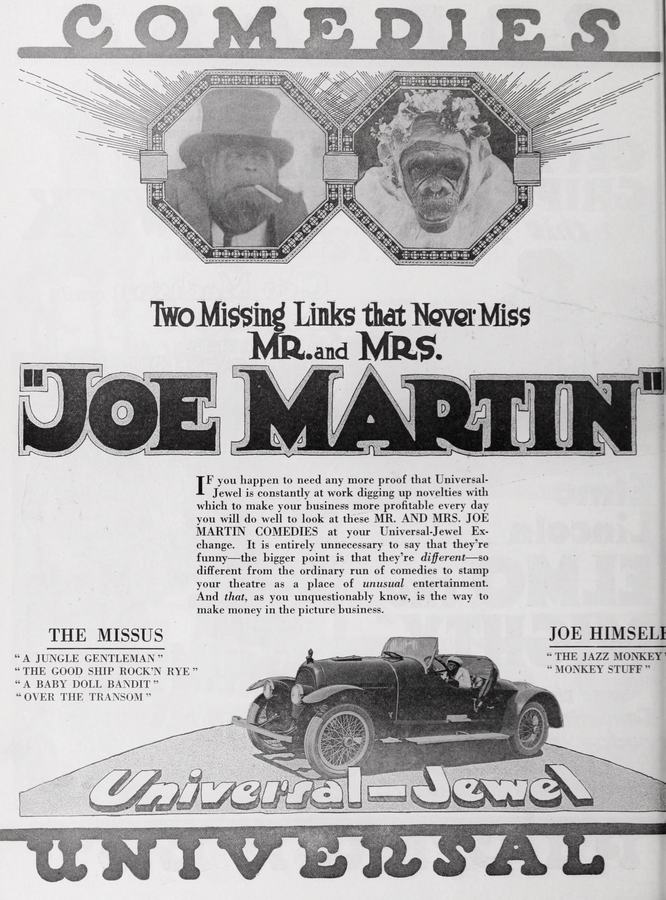
To witness Jazz Monkey is to step into a temporal rift where the emerging chaos of the 1920s is filtered through the lens of pure, unadulterated simian energy. Released in 1919, a year defined by the world’s desperate attempt to reconstruct itself after the Great War, William Campbell’s short film offers something far more subversive than mere animal husbandry on screen. It presents a world where the rigid structures of Victorian morality are beginning to dissolve into the frantic, syncopated rhythms of the Jazz Age. While many contemporary critics might dismiss this as a simple novelty, a closer inspection reveals a fascinating interplay between the primitive and the sophisticated.
The film doesn't rely on the heavy-handed moralizing found in The Price Woman Pays. Instead, it finds its voice in the wordless, physical eloquence of its stars. There is a certain audacity in Campbell’s decision to place the narrative weight entirely on the shoulders of Joe Martin. This isn't just a monkey doing tricks; it is a performance that demands we recognize the human-like anxieties and joys within the primate form. The kinetic energy of the piece mirrors the burgeoning urbanization of the era, a chaotic dance that feels both terrifying and exhilarating.
Joe Martin was no ordinary performer. In the pantheon of silent-era stars, he occupied a space that was simultaneously peripheral and essential. His ability to mimic human social graces—and more importantly, human social failures—is what gives Jazz Monkey its lasting bite. When we watch him navigate the props and sets of a human environment, we aren't just seeing a trained animal; we are seeing a caricature of ourselves. This is a far cry from the gritty, grounded realism of The Bruiser, which deals in the raw physicality of human combat. Joe Martin’s physicality is of a different sort—it is a deconstruction of human dignity.
The chemistry between Joe and Mrs. Joe Martin provides a domestic framework that is surprisingly nuanced. Their interactions, though ostensibly played for laughs, carry a weight of familiarity that borders on the unsettling. It’s as if Campbell is suggesting that the domestic bliss sought in films like Somebody's Baby is just as performative and instinct-driven as the antics of these primates. The boundary between the 'civilized' viewer and the 'wild' performer begins to blur, creating a viewing experience that is as much about self-reflection as it is about entertainment.
Writing for a non-human cast requires a specific kind of architectural thinking. William Campbell, the architect of this specific madness, understands that the 'plot' of Jazz Monkey must be secondary to the visual rhythm. Unlike the complex social tapestries woven in Society's Driftwood, Campbell’s script is a series of escalating provocations. He places his actors in situations that highlight the absurdity of modern life—the clothes, the furniture, the social expectations—and lets the inherent nature of the primates tear those structures down.
There is a rhythmic quality to the editing that feels almost musical, justifying the 'Jazz' in the title long before the genre had fully colonized the American psyche. The cuts are sharp, capturing the darting eyes and sudden movements of Joe Martin with a precision that predates the more celebrated montage techniques of the 1920s. While films like A Man's Making focus on the linear progression of character, Jazz Monkey is circular, looping back on its own absurdity until the viewer is left questioning the very necessity of human narrative.
To understand the impact of Jazz Monkey, one must look at the broader landscape of 1910s cinema. In a year where audiences were being moved by the spiritual weight of The Sign Invisible, Campbell’s work provided a necessary release valve. It was the antithesis of the 'high art' that sought to elevate the soul. Instead, it sought to ground the viewer in the visceral reality of the body. There is no divine intervention here, only the chaotic intervention of a monkey in a tuxedo.
When compared to the lighthearted domesticity of Bab the Fixer, Jazz Monkey feels almost avant-garde. It doesn't try to 'fix' anything; it revels in the breaking of things. There is a destructive joy in seeing the meticulously curated sets of the silent era being upended by a force that doesn't respect the fourth wall or the social contract. It shares a certain kinship with A Night Out, capturing that sense of revelry that borders on the catastrophic, yet it does so with a cast that is entirely unburdened by the ego of the human actor.
Visually, the film is a masterclass in the use of high-contrast lighting and cramped interior spaces. The set design is deliberately ornate, providing a stark contrast to the fluid, unpredictable movements of Joe and Mrs. Joe Martin. This visual tension is what keeps the film from descending into mere slapstick. There is a palpable sense of danger—not physical danger, but the danger of the unpredictable. This is a quality often missing from the more rigid melodramas like The Test of Honor.
The camera work remains relatively static, allowing the action to unfold within the frame like a theatrical performance. However, the internal movement within that frame is dizzying. The juxtaposition of the monkeys' natural agility with the stiff, formal costumes they are forced to wear is a visual metaphor for the human condition itself. We are all, Campbell seems to say, just monkeys in suits, trying to navigate a world of our own making that we don't quite understand. It is a theme that resonates even more strongly when viewed alongside the social critiques of Salt of the Earth.
The technical achievements of Jazz Monkey are often overlooked because of its subject matter. However, the coordination required to capture these performances on the crank-operated cameras of the day is nothing short of miraculous. There is no room for 'method acting' here; it is a triumph of patience and observation. Campbell’s direction is invisible yet omnipresent, guiding the chaos into a form that is digestible for the audience while retaining its wild edge.
In contrast to the sweeping vistas of The Secret of the Storm Country, Jazz Monkey is an exercise in claustrophobia. The smallness of the world makes the monkeys' actions feel larger, more consequential. Every knocked-over vase or shredded curtain feels like a monumental act of rebellion against the status quo. It is this focus on the 'small' that allows the film to achieve a level of intimacy that larger productions often sacrifice for spectacle.
We cannot ignore the cultural context in which Jazz Monkey was birthed. The film arrived at a time when the world was pivoting away from the Victorian 'primrose path'—the very path explored in The Primrose Path—and toward a more cynical, hedonistic future. The monkey, with its lack of inhibition and its mockery of human ritual, became a perfect mascot for this transition. It represented the 'id' of a society that had seen the horrors of war and was ready to embrace the absurdity of existence.
Even international comparisons like Die Claudi vom Geiserhof or the Russian intensity of V Lapah Zheltago Dyavola highlight how unique the American 'simian comedy' was. While European cinema was often grappling with folklore or the 'Yellow Devil' of capitalism, American cinema was using Joe Martin to poke fun at the very idea of 'civilized' behavior. It was a form of self-deprecation that was uniquely tied to the American spirit of the time—a spirit that was both optimistic and deeply skeptical.
As we look back on Jazz Monkey from the vantage point of the 21st century, it is easy to get caught up in the ethical questions of animal performance. However, to do so without acknowledging the artistry involved is to do a disservice to the history of the medium. Joe Martin was a star in every sense of the word, possessing a screen presence that many of his human contemporaries envied. His work in this film, and others like it, paved the way for the complex creature effects and performance capture we see today.
Ultimately, Jazz Monkey stands as a testament to the versatility of silent cinema. It reminds us that film has always been a medium of the body—of movement, of gesture, and of the visceral connection between the viewer and the viewed. Whether it is the high-stakes moral drama of One Law for Both or the simian antics of Joe Martin, the goal remains the same: to capture a truth about the experience of being alive. In Jazz Monkey, that truth just happens to be covered in fur and wearing a tiny hat.
In the grand tapestry of 1919, where films were often trying too hard to be 'important,' Jazz Monkey was content to be honest. It was honest about our instincts, our follies, and our inherent desire to just break something and dance. It is a jazz-age fever dream that continues to resonate, a reminder that before we were poets, before we were soldiers, and before we were 'civilized' men and women, we were all just monkeys trying to make sense of the rhythm.
IMDb 6.8
1931
Community
Log in to comment.