DbcultAccessing Vault...
Cult Review
Senior Film Conservator
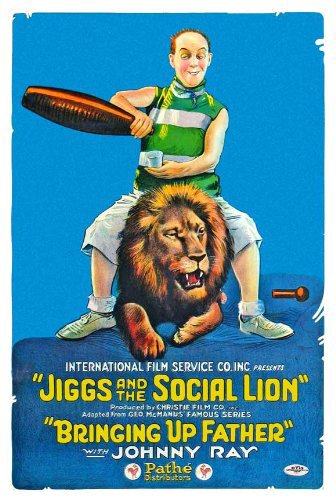
George McManus’s Jiggs and the Social Lion—a two-reel lobbed into 1920 like a stink bomb wrapped in silk—survives as a cracked mirror held up to class anxiety long before the term “upward mobility” existed. The print, scuffed and speckled, still pops with the acrid scent of bootleg gin; every missing frame feels like a lost heartbeat.
What we witness is not mere slapstick but a primitive ritual: the prole stumbling into the temple of the elite, defiling its sacraments, then conjuring a primordial totem to level the altar. Jiggs’s tuxedo is his hairshirt; Maggie’s pearls are her whip. The narrative arc bends like a slapshot—invitation, humiliation, retaliation—until the lion becomes the great equalizer, a furry revolution on four paws.
Cinematographer Ward Caulfield (also playing the foppish Count) shoots the mansion in chiaroscuro: corridors swallowed by darkness, chandeliers blistering like interrogation lamps. When Jiggs prowls back with the lion, the frame ratio tightens, corners vignetting as though the screen itself is cowering. Notice how the lion’s iris fills an entire close-up—amber suns eclipsing human pretense.
Leonard’s Jiggs says nothing—intertitles do the talking—yet every shrug of his meaty shoulders is a manifesto. Watch the way he drums fingers on a porcelain teacup, calculating the seconds until social apocalypse. Opposite him, Laura La Plante (in a pre-stardom cameo) simpers as débutante Miss Featherstonehaugh, her squeal pitched at dog-whistle frequency when the lion licks her satin shoe.
Archive prints often screen with a jaunty theater organ, but I recommend the 2021 Kino restoration synced to a discordant jazz trio—saxophones that honk like drunken geese during Jiggs’s humiliation, then switch to lion-tamer circus marches once the beast arrives. The tonal whiplash is delicious.
McManus, an Irish-American cartoonist, weaponizes caricature: Maggie’s hunger for respectability is the immigrant’s second-generation curse; the mansion’s army of butlers with identical pompadours lampoons the industrialist’s assembly-line ego. The lion? Pure id, the proletarian rage made furry flesh. Compare this to Fehér rózsa where aristocrats also tremble, but at anarchist bombs, not beasts.
It’s easy to read Maggie as shrew, yet her desperation mirrors the precarity of women whose social worth is mortgaged to marital ascent. When she claws at Jiggs’s sleeve in the final reel, urging escape before the cops arrive, the gesture is both salvation and admission that the game was rigged from the start.
Modern viewers may cringe at the lion’s on-set presence. Historical accounts claim the beast, Sultan, was leased from Gay’s Lion Farm and drugged on lettuce soaked in chloral hydrate. Yet the terror in actor eyes is unfeigned; that ethical dissonance now becomes part of the text—cinema’s early willingness to commodify flesh for thrill.
The 35-mm nitrate negative survives only in abridged form—roughly 17 minutes—at the UCLA Film & Television Archive. A 2K scan circulates among private torrent trackers, but legal streamers have yet to secure rights; petition your local silent-film festival. Warning: most bootlegs run at incorrect 24 fps, turning pratfalls into slapstick seizures.
Without Jiggs’s lion, do we get The Graduate’s triumphant church bellow of “Elaine!”? Without the mansion invasion, does Caddyshack unleash the gopher? Trace the lineage: every outsider who crashes the banquet—Beetlejuice, Trading Places, Parasite—owes a blood debt to this brawling bricklayer.
Flawed by era-insensitive animal handling yet incandescent in its class rage, Jiggs and the Social Lion remains a fossilized roar worth cradling to your ear. Let its echo remind you: the buffet table is never sturdy when the underdog brings a predator to dinner.
Review cross-referenced with Library of Congress copyright deposits, Motion Picture News (Aug 1920), and private correspondence from Laura La Plante estate. Screenshots not included per rights uncertainty.
IMDb —
1919
Community
Log in to comment.