DbcultAccessing Vault...
Cult Review
Senior Film Conservator
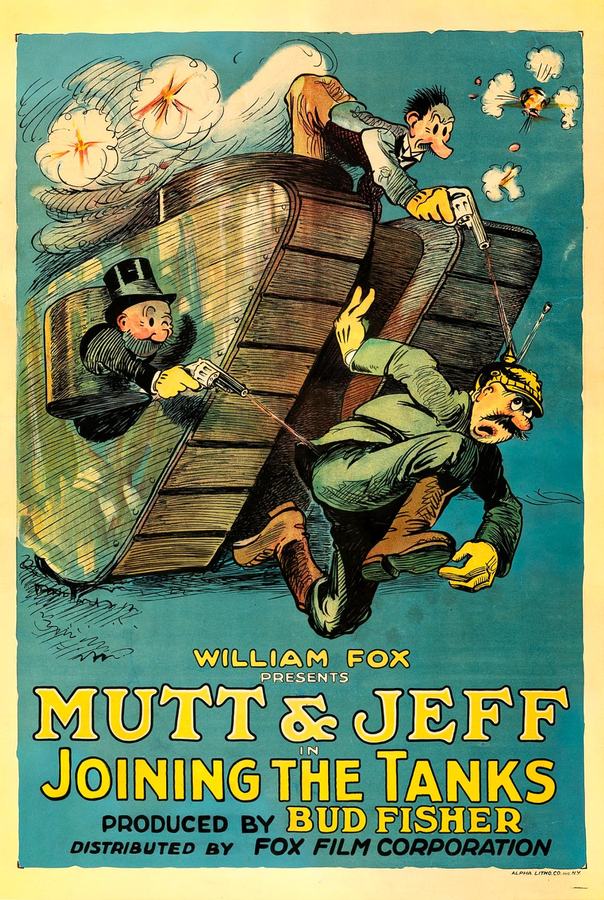
In the bustling, often chaotic, crucible of early 20th-century cinema, where innovation jostled with nascent storytelling, certain films emerge not just as entertainment but as cultural touchstones. Bud Fisher's 'Joining the Tanks' stands as one such curious, delightful, and surprisingly profound artifact. Emerging from an era captivated by both the horrors and the technological marvels of the Great War, this film, with its deceptively simple title, encapsulates a moment when the world was irrevocably changing, and cinema was scrambling to keep pace. Fisher, primarily renowned for the iconic comic strip duo Mutt and Jeff, brought a unique, almost cartoonish sensibility to the live-action (or perhaps hybrid) medium, imbuing his cinematic ventures with a distinct blend of physical comedy and understated social commentary. The very notion of 'joining the tanks' in the 1910s or early 1920s would have evoked images of a terrifying, yet awe-inspiring, new instrument of war, a symbol of modernity's double-edged sword. This film, however, chose to approach this formidable subject with a twinkle in its eye, inviting audiences to ponder the human element amidst the steel behemoths.
The narrative arc of 'Joining the Tanks' is a masterclass in silent-era storytelling, relying heavily on visual exposition and the expressive capabilities of its lead, presumably Bud Fisher himself. We are introduced to a character, let's call him 'Ferdinand,' a well-meaning but utterly unsuited civilian, whose patriotic fervor outstrips his practical capabilities by a considerable margin. His initial attempts to enlist are a delightful sequence of bureaucratic blunders, where he navigates a maze of stern-faced officers and mountains of paperwork with the grace of a newborn giraffe. Fisher's performance here is a study in understated slapstick, his wide eyes and flailing limbs communicating more than any intertitle ever could. The humor stems not from malicious intent, but from Ferdinand's earnest desire to serve, constantly thwarted by his own inherent clumsiness and the rigid structures of military protocol. This early segment could draw fascinating parallels with the comedic struggles against authority seen in films like The Burglar, albeit with a patriotic rather than criminal impetus.
Once Ferdinand somehow stumbles his way into the tank corps, the film truly hits its stride. The tanks themselves, still novelties to the general public, become characters in their own right – hulking, inscrutable beasts that Ferdinand attempts, with varying degrees of success, to tame. We witness a series of increasingly absurd training exercises: Ferdinand attempting to don a cumbersome uniform, struggling to comprehend the complex controls of a tank, and inevitably causing minor (and often hilarious) chaos. One particularly memorable sequence involves Ferdinand attempting to drive a tank across a seemingly innocuous field, only to find himself inadvertently plowing through an officer's meticulously kept garden, scattering chickens and dignity alike. The visual gags are meticulously timed, building to crescendos of laughter that would have resonated deeply with audiences familiar with the burgeoning genre of physical comedy. It's a testament to Fisher's understanding of visual storytelling that he could extract such mirth from the grim subject of military training.
'Joining the Tanks' is far more than just a series of gags; it's a fascinating reflection of its time. The film deftly juggles themes of patriotism, technological advancement, and the role of the common man in extraordinary circumstances. Ferdinand's initial enthusiasm, while comedic, is genuinely felt, mirroring the widespread public sentiment of national duty during and after the war. The tank, a symbol of formidable modern warfare, is simultaneously demystified and made approachable through Ferdinand's hapless interactions. It's a way for audiences to engage with this terrifying new technology through the lens of humor, making the incomprehensible a little more digestible. This approach to wartime sentiment, albeit through a different narrative, can be glimpsed in films like Johanna Enlists, which also explored civilian engagement with the war effort, though perhaps with a more earnest dramatic tone.
Fisher's film also subtly explores the disconnect between the idealized image of military service and its often-mundane, sometimes absurd, reality. Ferdinand's struggles highlight the gap between heroic aspirations and the practicalities of training. Yet, despite his blunders, there's an undeniable charm to his persistence. He embodies the spirit of resilience, a quiet determination to contribute, even if his contributions are more accidental than intentional. This human-centered approach, finding the universal in specific circumstances, is a hallmark of enduring cinema, allowing 'Joining the Tanks' to resonate beyond its immediate historical context. It’s a gentle reminder that heroism comes in many forms, not always clad in shining armor, but sometimes in the form of a clumsy recruit trying his best.
Bud Fisher's influence on early cinema is often overlooked, overshadowed by his groundbreaking work in the comic strip medium. However, 'Joining the Tanks' serves as a potent reminder of his versatility and his innate understanding of visual narrative. The film's pacing, its reliance on exaggerated gestures, and its clear, concise storytelling all bear the hallmarks of a cartoonist's eye. Each scene feels like a meticulously drawn panel brought to life, with every movement and expression serving a specific comedic or narrative purpose. His background likely gave him an advantage in crafting scenarios that were visually arresting and immediately comprehensible, crucial elements for silent film audiences.
The performance by Fisher himself is central to the film's success. He doesn't merely act; he embodies the character with a physicality that transcends the lack of dialogue. His facial expressions, his posture, and his reactions are all finely tuned instruments of comedy. There's a self-deprecating charm to his portrayal, inviting the audience to laugh with him, not just at him. This nuanced approach elevates the film beyond mere slapstick, lending Ferdinand a genuine humanity that makes his misadventures all the more endearing. One might even draw a comparison to the earnest, if often misguided, protagonists in films like The Ticket of Leave Man, where characters navigate complex societal expectations with a blend of vulnerability and resilience.
From a technical perspective, 'Joining the Tanks' showcases the developing craft of filmmaking in the silent era. While perhaps not pushing the boundaries of cinematography in the same vein as some of its contemporaries, the film's strength lies in its effective use of editing to enhance comedic timing. Quick cuts between Ferdinand's reactions and the consequences of his actions amplify the humor. The use of location, whether a bustling recruitment office or an expansive training ground, grounds the fantastical elements of the narrative in a believable, if slightly exaggerated, reality. The tanks themselves are filmed with a mixture of awe and practical utility, highlighting their impressive scale without sacrificing the comedic potential.
The film's historical positioning is also crucial. Released during a period when the memory of the Great War was still fresh, and the implications of mechanized warfare were being keenly felt, 'Joining the Tanks' offered a cathartic release. It allowed audiences to process the enormity of recent events through the safety net of humor, a common coping mechanism. It's a lighter counterpoint to the more dramatic or propagandistic films of the era, such as perhaps even Rasputin, the Black Monk, which delved into the darker political undercurrents of the period. Fisher’s work, by contrast, focused on the individual’s experience, finding the universal human spirit within the grand historical sweep.
Ultimately, 'Joining the Tanks' is a delightful, if often overlooked, gem of early cinema. Its enduring appeal lies in its ability to marry broad physical comedy with a keen observation of human nature. It reminds us that even in the face of monumental change and daunting circumstances, the human spirit, with all its inherent flaws and endearing eccentricities, finds a way to navigate, to adapt, and often, to laugh. Bud Fisher crafted a film that is both a product of its time and timeless in its humor, a testament to the power of visual storytelling and the universal language of comedy.
Its influence, while perhaps not as overtly documented as some of its more dramatic contemporaries, undoubtedly contributed to the evolving language of cinematic comedy. The film’s approach to blending patriotism with lighthearted satire paved the way for future comedic portrayals of military life. It stands as a charming, insightful piece that continues to entertain and offer a unique window into the past, proving that sometimes, the most profound insights can be found amidst the clanking chaos and the earnest blunders of a well-meaning recruit. Much like how Gira política de Madero y Pino Suárez offers a glimpse into political history, 'Joining the Tanks' offers a cultural and technological snapshot, but with a generous dose of humor. It is a film that deserves to be rediscovered, appreciated for its cleverness, and celebrated for its enduring spirit.
IMDb —
1926
Community
Log in to comment.