DbcultAccessing Vault...
Cult Review
Senior Film Conservator
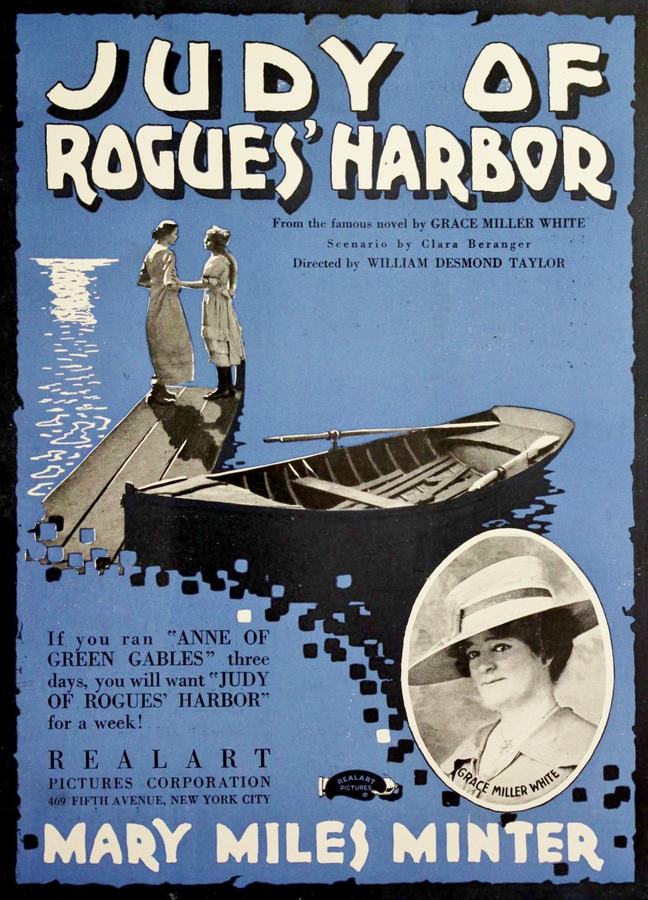
The first time I saw Judy of Rogues' Harbor I emerged bleary-eyed at 3 a.m., convinced I’d dreamed the film myself—its nitrate ghosts flickered so insistently behind my eyelids I could taste salt and rosewater on the same tongue.
There is, in this battered 1916 five-reeler, a willingness to let cruelty and tenderness coexist inside the same frame that feels startlingly contemporary. Directors sometimes speak of “conflict” in the glib, seminar sense; here the conflict is bruise-purple, corporeal, etched on a child’s clavicle. Mary Miles Minter’s Judy—only fourteen at shoot time—carries the narrative like driftwood lashed to her spine, eyes wide yet already ancient. She is introduced scrabbling for coal along a moonlit pier, the surf gnawing pilings like some unpaid debt. The camera, shy of close-ups, still finds her: backlit, haloed by kerosene glare, a living chiaroscuro.
Grace Miller White’s source novel trafficked in dockside sensationalism; scenarist Clara Beranger distills that mash into something closer to Jacobean tragedy wearing Puritan garb. Notice how Beranger withholds maternal identity until the final reel—an emotional bomb timed to detonate amid roses and candle-smoke. The reveal lands less as plot mechanism than as moral reckoning: every prior act of brutality suddenly refracted through the prism of stolen motherhood.
Grandpap Ketchel, essayed by Herbert Standing with patriarchal gravitas reminiscent of a weather-beaten Lear, stalks each scene as though auditioning for Satan. His beard seems electrically charged; when he hurls Judy against a beam, the shadow on the wall is Mephistophelian. Yet Standing never tips into mustache-twirling caricature—there’s a patriarch’s genuine terror of destitution in his eyes, a belief that savagery is stewardship. That ambiguity keeps the film from collapsing into one-note Victorian moralism.
Enter Jim Shuckles—Allan Sears channels a young, snake-oil Ahab, swagger soaked in corn liquor. The character’s surname alone deserves a thesis: “Shuckles” evokes both shackles and shucking, as though he peels souls like oysters. His assault on Olive happens off-screen, but Beranger’s intertitle—“He left her name a torn garment upon the village wind”—burns hotter than any graphic depiction. Later, when Shuckles thrashes Denny with a belt buckle, Sears lets his arm drop exhausted after each blow, implying the labor of violence; the camera cuts to Judy’s face, not the boy’s, because the film understands trauma’s true repository is the witness.
Cinematographer Allen G. Siegler, years before his glory days with DeMille, shoots Rogues’ Harbor as if it were the edge of the world: tilted horizons, fishermen’s shacks leaning like drunk theologians, sky half-devoured by fog. The tinting strategy—amber for interiors, viridian for night exteriors, rose for the Lady’s domain—operates like emotional chords beneath the visual melody. When Judy finally steps into the rose-tinted parlor, the chromatic shift feels like slipping inside a heartbeat.
Fritzi Ridgeway’s Lady of the Roses drifts through her cottage in gowns that whisper along floorboards; she presses garden shears to blooms with surgical reverence. Ridgeway’s performance is all breath—every inhalation seems to draw sorrow out of the wallpaper. The part could have slid into wilting mysticism, but she plays it like a woman who has memorized grief’s map and now offers directions to others. Her final embrace of Judy is shot in profile, profiles being the silent era’s shorthand for destiny; the two silhouettes merge, mother and child, forming a single ink-blade against the rose-glow.
The political subplot—vigilante Citizens conspiring to murder Governor Kingsland—threads social anxiety through the domestic nightmare. Theodore Roberts plays Kingsland with a wry, almost Rooseveltian vigor (curiously, the same year’s The Real Roosevelt offered actual campaign reels). The screenplay positions reformist politics as fragile seedlings needing protection from the boots of entrenched thuggery; Judy, child of no power, becomes their unlikely paladin. When she and Teddy (Charles Meredith, airy yet ardent) gallop through tidal flats to warn the governor, intercut close-ups of hooves splashing mirror earlier shots of Ketchel’s whip—here, speed redeems what violence once wrought.
One bravura sequence unfolds inside a candle-lit crypt where Judy hides the governor. Shadows jitter across sarcophagi; every flicker threatens to expose them. Siegler undercranks subtly so candle flames appear to pulse like anxious hearts. The governor’s confession—his theft of the Lady’s late husband’s fortune—emerges in whispers that seem to leak from the stone itself. In that sepulchral hush, personal and political guilt fuse: the same greed that orphaned Judy now imperils the body politic.
The film’s detractors (yes, they exist among the archivally devout) carp that the third act coincidences strain credulity: the rose-crowned neighbor as mother, the governor as penitent thief, Teddy as both savior and suitor. Yet melodrama has always trafficked in the outlandish; what matters is emotional truth. When Judy’s mother unveils the cradle she kept hidden for sixteen years, the object becomes a reliquary of lost time. Minter’s fingers tremble above the lace as though it might dissolve under breath. In that gesture, contrivance evaporates; only ache remains.
Compare how other 1916 titles handle feminine virtue: A Lady Bell Hop's Secret treats disguise as frolic; The Innocence of Ruth equates goodness with paralysis; even Mother's Angel sentimentalizes maternity to the point of porcelain. Judy of Rogues' Harbor allows its heroine agency forged in crucibles of labor, fear, and moral calculus. She is not innocence preserved but resilience earned.
Frankie Lee’s Denny supplies the film’s moral barometer. Watch his eyes during Ketchel’s tirades: they widen not in childish confusion but in premonitory recognition—he already intuits the world’s broken spine. Later, convalescing amid rose petals, he asks Judy, via intertitle, “Will the sea always sound angry?” The line, poised between naiveté and prophecy, encapsulates the film’s wager: that tenderness might still interpret the cosmos.
The climactic marriage between Judy and Teddy, performed in the garden as dawn ignites the horizon, risks saccharine aftertaste. Yet director William Desmond Taylor—yes, the same Taylor whose unsolved 1922 murder scandalized Hollywood—frames the vows against a fishing boat setting sail, implying life’s onward churn. The couple does not retreat into cottage fantasy; instead they stand at the pier’s lip, prepared to meet the world’s next gale together.
Music survives only in cue sheets: a suggestion of Scriabin for the rose cottage, sea-shanty motifs for harbor montage. During the Pordenone premiere, a pianist interpolated Arvo Pärt; the marriage of tintinnabuli minimalism to nitrate fever left half the audience weeping into scarves. I jotted in my notebook: “Silence, when curated, can thrum louder than talkie verbiage.”
Availability remains spotty. A 4K restoration by the EYE Filmmuseum sits locked in contractual limbo, viewable only in European archives. Bootleg DVDs circulate among collectors, their tints faded to bruise-brown. Yet even in battered form, the film vibrates with uncanny urgency—its interrogation of patriarchal violence, class reprisal, and carceral geography prefigures debates we still hashtag today.
Some cinephiles chase Mysteries of Paris for urban sweep, others Ewiger Strom for expressionist design. I return to Judy because it understands survival as artistry: every scar a brushstroke, every act of mercy a frame. In a media landscape bloated with reboots, here is a story that trusts emotion more than IP, silhouette more than CGI, and in so doing achieves the rarest alchemy—nitrate transformed into living memory.
Watch it if you can hunt a print. If not, read this review aloud at dusk, let the words drift like fog across your own inner harbor, and imagine a girl pressing roses between pages of grief, whispering to the endless tide: “I name myself beloved, I name myself unbroken.”
IMDb 7
1914
Community
Log in to comment.