DbcultAccessing Vault...
4.4/10
Senior Film Conservator
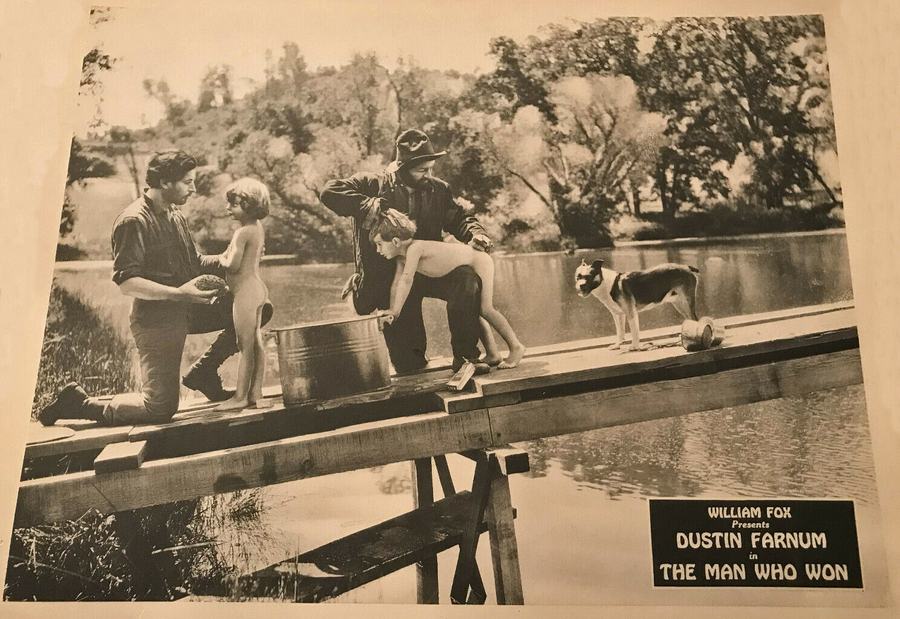
A definitive 4.4/10 rating for a film that redefined the boundaries of cult cinema. The Man Who Won remains a cornerstone of transgressive art.
There is a specific, haunting quality to the 1923 silent era that often escapes modern retrospectives. The Man Who Won, directed with a steady, unblinking eye, stands as a testament to this lost gravitas. Dustin Farnum, an actor whose presence often commanded the frame with a rugged, almost statuesque stillness, portrays Wild Bill not merely as a card-player, but as a secular saint of the sagebrush. Unlike the more whimsical depictions of surrogate fatherhood found in films like The Bachelor Daddy, Farnum’s interaction with the children of Scipio is filtered through a lens of weary necessity. He isn't playing at being a father; he is fulfilling a debt to humanity that the frontier usually ignores.
The film opens with a landscape that feels both vast and claustrophobic. Scipio, played with a frantic, desperate energy by Ralph Cloninger, is the antithesis of the Western hero. He is unlucky, broken, and eventually, cuckolded. When 'Lord' James—a villain whose name suggests an unwanted European aristocratic imposition on the American dream—steals Jessie, the narrative could have easily devolved into a standard revenge flick. However, the writers Ewart Adamson and Ridgwell Cullum imbue the script with a layer of sacrifice that elevates it. The decision to have Bill stay behind to protect the children while Scipio hunts his wife creates a dual narrative tension that is masterfully sustained.
Visually, the film utilizes the harsh sunlight of the desert to create a naturalistic chiaroscuro. The shadows in the miner’s shack are deep and unforgiving, mirroring the internal state of a man who has lost his partner to a bandit. This domestic strife echoes the thematic weight of The Woman in Room 13, though transposed from the parlor to the prairie. The repentance of Jessie (Jacqueline Gadsdon) is handled with a subtlety that was rare for the time. She isn't just a trophy to be retrieved; she is a woman who has peered into the abyss of 'Lord' James’s banditry and found it wanting.
The supporting cast of gamblers—Toby, Sunny, and Sandy—provides a crucial tonal counterpoint. Their camaraderie offers a glimpse into a subculture of honor among outcasts. They are the Greek chorus of this tragedy, providing the logistical support that allows Bill to execute his final, fatal bluff. Their presence reminds the viewer of the collective effort required to survive the wilderness, a theme explored with different stakes in Arizona, another Farnum vehicle that defined the genre's early boundaries.
"In the silent West, the loudest statements were made through the barrel of a gun and the silence of a dying man's smile. 'The Man Who Won' is a paradox of victory achieved through total loss."
The centerpiece of the film—the stagecoach ruse—is a masterclass in editing and pacing. Bill driving a stage filled with gold, knowing he is the target of a ruthless gang, creates a palpable sense of dread. This isn't the high-octane action of modern cinema; it is a slow, methodical march toward a confrontation. The shootout itself is visceral. When Bill engages James’s gang, the film sheds its domestic skin and becomes a raw, kinetic struggle for survival. It lacks the operatic stylings of Giuditta e Oloferne, opting instead for a gritty realism that feels remarkably ahead of its time.
What makes this sequence particularly poignant is the knowledge that while Bill is fighting for his life, Scipio is elsewhere, reclaiming his family. The bifurcation of the climax ensures that the audience's emotional investment is split between the hope for a family reunited and the fear for a hero's life. It’s a narrative structure that demands more from the viewer than the simplistic morality plays like The Lilac Sunbonnet.
The title, The Man Who Won, is a brilliant piece of linguistic misdirection. By the time the credits roll, we have to ask: who truly won? Bill reaches the bank, his duty discharged, the gold safe, and the children protected. But he pays the ultimate price. His death is not a cinematic flourish; it is a quiet, devastating expiration. The image of the gambler dying at the threshold of the institution he saved—the bank—is a biting commentary on the cost of civilization. He is the hobo of the spirit, much like the protagonist in The Hobo of Pizen City, who finds no place in the world he helps to build.
Then there is Scipio. The discovery of oil on his land at the film’s conclusion provides a jarring transition from the spiritual to the material. It’s a resolution that feels almost cynical in its timing. While Bill’s body is likely still warm, Scipio and Jessie are looking toward a future of immense wealth. This intersection of blood and black gold prefigures the great American themes of the 20th century. It moves the film away from the simple romanticism of Jess and into a more complex exploration of capital and consequence.
Dustin Farnum’s performance deserves a resurgence in critical conversation. He possessed a face that seemed carved from the very cliffs of the canyon, capable of conveying a deep, internal melancholy without the histrionics common in the early 20s. His chemistry with the child actors, including Mickey McBan and Muriel McCormac, is genuinely touching, avoiding the saccharine pitfalls of The Dog Doctor. There is a scene where Bill simply looks at the children, realizing the life he could never have, that carries more weight than ten pages of dialogue.
Lon Poff and Harvey Clark provide excellent support, grounding the film in a sense of community. The 'Lord' James of Lloyd Whitlock is a villain of icy detachment, a man who views people as property, much like the antagonists in Men, Women, and Money. His defeat is satisfying, yet it feels secondary to the personal journey of Wild Bill. The film’s focus remains steadfastly on the internal transformation of the gambler from a man of chance to a man of conviction.
In terms of production value, The Man Who Won reflects the peak of Fox Film Corporation’s silent output. The costume design, particularly the contrast between Bill’s utilitarian gambler’s duds and James’s more refined attire, tells a story of class warfare in the dirt. The editing by the uncredited cutters of the era maintains a rhythm that rivals the psychological tension of The Page Mystery. It’s a film that understands the power of the frame—when to hold on a close-up of a hand reaching for a holster and when to pull back to show the isolation of a lone rider against the horizon.
Comparing it to The War Bride's Secret, we see a shift in the 1923 cinematic landscape toward a more rugged, individualistic morality. Where earlier films might have focused on the societal shame of the 'repentant wife,' The Man Who Won focuses on the grace afforded to her by the hero’s sacrifice. It is a more forgiving, yet more violent, world. The film doesn't shy away from the consequences of Jessie's departure, but it places the ultimate burden of redemption on Bill's shoulders.
Ultimately, The Man Who Won is a somber, beautiful piece of work. It eschews the easy happy ending for something more resonant and truthful. The final image of the oil derrick rising like a new monument over the land is both a promise and a threat. It signals the end of the Wild Bill era—the end of the lone, honorable gambler—and the beginning of an industrial age where wealth is extracted rather than won through character. It shares a certain DNA with the investigative gloom of Signori giurati..., where the truth is often found in the wreckage of a life.
For those who dismiss silent films as simplistic or overly theatrical, this 1923 gem is a necessary correction. It is a film of textures: the grit of the sand, the coldness of the gold, and the warmth of a dying man’s final act of kindness. It reminds us that in the grand gamble of life, the only way to truly win is to be willing to lose everything for someone else. It is a haunting, essential chapter in the history of the Western, and a poignant reminder of Dustin Farnum’s enduring legacy as a titan of the screen. If you can find a print, watch it not for the action, but for the silences. That is where the real story lives.
IMDb 6.7
1934
Community
Log in to comment.