DbcultAccessing Vault...
Cult Review
Senior Film Conservator
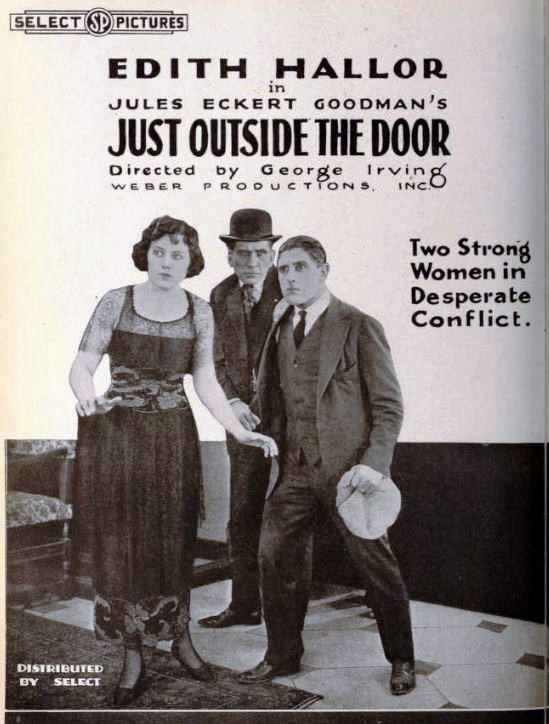
*Just Outside the Door* is a masterclass in subtextual tension, where every glance and gesture carries the weight of unspoken betrayals. Directed with a precise, almost clinical eye by Harvey F. Thew, the film weaponizes the stark contrasts of 1920s cinema to mirror the moral dichotomies at its core. Gloria Wheaton, portrayed with chilling detachment by Betty Blythe, is a figure of aristocratic disdain, her every movement a calculated assertion of power. Her alliance with Edward Burleigh (Arnold Gray), a man whose superficial charm belies a complicity in her schemes, forms the film’s narrative spine—a toxic partnership that weaponizes systemic classism and gendered double standards.
The film’s opening act is a masterstroke of slow-burn dread. Gloria’s manipulation of Ned (A. Edward Sutherland), Madge’s (Betty Blythe’s sister, J. Barney Sherry) hapless sibling, is rendered with a Kafkaesque sense of inevitability. His forgery of welfare documents is not a moment of moral collapse but a symptom of a society that has already deemed him disposable. Madge’s refusal to abandon Ned, despite his transgressions, becomes a quiet act of resistance against the dehumanizing forces of institutional bureaucracy, a theme that resonates with the ethos of contemporaneous works like *Her Husband’s Friend* (her-husbands-friend) and *Deliverance* (deliverance).
What elevates *Just Outside the Door* beyond a mere potboiler of the era is its nuanced exploration of complicity. Edward’s role as Gloria’s collaborator is never explicitly villainous; instead, his quiet obedience to her will underscores the insidiousness of patriarchal structures. He is the archetypal enabler, a man who believes his privilege is contingent on his ability to uphold the status quo. This dynamic finds a disquieting parallel in *The Golden Chance* (the-golden-chance), where societal expectations warp individual morality into a grotesque parody of virtue.
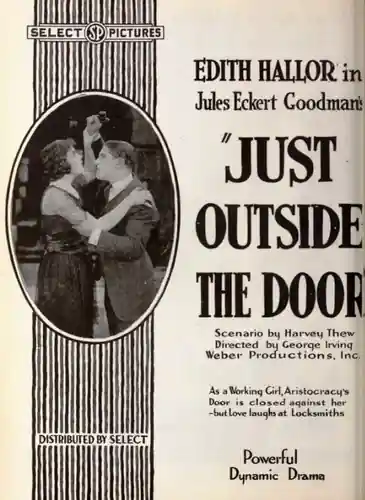
Madge’s resilience is the film’s emotional nucleus. Her scenes with Dick, played with understated warmth by Edith Hallor, are imbued with a restrained longing that contrasts sharply with Gloria’s overtly performative despair. When Madge defends Ned before the town’s disapproving gaze, her defiance is not rooted in sentimentality but in an unyielding belief in redemption—a theme that echoes the existential stakes of *Fate’s Mockery* (fates-mockery). The film’s most striking sequence is Ned’s confession, delivered in a dimly lit room where the flickering shadows on the walls seem to judge him more harshly than any jury could.
Cinematographically, the film is a study in contrasts. The Burleigh Mills, where Madge works, is rendered as a labyrinthine space of industrial decay, its brickwork and iron grates framing characters like subjects in a moral allegory. Gloria’s mansion, conversely, is a sterile tableau of white marble and gilded fixtures, its opulence a metaphor for the spiritual emptiness of her character. These visual motifs recall the stark duality of *The Dead Line* (the-dead-line-1920), though *Just Outside the Door* employs its setting with a more introspective finesse.
The film’s score, though minimal, is a haunting counterpoint to its narrative. A recurring motif of dissonant strings underscores Gloria’s internal volatility, while Madge’s scenes are accompanied by a sparse, almost pastoral melody that evokes her connection to the working-class community she serves. These auditory cues, subtle yet effective, elevate the film from a mere melodrama to a symphonic exploration of human frailty.
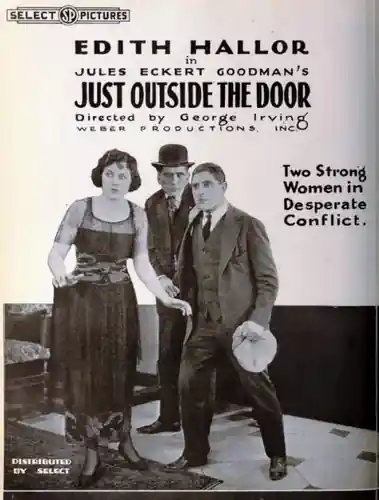
Critics of the time dismissed *Just Outside the Door* as a “sordid parlor drama,” a reductive dismissal that overlooks its subversive critique of social hierarchies. Gloria’s downfall is not a cathartic punishment but a necessary reckoning with the consequences of her parasitic worldview. Her final exit, a slow walk into the fog-shrouded woods, is a masterclass in ambiguity—does she seek redemption, or merely evade accountability? This ambiguity is a hallmark of Thew’s directorial style, one that invites comparisons to the existential void of *Out for the Night* (out-for-the-night).
Performances are uniformly excellent, though Blythe’s portrayal of Gloria is the standout. Her ability to convey menace through a mere tilt of the head or a pause in her dialogue makes her a proto-femme fatale, a precursor to the more overtly dangerous characters in later noir. Madge, conversely, embodies a quiet strength that feels both anachronistic and timeless, a trait she shares with the heroine of *The Love Trail* (the-love-trail). Sutherland’s Ned, often written off as a comic relief figure in reviews, is instead a tragic character whose flaws are rendered with aching humanity.
The film’s climax is a masterstroke of narrative economy. As Madge reunites with Dick, the camera lingers not on their embrace but on the empty chair where Gloria once sat, a visual metaphor for the hollow triumph of conventional morality. It is a moment that transcends the film’s period setting, resonating with the same existential weight as the final scenes of *Life or Honor?* (life-or-honor).
In its exploration of societal pressures and personal integrity, *Just Outside the Door* remains a quietly revolutionary work. It challenges the viewer to question not just the characters’ actions but the systems that enable such actions to flourish. The film’s legacy is one of understated power, a relic of a bygone era that still speaks volumes about the human condition.
IMDb —
1919
Community
Log in to comment.