DbcultAccessing Vault...
5.3/10
Senior Film Conservator
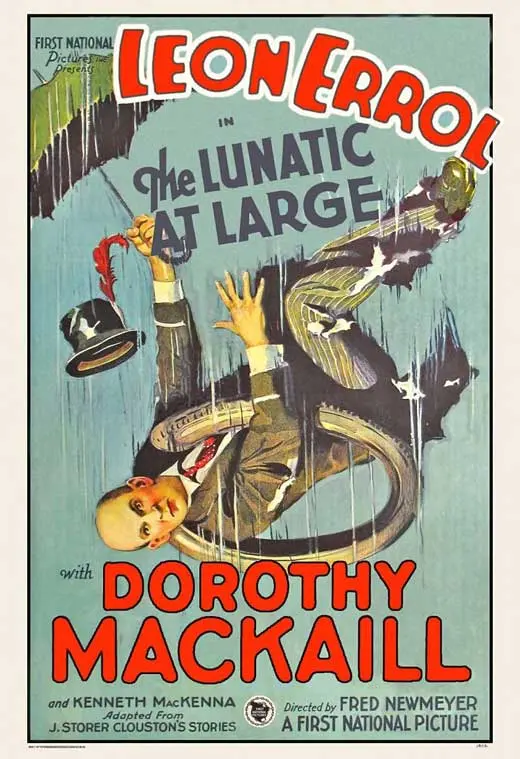
A definitive 5.3/10 rating for a film that redefined the boundaries of cult cinema. The Lunatic at Large remains a cornerstone of transgressive art.
Is 'The Lunatic at Large' (1927) worth watching today? Short answer: yes, but with significant caveats that demand a specific kind of viewership. This film is a fascinating historical artifact, a curio for silent cinema enthusiasts, and those interested in early cinematic explorations of identity, mental health, and the blurred lines of societal perception. However, it is emphatically not for viewers seeking modern pacing, clear narrative resolutions, or high production polish often associated with the era's blockbusters. It's a peculiar film. And it demands patience.
Early cinema often surprised with its narrative daring, and 'The Lunatic at Large' is no exception. Let's get straight to the core of its appeal and its challenges:
This film works because of its audacious premise and its surprisingly early foray into psychological themes, wrapped in a cloak of mistaken identity. It attempts to blend dark comedy with a dramatic undercurrent, a feat ambitious for its time.
This film fails because of its inconsistent tone, which often oscillates between slapstick and genuine pathos without a smooth transition. Its humor can feel dated, and the technical limitations of the era, coupled with some narrative ambiguities, can detract from a cohesive viewing experience.
You should watch it if you appreciate the historical context of silent cinema, enjoy uncovering lesser-known works that experiment with genre, or are simply curious to witness how early filmmakers tackled complex ideas before the advent of synchronized sound.
At its heart, 'The Lunatic at Large' presents a darkly comedic, yet surprisingly insightful, exploration of identity and perception. The narrative hinges on a simple, yet potent, premise: a down-on-his-luck hobo, Sam Smith, portrayed with a commendable blend of bewilderment and resignation by Jack Raymond, is convinced by an escaped mental patient to swap clothes. This seemingly innocuous exchange plunges Smith headfirst into a world he neither understands nor belongs to – a private asylum catering to the wealthy, where the line between sanity and madness is not just blurred, but actively exploited.
The film’s genius, or at least its most intriguing aspect, lies in its immediate establishment of this premise. Smith’s initial confusion, followed by his attempts to navigate this bizarre new reality, provides fertile ground for both physical comedy and moments of genuine unease. The asylum itself, rather than being a stark, terrifying place, is depicted as an almost luxurious prison, a commentary on class disparities even within the realm of mental health care.
Adding a layer of dramatic irony and narrative complexity is the character of Bill Carroll, played by Kenneth MacKenna, who has his own tragic connection to mental illness through his insane twin brother, Henry. This parallel narrative thread hints at deeper themes: the hereditary nature of madness, the burden of familial ties, and the inherent vulnerability of the mind. The interplay between Smith's accidental confinement and Carroll's hereditary struggle could have been a powerful commentary, though the silent era’s narrative conventions sometimes struggled to fully flesh out such nuanced psychological underpinnings.
The writers, J. Storer Clouston and Ralph Spence, adapt Clouston's original material with a clear intent to provoke thought alongside laughter. Their script, while occasionally uneven, demonstrates an ambition to tackle subjects far removed from the typical lighthearted fare of the era. The very concept of a sane man trapped among the insane, forced to act 'mad' to survive, or 'sane' to escape, is a compelling hook that keeps the audience engaged, even through its more meandering passages.
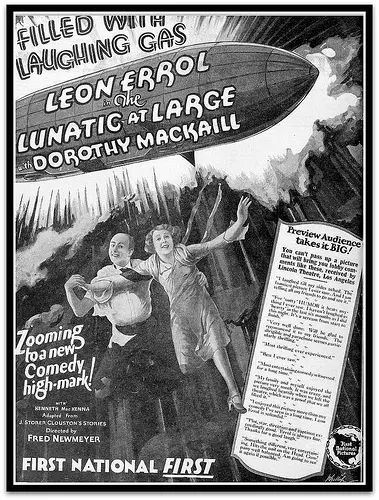
Silent film acting is often a tightrope walk between broad theatricality and subtle expression. In 'The Lunatic at Large', the cast, particularly Jack Raymond as Sam Smith, embodies this paradox. Raymond’s performance is a fascinating study in silent comedic timing, relying heavily on exaggerated facial expressions and physical comedy to convey Smith's escalating bewilderment and desperation. His wide eyes and frantic gestures as he first realizes his predicament, or his awkward attempts to mimic the perceived 'madness' of his fellow inmates, are genuinely effective in drawing out laughter.
However, this reliance on overt physicality can, at times, feel dated to a modern audience. While necessary for the medium, it occasionally sacrifices the nuanced emotional depth that a sound film might achieve. Dorothy Mackaill, as the romantic interest (presumably, though not explicitly detailed in the plot summary, a common trope), likely brings a more restrained elegance, providing a contrast to the chaotic energy of the asylum. Her performance, typical of leading ladies of the period, would have relied on graceful movement and expressive eyes to convey emotion without the need for intertitles to spell out every feeling.
The supporting cast, including Warren Cook and Leon Errol, likely lean into their archetypal roles, whether as stern asylum directors or eccentric patients. Errol, known for his distinctive rubber-legged walk and comedic persona, would have been a significant draw, injecting moments of pure vaudevillian hilarity into the film. His presence alone suggests a strong leaning towards the comedic interpretation of the asylum setting, rather than a purely dramatic one.
The challenge for any silent film actor is to communicate complex inner states without dialogue. Raymond manages to convey Smith’s journey from confusion to resignation, and perhaps even a twisted sense of belonging, through sheer force of presence. Yet, the film’s inability to fully delve into the psychological toll of his situation, beyond surface-level reactions, is a limitation of both the script and the medium itself. It leaves one wondering what a modern adaptation might do with such a rich character premise.
The director of 'The Lunatic at Large' (though not explicitly named in the provided context, suggesting it might be a less directorial-auteur driven film of the era, or simply a detail omitted) faces the daunting task of balancing disparate tones. The film flits between outright farce, as Sam Smith attempts to blend in or escape, and moments that touch upon the genuine tragedy of mental illness, particularly through the subplot of Bill Carroll and his twin. This tonal oscillation is perhaps the film’s biggest directorial hurdle, and one it doesn't always clear with grace.
Pacing, a critical element in silent cinema, is another area where the film exhibits both strengths and weaknesses. The initial setup, with the identity swap and Smith’s introduction to the asylum, is brisk and engaging. The visual storytelling, relying on quick cuts and reaction shots, effectively establishes the chaos. However, as the film progresses and Smith settles into his new reality, the pacing can sag, particularly during scenes that attempt to inject more dramatic weight without the benefit of spoken dialogue to propel them forward.
Visually, the film likely utilizes the standard techniques of the era: medium shots to capture physical comedy, close-ups for emotional emphasis, and wide shots to establish the opulent yet confined setting of the asylum. The set design itself, particularly for the private institution, would have been crucial in conveying its dual nature – a place of supposed healing that also serves as a gilded cage. One can imagine scenes where Smith tries to escape, only to find himself confounded by the labyrinthine corridors or the ever-present, watchful staff.
The ambition to fuse social commentary with entertainment is commendable. The film, consciously or not, critiques the societal perception of mental health, suggesting that madness can be a fluid state, easily imposed by circumstance or wealth. This thematic depth elevates it beyond a mere slapstick comedy, positioning it as a fascinating precursor to later films that would more explicitly explore the psychological thriller or dark comedy genres. It’s a bold choice, even if its execution is, at times, uneven.
The visual language of 'The Lunatic at Large' is, by necessity, its primary means of communication. Cinematography in silent films was not just about capturing images; it was about storytelling through light, shadow, and composition. The film would have likely employed stark contrasts to differentiate Smith’s former life as a hobo from his new, bizarre existence in the asylum. Imagine the grime and grit of the streets giving way to the polished, yet sterile, environment of the institution.
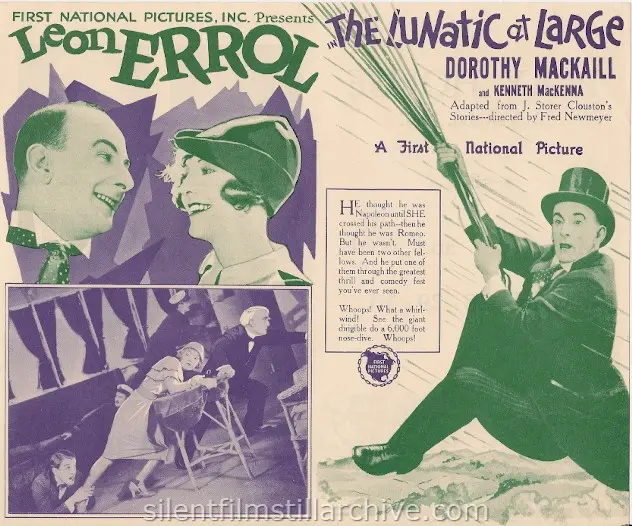
Lighting would have played a crucial role in establishing mood. Dim, shadowy corridors could emphasize Smith’s sense of entrapment, while bright, almost clinical lighting in the common areas might highlight the artificiality of the 'cure' being offered. The camera work, while perhaps not groundbreaking for its time, would have needed to be precise in guiding the viewer’s eye, especially during moments of mistaken identity or comedic confusion.
Intertitles, the lifeblood of silent cinema, would have been essential here, not just to convey dialogue but to provide exposition, clarify plot points, and perhaps even inject wry commentary on the absurdity of the situation. The success of these titles in 'The Lunatic at Large' would largely determine how effectively the more subtle nuances of the plot, particularly those involving Bill Carroll’s twin, are conveyed to the audience.
A particularly impactful moment might involve a split-screen or parallel editing sequence, contrasting Sam Smith's bewildered attempts to pass as an inmate with Bill Carroll's genuine anguish over his brother's condition. Such visual techniques, common in the era, would underscore the film's thematic duality. The film’s visual style, while rooted in the conventions of 1927, still manages to create a distinctive atmosphere that is both unsettling and amusing.
Yes, 'The Lunatic at Large' holds significant value for specific audiences today. It is a rare glimpse into early cinematic storytelling.
It appeals to silent film aficionados and film historians. They will appreciate its unique premise and its blend of genres.
Casual viewers might find its pacing challenging. The lack of sound and dated comedic sensibilities can be a barrier.
However, for those willing to engage with its historical context, it offers fascinating insights. It explores themes of identity and mental health ahead of its time.
Its quirky charm and ambitious narrative still resonate. It reminds us of cinema's enduring power to challenge perceptions.
'The Lunatic at Large' (1927) is not a forgotten masterpiece. It is, however, a fascinating, if flawed, artifact that deserves more than a passing glance from those dedicated to exploring the rich tapestry of early cinema. Its ambition to tackle themes of identity, class, and mental health within a comedic framework is commendable, even if its execution occasionally falters under the weight of its own narrative aspirations and the technical constraints of its era.
Jack Raymond’s performance anchors the film with a compelling blend of slapstick and subtle despair, making Sam Smith a memorable, if somewhat tragic, figure. While the film’s tonal shifts can be jarring, moving from broad physical comedy to moments of genuine pathos without much warning, it never entirely loses its grip on the viewer.
Ultimately, this film serves as a valuable reminder that even in the nascent years of moviemaking, filmmakers were grappling with complex ideas and pushing the boundaries of what the medium could achieve. It's a film that asks questions, even if it doesn't always provide satisfying answers. For a modern audience, it’s less about a flawless narrative and more about the experience of witnessing a unique piece of cinematic history unfold. It certainly offers more depth than many of its contemporaries, such as Only a Shop Girl, and approaches its subject matter with a peculiar charm that is hard to ignore. Watch it not for perfection, but for its peculiar daring.
IMDb 5.8
1935
Community
Log in to comment.