DbcultAccessing Vault...
Cult Review
Senior Film Conservator
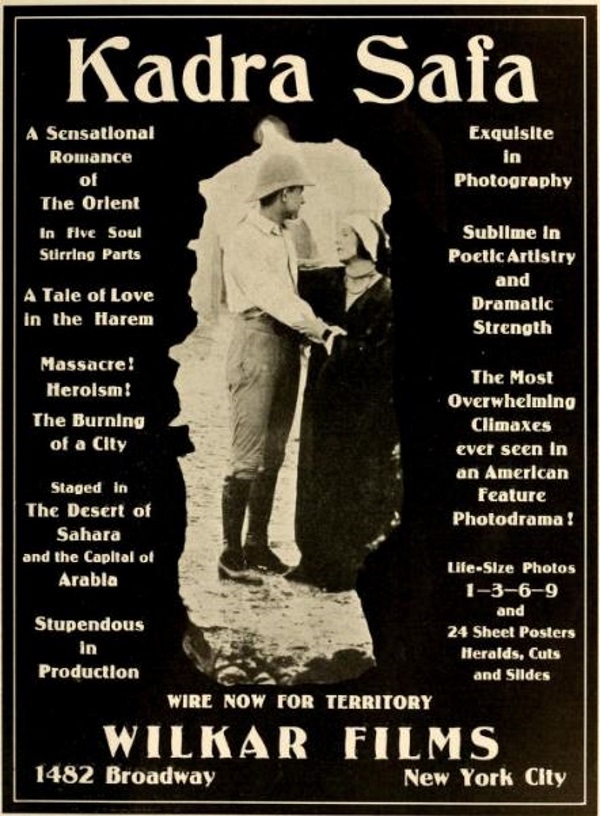
The first thing that strikes you about Kadra Sâfa is its odour: celluloid steeped in attar of rose, gunpowder, and wet limestone. Forgotten for a century, the film drifts back like incense smoke taking on the shape of a corpse. Shot on evaporated sets outside Berlin, draped in North-African drag, it wants to be The Adventures of Kathlyn with twice the opium and half the ethics. Instead it becomes an accidental X-ray of Weimar desires: white bodies dreaming themselves sovereign over dusky flesh, while that very flesh quietly plots escape.
Grete Wiesenthal—Viennese whirlwind formerly celebrated for her La Danse bleue—incarnates Kadra not as odalisque but as kinetic poem. When she pivots inside the harem’s octagonal throne room, the camera pirouettes with her, silk panels fluttering like pages torn from One Thousand and One Nights and rewritten by Loie Fuller. Each shimmy is a syllable of motion-poetry addressed to power: I glitter, therefore I am. Yet the film cannot bear the weight of its own enchantment; the gaze keeps cracking, revealing the machinery of colonial fantasy. The sheik—Ludwig Colani in kohl and glued beard—never speaks above a murmur, as though fearing the German language might puncture his oriental disguise. His favourite wife’s value is measured in metres of silk and minutes of dance; beyond that she is a cipher waiting for rescue, or ruin, or both.
The picture opens on a processional of extras shouldering cardboard palms. It’s 1919, sugar is rationed, but the studio has liquefied its entire supply of gold paint to gild Kadra’s litter. She emerges—a sunbeam caught in a spiderweb of jewellery—while the intertitle throbs: “The Sheik’s Pearl, gazed upon by every man yet owned by none but Allah.” Already the syntax is sweating double meaning: ownership as spiritual curse, beauty as blasphemy. When bandits swoop, the stunt riders kick up chalk dust meant to pass for Saharan sand. The abduction happens in whip-crack montage: a veil torn away, a slave girl trampled, a musical leitmotif borrowed from Fantomas pulsing like a panic attack. The effect is delirious, halfway between Saturday-matinee serial and fever dream.
Enter Dr. Robert Allister, played by Jean Ducret with the brittle charm of someone who has read half a medical textbook and every poem by Lord Byron. He wears jodhpurs, carries a vasculum blooming with desert poppies, and embodies the civilising mission in a pith helmet. The moment he lifts Kadra’s limp form across his saddle, the film tilts into racial melodrama: white saviour, brown saved, though the palette is so monochrome you can only infer chromatics from dialogue cues. “Her skin,” the doctor whispers in an intertitle, “like coffee kissed by cream.” Modern stomachs lurch; 1920 audiences reportedly sighed.
Back inside the palace walls, director Erich Zeiske stages the harem like a circular panopticon. Latticed balconies admit rhombuses of light that skate across naked backs. Slave girls freeze into tableaux vivants whenever the sheik passes, as though someone pressed the pause crank on reality. Kadra alone is allowed fluidity; her dance becomes both gift and threat—a reminder that sensuality can weaponise itself. Cinematographer H. Tomaschek (also cast as the palace astrologer) shoots Wiesenthal through diffused gauze, then racks focus so her eyes snap into razor clarity. The shift is erotic semaphore: I am blurred, I am sharp, I am everywhere and untouchable.
The doctor, confined to guest quarters, experiences this erotic regime as torment. His cell overlooks the dance courtyard; every morning he wakes to the susurrus of castanets made from walnut shells. A slave—Frl. Friedmann in burnt-umber body paint—brushes past and murmurs, “To look is to lose marrow from bone.” Whether this line came from Zeiske’s pen or the actress’s improvisation is lost to time, but it condenses the picture’s moral algebra: voyeurism exacts a blood price.
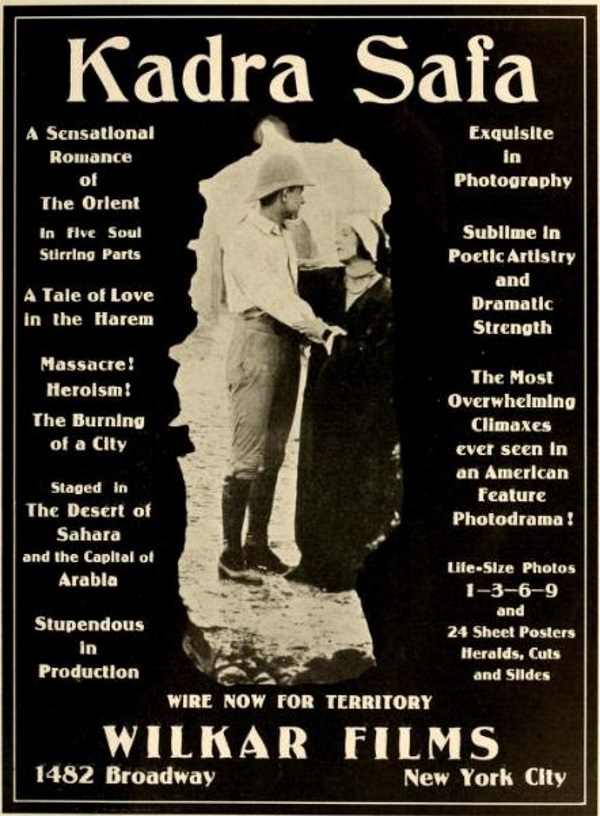
Narrative gears grind during the rose-toss scene. Kadra’s dance peaks; musicians slap derbukas until goatskin threatens to rupture. The doctor, unable to contain the metastatic longing, flings a rose that arcs in buttery slow-motion (achieved by cranking the camera to 12 fps). Petals graze Kadra’s collarbone; she falters for eight frames—barely a heartbeat—but enough to signal reciprocity. From that instant the film swaps genres: from orientalist pageant to resistance thriller. Kadra feigns fever; the sheik summons the foreign physician; in a close-up worthy of Dreyer, she swallows a scrap of onion-skin paper that reads: “High noon—wall of astrologers—come dressed as your own ghost.”
Zeiske crosscuts between two ticking clocks: the lovers’ tryst and the imam’s decree that Christian heads must roll at the sun’s zenith. It’s Griffith’s Intolerance miniaturised, shot through with German expressionist dread. Shadows elongate like spilled ink; palace cats yowl in harmonic minor. You sense history’s vise tightening, though the historical referent is pure hokum—no record exists of such a massacre in any German protectorate. Truth hardly matters; myth is the currency here.
When betrayal erupts—an eunuch spies the exchange of glances—the film abandons all restraint. The sheik’s scream is rendered as a title card bristling with exclamation marks sharp enough to cut fingers. Soldiers scramble; torches blaze; Kadra and the doctor sprint through secret corridors that smell of damp sandstone. They descend into the derelict well, a shaft once used to irrigate pleasure gardens, now a throat leading to Hades. The camera peers down from above: two white dots swallowed by darkness. Then comes water—first a trickle, then a cataract—shot in reverse negative so the liquid looks mercury-thick, poisonous. Contemporary critics compared the sequence to Poe’s “The Pit and the Pendulum,” though it anticipates the drowning of The Port of Doom by six years.
Zeiske lingers on their final moments with almost sadistic piety. Kadra presses her cheek against the doctor’s waistcoat; he recites the Lord’s Prayer while undoing her braids, as if sacrament and sensuality could merge underwater. Bubbles rise—each one a truncated lifespan—until the screen fades to black, then to a single intertitle: “Thus the pearl returns to the deep.” No moral, no epilogue, just the cavernous hush of extinction.
Wiesenthal’s acting is half-dance, half-exorcism. Trained in the Hellerau school of eurhythmics, she never merely walks; even her collapse is a spiral, torso folding like silk fans. One suspects the camera operator began cranking only when she reached apex velocity, hence the strobed fluidity of her limbs. By contrast, Ducret plays the doctor as a man forever straightening his cravat in the face of apocalypse—every inch the colonial functionary whose civilisation is a tailor’s illusion. Their chemistry is asymmetrical: she kinetics, he stasis; she orbit, he axis. It works because the story itself is about mismatched gravitational fields.
Colani’s sheik skulks on the periphery, a study in regal paranoia. His eyes, ringed with kohl, gleam like obsidian arrowheads. In the penultimate scene, when he orders the lovers drowned, his face fills the frame; the intertitle reads simply: “Allah is merciful—I am not.” The line, deliciously villainous, became a popular Reich-weit postcard caption, proof that audiences adored monstrous fathers when cloaked in exotic garb.
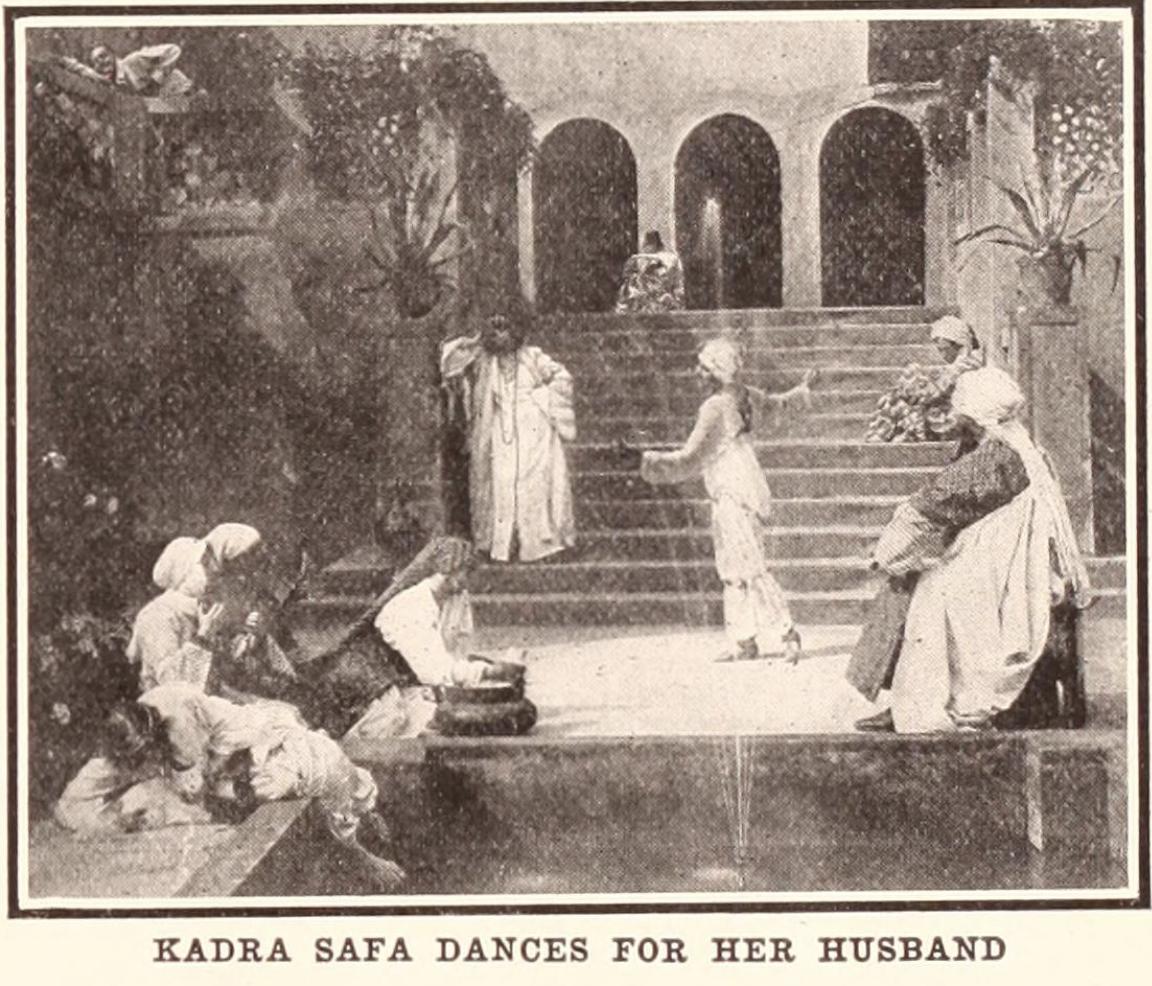
Colour tinting survives in the only extant Bavarian print: amber for palace interiors, cyan for night exteriors, sickly green for the subterranean climax. The amber passages glow like honey poured over marble, accentuating the decadence. Cyan sequences—particularly the desert chase—bleed into aquamarine, suggesting sky liquefying into sand. The well scenes are untinted, stark monochrome, a deliberate void where colour equals life and its absence equals death. Restorers at Munich Filmmuseum attempted digital colour grading in 2018 but abandoned the project; the emotional punch, they claimed, resides in those bleached final metres.
No original score remains. Contemporary exhibitors paired the picture with improvisations: oud and zither in Berlin, cinema organ in Vienna, klezmer ensemble in Kraków. Archival reports describe a Vienna screening where the drummer misread cues and accelerated during the drowning scene, turning tragedy into slapstick. Audiences laughed until an elderly woman fainted; the newspaper Arbeiter-Zeitung called it “a parable of civilisation choking on its own spit.” Today, festivals commission new scores—minimalist drones, electro-darbuka loops, even a doom-metal rendition by Lebanese band The Well. Each reinvention proves how hollow the film is without sound, and how loudly silence can scream.
Modern scholars flay Kadra Sâfa for its orientalist DNA—every frame drips with the assumption that East equals harem equals woman equals chattel. Yet some feminist historians read Kadra’s dance as insurgent choreography, her final refusal to scream underwater as existential victory. She chooses the manner of her death, they argue, wresting authorship from both sheik and saviour. The film thus flickers on the razor-edge between fetish and revolt, much like Eva or Marta of the Lowlands, where heroines drown rather than capitulate.
Post-colonial critics note the American doctor’s botanical vocation: he plunders flora while imagining he rescues fauna (i.e., Kadra). The rose he throws is both romantic offering and taxonomic tag—specimen labelled: Beautiful, Oriental, Doomed. His death beside her reads less as transcendent love than as imperial comeuppance, a trope Hollywood would recycle for decades.
After the Hitler era the film vanished; Nazi censors deemed it “trashily sensual” yet archived the negative for supposed historical value. Allied bombs shattered the storage facility in 1944; only a dupe positive surfaced in 1968 in a Tyrolean monastery. Bootlegs circulated among cine-clubs, inspiring queer reinterpretations: the harem as closet, the well as cruising ground, the drowning as erotic asphyxia. You can trace visual echoes in everything from Ken Russell’s Salome’s Last Dance to Beyoncé’s “Haunted” video—slow-motion water, golden fabric, fatal femininity.
Streaming platforms shun it—no 4K scan, no soundtrack, plus the racial minefield. Yet Blu-ray rumours persist; a boutique label in Bologna has reportedly colour-graded the amber sequences using hand-tinted postcards as reference. If released, expect deluxe liner notes, a synth score, and a trigger warning.
Yes, if you can stomach beauty poisoned by politics. Kadra Sâfa is neither masterpiece nor footnote—it is a wound that refuses scabs. You’ll swoon at Wiesenthal’s kinetic lyricism, gag at the colonial clichés, and exit gasping from that final well of inky silence. Approach it like you would a scorpion under glass: admire the iridescent carapace, but never forget the venom.
Final arithmetic: 7/10 for visual poetry, 3/10 for ethical aftertaste, 10/10 for remaining unforgettable.
IMDb —
1924
Community
Log in to comment.