DbcultAccessing Vault...
Cult Review
Senior Film Conservator
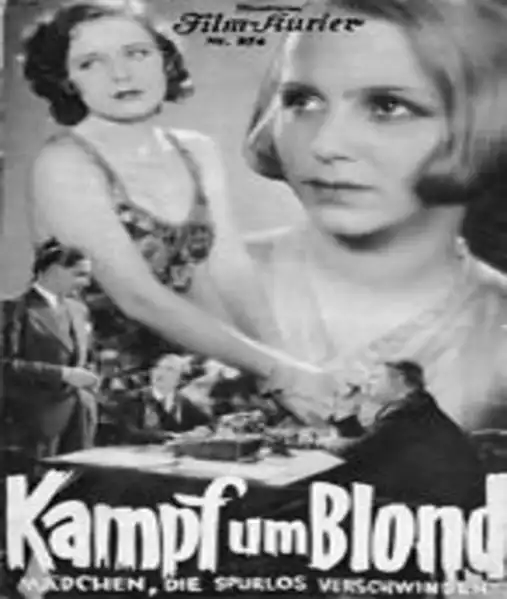
If you're into those old-school German mysteries—the kind where the shadows are basically their own characters—then Kampf um Blond is worth your time tonight. It’s got that specific kind of grit that you only find in movies made right before everything in Europe changed.
If you need fast explosions or people who don't look like they're wearing five layers of wool, you’ll probably hate it. It moves at its own pace. Sometimes that pace is a slow crawl through a dark hallway.
The whole thing starts with a simple, creepy idea: blonde women are just disappearing. No ransom notes. No bodies. Just empty apartments and confused boyfriends.
It feels a bit like a tabloid newspaper from the 30s come to life. You can almost smell the stale cigarette smoke in the police stations.
Albert Lieven shows up here, and he’s got this very specific intensity. He doesn't just walk into a room; he sort of looms into it.
There is this one scene early on where a woman is getting ready in front of a mirror. The camera stays on her for a long time. Way too long.
You keep waiting for something to jump out from behind the curtain. Nothing does. But the dread is just... thick.
I found myself thinking about The Gray Mask while watching this. Both movies have that obsession with hidden identities and urban fear.
The street scenes are my favorite part. They look so empty. Not like a movie set empty, but like everyone just decided to stay inside because they were scared of the dark.
The lighting is very... let's call it 'moody.' There are moments where you can barely see the actors' faces. I love that.
Modern movies are always so bright, like they’re afraid you’ll miss a pixel. Here, the darkness does the heavy lifting.
John Mylong is in this too. He’s got one of those faces that looks like it’s been through a lot. He doesn't say much, but he doesn't have to.
I did notice the sound is a bit rough in places. There’s a scene in a club where the music is so loud you can barely hear the dialogue. Maybe that was on purpose?
It reminded me of the atmosphere in Der Mann im Dunkel. Just that feeling of being watched from the shadows.
Some of the acting is... well, it’s 1933. People gestured a lot more back then.
There is a guy who plays a minor role—I think his name was Paul Heidemann—who keeps doing this weird thing with his hat. Every time he talks, he adjusts it. Every. Single. Time.
I started counting how many times he touched it. I think I got to twelve before I lost track. Small things like that make these old movies feel real.
The plot gets a bit tangled in the middle. I’m not even sure I fully understood why the kidnappers were doing what they were doing.
But honestly, does it matter? The vibe is what keeps you there. It’s like a fever dream about being lost in Berlin.
It’s definitely more interesting than The Spirit of the Poppy, which felt a bit more theatrical and stiff. This feels like it actually wants to be a movie.
The women in the film, like Hertha von Walther, aren't just victims though. They have these moments of looking absolutely fed up with the men around them.
There’s a bit where one of the blondes is being questioned and she just gives the cop this look. Like, 'Are you really this dumb?' It’s great.
I wish they had spent more time on the actual mystery solving. Sometimes it feels like characters just stumble onto the next clue by accident.
You see a lot of this in movies like Ladies of the Mob too. The plot is just a clothesline to hang cool scenes on.
The ending is... fast. Like, really fast. It’s like the director realized they only had three minutes of film left in the camera and had to wrap everything up.
One minute they’re in danger, the next minute everyone is fine and the credits are rolling. It’s a bit of a head-scratcher.
Still, I’d take this over a boring modern thriller any day. It has texture.
You can see the dust in the air. You can hear the floorboards creak. It feels like a physical object.
Is it a masterpiece? No. But it’s a solid way to spend an hour and a half if you want to feel like you’ve traveled back in time.
I keep thinking about that mirror scene. It’s going to stick with me for a while.
Just don't expect a clean ending. Real life isn't clean, and apparently, 1933 German cinema wasn't either.
It’s weirdly comforting in its own dark way. Give it a shot.

IMDb 6.6
1931
Community
Log in to comment.