DbcultAccessing Vault...
6.7/10
Senior Film Conservator
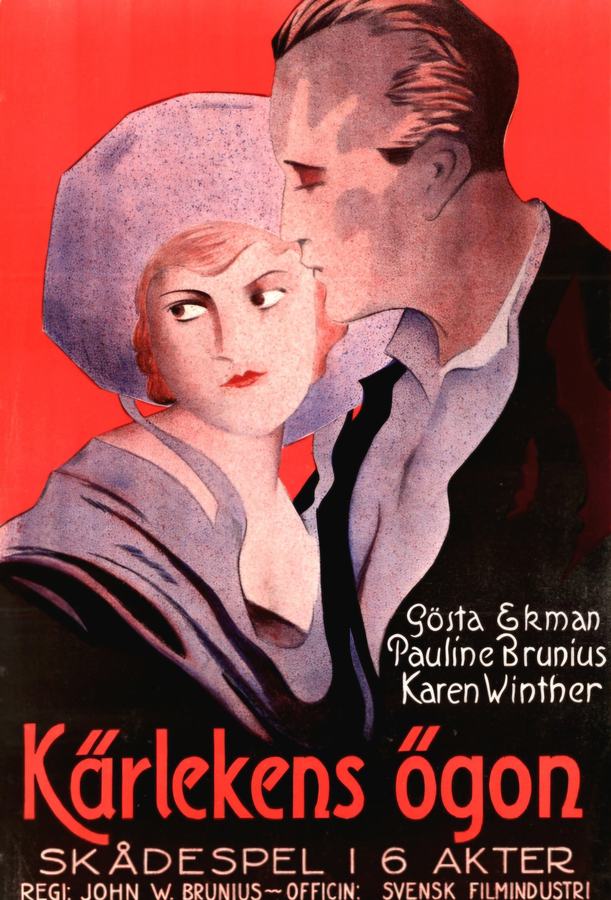
A definitive 6.7/10 rating for a film that redefined the boundaries of cult cinema. Kärlekens ögon remains a cornerstone of transgressive art.
In the annals of Nordic cinema, the year 1922 stands as a testament to the medium's transition from mere novelty to a profound art form. Kärlekens ögon (Eyes of Love), directed by the stalwart John W. Brunius, is a quintessential artifact of this era. It is a film that breathes the rarefied air of the Swedish silent tradition while simultaneously flirting with the gritty undercurrents of the crime thriller. To watch this film today is to witness a collision between Victorian morality and the burgeoning cynicism of the post-war world. The narrative, penned by Sam Ask and Brunius himself, is far more than a simple account of a restaurant robbery; it is a sophisticated exploration of visibility, deception, and the social masks we wear to navigate the hierarchies of desire.
The 'Oriental' restaurant serves as the film's primary stage, a microcosm of a society obsessed with spectacle. Brunius utilizes this setting to establish a sense of decadent security before shattering it. The cinematography captures the shimmering chandeliers and the rhythmic movements of the dancers with a fluidity that was quite advanced for its time. Unlike the domestic intimacy found in The Way of a Maid, Kärlekens ögon thrives on the public gaze. The heist itself—a sudden plunge into darkness—is a stroke of directorial genius. In that void, the film forces the audience to confront the fragility of the social order. The theft of the jewelry is not merely a financial loss for the elegant guests; it is a violation of their curated personas.
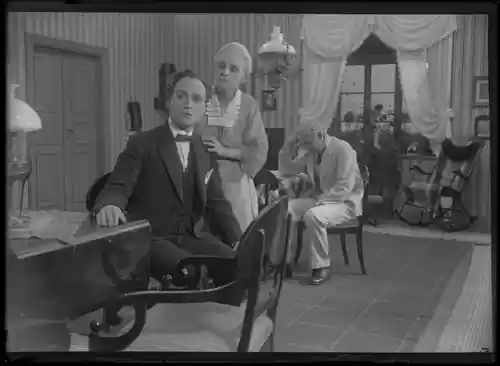
Louise Kent and Charles Zukor are portrayed not as caricatures of evil, but as predators of exquisite refinement. Their chemistry is the engine that drives the film's suspense. Unlike the more melodramatic villains of The Siren's Song, Kent and Zukor operate with a surgical precision that feels modern. They understand that in a world of high fashion and higher stakes, the best disguise is to look exactly like your prey. This thematic preoccupation with 'the mask' aligns the film with the psychological depth of Homunculus, 1. Teil, where the external appearance belies a fractured internal reality.
The ensemble gathered for Kärlekens ögon is a 'who's who' of early 20th-century Swedish theater and film. The presence of Gösta Ekman, even in a supporting capacity, elevates the production. Ekman, a titan of the stage, brings a gravitas that anchors the film's more flighty moments. Furthermore, for the modern cinephile, the inclusion of a young Greta Garbo—still years away from her Hollywood apotheosis—is a revelation. Even in these early frames, one can perceive that luminous quality, that 'it' factor that would eventually redefine the cinematic landscape. Her presence here, alongside veterans like Pauline Brunius and Carl Browallius, creates a fascinating bridge between the old world of theatrical performance and the new world of filmic charisma.
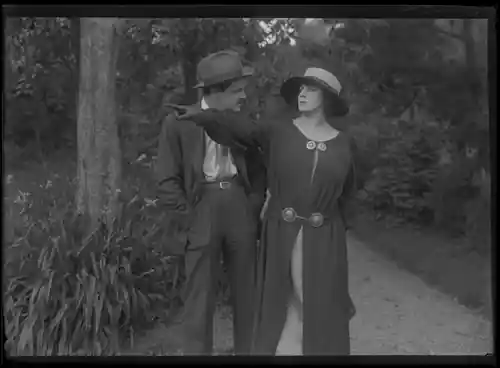
The acting style, while naturally more gestural than modern standards, avoids the histrionics often associated with the era. There is a restrained intensity in the performances of Jenny Tschernichin-Larsson and William Larsson that suggests a deep understanding of the camera's ability to capture subtext. This subtlety is reminiscent of the emotional nuances seen in The Safety Curtain, where the unspoken word carries as much weight as the title cards.
Technically, Kärlekens ögon is a marvel of light and shadow. The transition from the brightly lit dance floor to the pitch-black chaos of the heist required a sophisticated understanding of exposure and timing. Brunius uses the darkness as a narrative tool, much like the thematic use of environmental hazards in The Mystery of the Poison Pool. The confusion is palpable, and the audience is left to piece together the crime alongside the bewildered guests. This participatory element of the filmmaking makes the viewer an accomplice to the theft, heightening the tension and the eventual moral payoff.
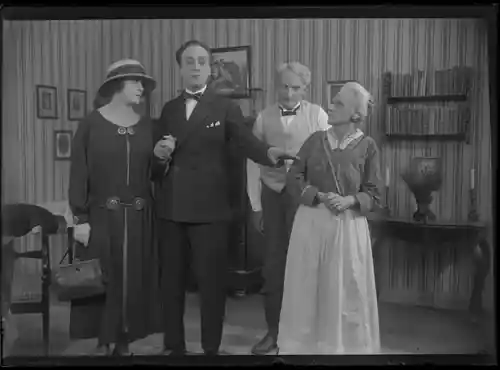
The title Kärlekens ögon suggests a romance, but the film subverts this expectation by framing love through the lens of criminality. Is the bond between Louise and Charles a genuine affection, or is it merely a partnership of convenience? This ambiguity is what makes the film endure. It asks whether love can exist in a vacuum of ethics, a question also posed in the dramatic arcs of His Vindication. Unlike the straightforward moralism of Gun Law, Brunius's work suggests that the human heart is as difficult to navigate as a darkened room full of panicked socialites.
The film also touches upon class dynamics. The criminal duo targets the 'Oriental' precisely because it is a bastion of unearned wealth. There is a subtle, perhaps unintentional, proletarian satisfaction in watching the arrogant elite stripped of their finery. This social commentary, while perhaps not as overt as in Life or Alsace, provides a necessary layer of grit to the otherwise glossy proceedings. It reminds us that in 1922, the world was still reeling from the collapse of empires, and the 'eyes of love' were often looking for a way to survive in a harsh new reality.
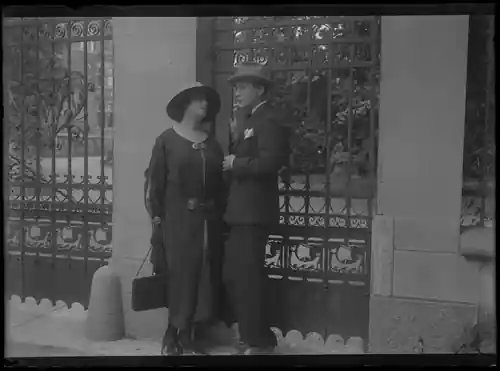
When compared to other films of the period, such as The Redhead or The Stolen Voice, Kärlekens ögon stands out for its structural integrity. While many silent films relied on episodic melodrama, Brunius maintains a tight narrative focus. The pacing is deliberate, building toward the 'Oriental' climax with a sense of mounting dread. It lacks the whimsicality of My Dog, Pal or the domestic lightness of A Bedroom Scandal, opting instead for a noir-adjacent atmosphere that would become a staple of Scandinavian cinema in later decades.
John W. Brunius was a master of the ensemble, and Kärlekens ögon is perhaps his most cohesive work. His ability to balance a large cast—from the leads to the background players like Astrid Lindgren and Edvin Adolphson—is nothing short of remarkable. He creates a world that feels inhabited and lived-in, rather than just a set. The film’s exploration of the 'eyes' that see and the 'eyes' that are blinded serves as a metaphor for the cinematic experience itself. We, the audience, are the ultimate voyeurs, watching the heist from the safety of the dark, our own 'eyes of love' fixed upon the flickering screen.
In the broader context of European cinema, this film shares a certain DNA with the Danish production Penge, which also dealt with the corrupting influence of wealth. Yet, there is something uniquely Swedish about Kärlekens ögon—a specific kind of melancholy that permeates even its most thrilling moments. It is a film that recognizes that every coup has a cost, and every dance must eventually end in the dark.
Ultimately, Kärlekens ögon is a vital piece of film history that deserves more than a footnote. It is a bridge between the theatrical traditions of the 19th century and the cinematic innovations of the 20th. It showcases a director at the height of his powers, a cast of legendary proportions, and a story that, despite its silent medium, speaks volumes about the human condition. Whether you are drawn to it for the historical curiosity of a young Garbo or the technical brilliance of its heist sequence, the film offers a rich, rewarding experience. It reminds us that even when the lights go out, the camera continues to see, capturing the truth of our desires and the shadows of our deceptions. In the end, we are all like the guests at the Oriental—distracted by the dance, unaware of what we are about to lose, and forever searching for clarity through the eyes of love.
For those navigating the vast landscape of silent cinema, this film is a mandatory stop. It possesses a sophistication that rivals Yes or No and a visual flair that remains impactful a century later. It is a testament to the enduring power of Swedish storytelling, a silent beacon that continues to shine through the darkness of time.
IMDb 6.3
1936
Community
Log in to comment.