DbcultAccessing Vault...
Cult Review
Senior Film Conservator
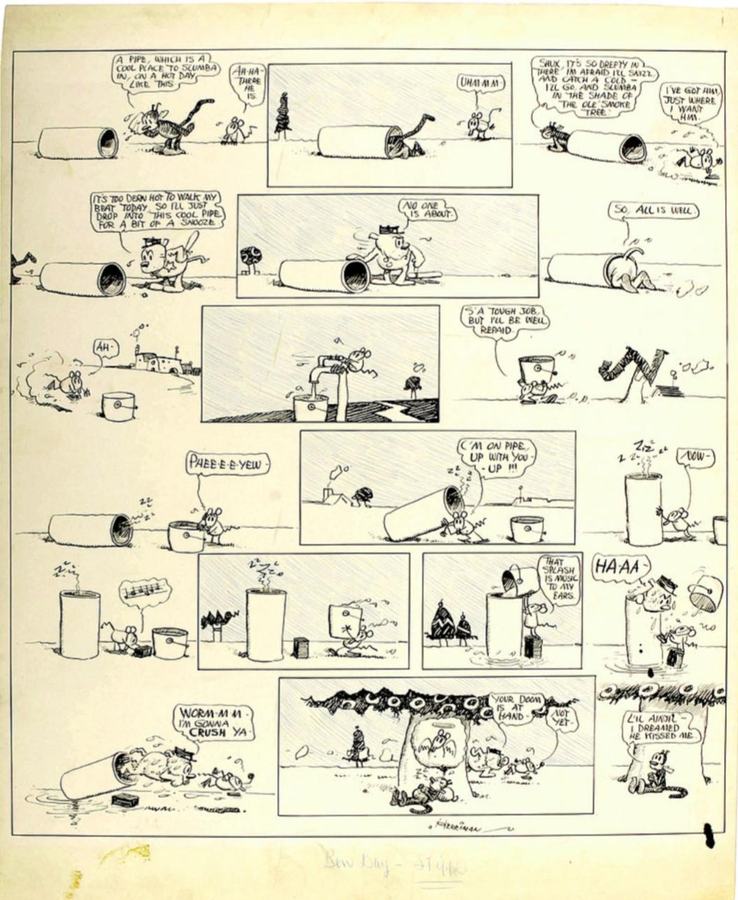
Somewhere between a heat-stroke hallucination and a vaudeville pratfall lies Kats Is Kats, a 1920 one-reeler that should have crumbled into nitrate dust but instead lingers like a chili-pepper ghost on the back of the tongue. Gregory La Cava—later the sardonic mind behind Stage Door—directs this Herriman adaptation as though he’s juggling nitroglycerin inside a kaleidoscope. The result is a film that refuses to behave: it hiccups, moonwalks, and sets fire to its own continuity, daring you to call it nonsense while secretly rewiring your synapses.
The plot, if one dares to chain it to that noun, is a mercurial loop: Ignatz steals a brick from a crumbling Spanish mission, paints it with lurid ochre, and hurls it at the Smelly Skunk—an unglamorous creature whose fur drips with the acrid stench of bankruptcy. The skunk collapses, Ignatz scoops the limp form like a victory trophy, and trots to the nearest desert saloon where the bartender pays in cold coins stamped with the face of a bored emperor. Meanwhile, Krazy Kat—gender-fluid, heart-in-crescendo—interprets the brick as a matrimonial bouquet and pirouettes across the dunes, leaving paw-shaped apostrophes in the sand.
La Cava shoots the mesa as if it were a broken chessboard: low-angle shots make the cacti resemble bishops who’ve lost faith, while the sky is tinted bruise-violet in scenes of romantic delusion. Intertitles appear on what looks like torn cigarette paper, each letter jittering like a flea in a sideshow. The film’s tempo is a jazz rhythm learned from a drunk metronome—16 frames per second one moment, 12 the next—so that the slapstick violence vibrates with a moral vertigo.
Contemporary audiences weaned on Extravagance’s opulent melodrama or The Drifter’s moral homilies must have felt their scalps unscrew when confronted by this anarchic mini-epic. Where Lombardi, Ltd. peddled department-store satire with tidy three-act bows, Kats Is Kats prefers to unravel the very notion of merchandise: the skunk’s stench becomes a currency more honest than the silver Ignatz pockets.
Herriman’s comic strip always flirted with ontological mischief—Cocoanut sidewalks that disobeyed perspective, dialogue balloons that smelled of gumbo—but La Cava translates that instability into cinematic sprezzatura. Watch how the brick, once thrown, re-enters the frame from the top of the screen, as if gravity had filed for divorce. The gag repeats across five separate shots, each time with a slightly varied angle, so the object becomes a metaphysical boomerang, a reminder that cause and effect are merely gossiping neighbors, not Siamese twins.
Because the cast is hidden under animal carapaces—fur suits stitched from moth-eaten theatre curtains—acting becomes a choreography of elbows and tails. Yet within those constraints, the performers convey a humid emotional intelligence. The actor inside Ignatz (unbilled, perhaps blacklisted for crimes against dignity) gives the mouse a jittery swagger, the gait of a rodent who’s read Nietzsche but misinterpreted every clause. His tail twitches like a conductor’s baton cued to a silent orchestra of resentment.
Krazy Kat, portrayed by a vaudeville contortionist rumored to have rubber vertebrae, moves with the languid hope of someone who’s been heartbroken since the Paleocene. When the brick kisses her cranium, the noggin compresses like a stress ball, then rebounds in slow-motion ecstasy. No blood, no bruise—only a lover’s blush rendered in sepia tint. It’s the most perverse Meet-Cute ever spliced together, and it makes the courtship in The Wishing Ring: An Idyll of Old England look like a mortgage application.
Released during the twilight of the silent era, the picture lacks synchronized dialogue yet overflows with sonic suggestion. Intertitles issue onomatopoeic gags: “PLOOOSH!” for the skunk’s perfume, “CLINK-CLINK-CLANK!” for Ignatz’s coins. Modern viewers conditioned to Dolby thunder might smirk, but the absence of literal noise forces the imagination to become Foley artist. You hear the brick’s clayey thud, you smell the acrid musk, you taste the desert’s alkali bite. The film weaponizes sensory absence the way horror flicks weaponize shadows.
Compare that strategy to Ave Maria’s orchestral piety or Skruebrækkeren’s industrial clatter; here the void becomes a character, a yawning mouth that devours certainty. The skunk’s stench functions like the MacGuffin in Behind the Mask—everybody wants it, nobody understands it—but Herriman and La Cava dare to make the MacGuffin both ephemeral and ethical: a reek that pays debts, topples regimes, and breaks hearts.
Beneath the slapstick lies a sly post-colonial sneer. The mission ruins from which Ignatz loots his brick stand as cracked monuments to Spanish conquest, now reduced to ammunition for rodent capitalism. The saloon where the skunk is traded for silver occupies what was once Indigenous land, though the film never utters the word “annexation.” Instead, it lets the imagery do the accosting: sagging roof beams shaped like crucifixes, poker cards illustrated with faceless conquistadors, a bartender who speaks only in dollar signs. In 1920, such iconoclasm must have felt like a burlesque of Manifest Destiny, predating the explicit anti-imperial screeds of The Royal Slave by a hair’s breadth.
Krazy Kat’s gender ambiguity is no coy punchline but the engine of the narrative’s philosophical restlessness. The character’s pronouns oscillate from intertitle to intertitle—she swoons, he salutes, they pirouette—mirroring the desert’s own refusal to stay put. La Cava frames Krazy in soft, effeminated poses, yet undercuts them with angular shadows that suggest masculine resolve. The effect destabilizes viewer expectation more efficiently than any twist in Cyclone Smith's Partner. Gender becomes a costume changed in the blink of a brick, a fluidity that feels radical even by 2020 standards, let alone 1920.
Place Kats Is Kats beside The Beetle’s expressionist dread or Hidden Valley’s pastoral optimism, and you’ll notice how La Cava’s film sabotages both horror and harmony. It borrows Germanic angles but refuses their gloom; it flirts with pastoral vistas only to drop a brick into them. Even The Lady Clare’s medieval honor looks quaint when compared to Ignatz’s mercenary rodent code, where chivalry is measured by the heft of masonry.
Most one-reelers of the era—see The Destruction of Carthage—were melted down for their silver halide, yet fragments of Kats Is Kats survive in a patched 35-mm print discovered inside a condemned Osaka theater in 1987. The red tinting has faded to bruised apricot, the cyan to dusk, but the decay adds a patina of unintended poignancy: scratches look like desert winds, missing frames feel like coyote howls. Watching it today is to witness cinema dream of its own demise and giggle at the prospect.
By the time the end card “KATS IS KATS—AND THAT’S THAT” splinters across the screen, you realize the sentence is both tautology and insurrection. Identity is fixed, yet reality is elastic; love hurts, but pain is currency. Few films manage to be so breezy and so corrosive, so childlike and so politically sulphuric. In under twelve minutes, La Cava and Herriman deliver a manifesto for trickster art: break the mold, hurl it at the audience, then charge admission for the bruise.
If you emerge from this flick without questioning the bricks you yourself throw—metaphorical or otherwise—then you’ve missed the skunk’s stench whispering in your ear: “Ownership is odor, love is impact, and Krazy is the sanest soul in a world addicted to straight lines.”
IMDb —
1923
Community
Log in to comment.