DbcultAccessing Vault...
Cult Review
Senior Film Conservator
Keep Moving is what happens when commerce itself develops a sadistic sense of humor and hires Mack Sennett’s most masochistic jester to ring up the catastrophe.
Shot in the amber haze of 1915 Fort Lee, this one-reel grenade detonates the polite consumer comedy of the era. Instead of clerks and courting, we get Musty—part scarecrow, part cash-register Sisyphus—whose face seems permanently set to “wince.” The plot, if one can tether such nitroglycerin, is a daisy-chain of retail vendettas that begin with a five-cent humiliation and end in flaming facial hair. It is the missing link between The Spoilers’ rugged frontier chaos and A Bunch of Keys’ domestic anarchy, yet it out-surreals both by treating commerce itself as a blood sport.
Watch the first ninety seconds: a matron glides in, her hat a vineyard of glossy grapes that never knew soil. She demands a tour; Musty obeys like a penitent monk. She buys one cracker—five cents—an act so exquisitely petty it feels like performance art. Ruby Hoffman plays this grande dame with the languid cruelty of a duchess swatting a gnat. When Musty, stung by the insignificance of the sale, masticates her faux fruit, the editing cadence quickens: medium shot, insert of teeth puncturing plastic skin, smash-cut to her horrified gasp. Apples become artillery; the staccato rhythm prefigures Eisenstein’s Battleship Potemkin montage, only here the proletariat is produce.
Enter the “sissy-boy,” cinema’s earliest flamboyant consumer—purchasing azure yarn for unseen knitting. Scholars still debate whether the performance is lampoon or covert celebration; either way, Musty’s disgust reads as toxic masculinity on a sugar high. He slips a lit firecracker into the yarn ball. The resulting explosion is not mere slapstick; it is a rupture of gendered expectations, the pink-flash bloom vaporizing any residual gentility. Compare this to the refined dandy in An American Gentleman; there, elegance is envied, here it is punished with gun-cotton.
Just as you acclimate to the tempo, a cowboy-desperado swaggers in—spurs, ten-gallon hat, the whole frontier myth compressed into one swagger. He slaps down a nickel and exits with armfuls of canned goods, a parody of manifest destiny enacted in aisle three. Musty, emasculated, can only gape. The transaction lampoons the era’s unregulated markets; it’s the trusts and monopolies distilled into one pistol-packing shopper. If The Dollar Mark sermonized against greed through melodrama, Keep Moving mocks it via armed grocery shopping.
The drummer—part huckster, part proto-Elmer Gantry—tries to sell stale crackers. Musty warns the proprietor; hostility ignites. Crumpled crackers ricochet off Musty’s cheeks like papier-mâché bullets. Retribution arrives liquid: Musty upends a pitcher of milk into the drummer’s derby, so when the hat is donned, a geyser of ivory cascades down the salesman’s face. The gag is elementary yet baroque, a Rube Goldberg of dairy. Contemporary critics of Just Out of College praised collegiate pranks; here, dairy becomes the diploma in mischief.
Ever the auteur of self-harm, Musty guzzles Tabasco, mistaking it for digestive balm. His spasmodic hunt for water leads to a suspended watering can; one tug and the entire ceiling avalanches—lath, plaster, existential despair—burying him like a consumerist Pompeii. The proprietor, apoplectic, points to the door. Musty’s termination is filmed in a single take: the dust cloud settles, the boss’s finger extends, the camera tilts up to the gaping roof where sunlight mocks the employee like a deity with a grudge. No intertitle is needed; the visual punchline is cosmic.
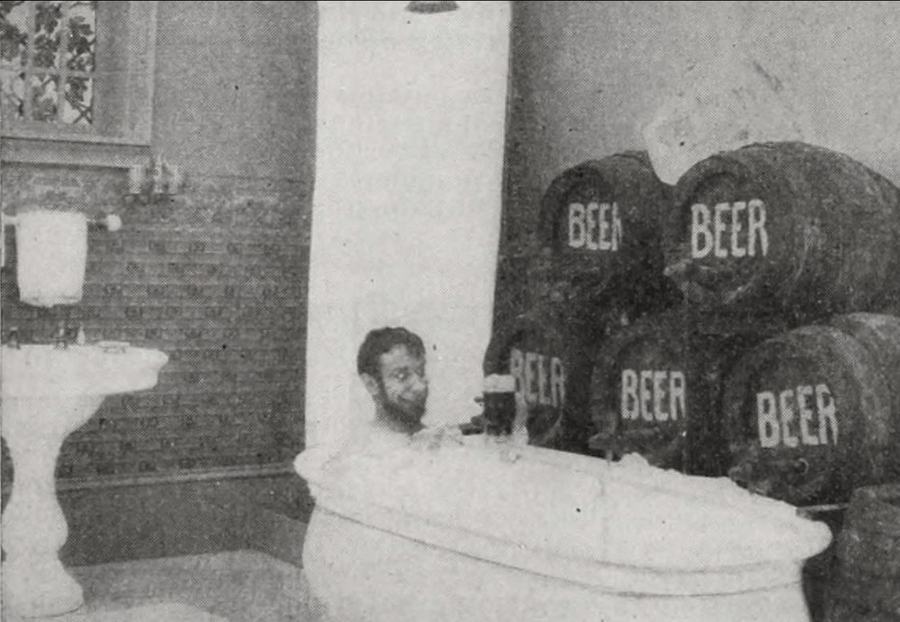
Unemployed and follicularly cursed, Musty seeks a shave. The barber—Snitz Edwards in a performance of mute deadpan—wears a gag, ostensibly to shield patrons from his breath. The shave proceeds, but the aftershave is replaced with hair-restorer; within seconds Musty sprouts a pelt wilder than a Chia Pet on amphetamines. Unable to pay, Musty flees; the barber, in pursuit, is arrested by a passing cop. The scene’s claustrophobia—mirrors reflecting infinite incompetence—anticipates the expressionist corridors of Der Andere, yet filtered through vaudeville.
Finally, Musty drifts into a “thirst emporium,” a saloon where sawdust floats like brown snow. A brute is ejected; Musty, left in charge, ladles free soup into the ruffian’s bowl. The soup is flung back; fisticuffs erupt. During the melee, Musty’s restored beard absorbs gasoline. A spark from the pot-bellied stove leaps; the beard explodes into a saffron halo, singeing away his shame along with his whiskers. He exits, smoother-chinned than a mannequin, yet spiritually cauterized. The conflagration is both baptism and exorcism.
Ruby Hoffman’s matron glides with predatory elegance; Maxfield Moree’s Musty is elastic, his eyebrows semaphore flags of panic. Harry Watson’s cowboy swaggers so wide his spurs seem to jangle even in silent frames. Rosa Gore’s cashier, though fleeting, supplies the perpetual eye-roll that anchors the chaos. Cissy Fitzgerald cameos as a tipsome patron, her laughter a silent kazoo.
Though monochromatic, the film thinks in tri-chrome. Notice how the grapes glow with imagined burgundy, the crackers ochre, the milk alabaster. Directors of the era painted with shade; cinematographer H.H. McCullum cranks the aperture so that milk spurts resemble liquid moonlight. Compare this palette strategy to Filibus’ sky-high tints, yet here the hues live only in the spectator’s synapses.
At 12 minutes, the film averages 3.4 seconds per shot—breakneck for 1915. The firecracker gag cuts on ignition, explosion, reaction, each slice shorter than the fuse. Soviet theorists later labeled such acceleration “intelligent montage”; Sennett’s crew arrived there via pie-fight necessity.
Original exhibitors likely accompanied the reel with a medley of “The Entertainer” and gallop themes. Modern screenings benefit from ironic counterpoint—try pairing with a bossa nova; the juxtaposition renders Musty’s agony almost existential.
Buñuel hoarded 1910s comedies for their dream logic; you can spot Keep Moving’s DNA in Un Chien Andalou’s eyeball slash—both treat causality as optional. The film also forecasts Tati’s Playtime, where consumer spaces wage guerrilla war on their patrons.
Does the film indict capitalism, masculinity, or merely the human chin? It refuses to choose, preferring to juggling all three until they combust. The brevity is merciful; another reel and the universe itself might file Chapter 11. Seek out the 4K restoration on the Slapstick Sorcery Blu-ray; the milk geyser in 1080p resembles a porcelain Jackson Pollock. Beware of inferior 16mm bootlegs where the Tabasco gag looks merely like Musty swallowed a flashlight.
Final tally: five cents, twelve minutes, infinite bruises. Keep Moving doesn’t just push the envelope—it mails it C.O.D. to the cosmos, postage due upon delivery.

IMDb —
1930
Community
Log in to comment.