DbcultAccessing Vault...
5.6/10
Senior Film Conservator
A definitive 5.6/10 rating for a film that redefined the boundaries of cult cinema. Kemurigusa monogatari remains a cornerstone of transgressive art.
Is 'Kemurigusa monogatari' worth your time today? The short answer is an emphatic yes, but with the crucial caveat that its value lies almost entirely in its historical and artistic curiosity, rather than a conventional viewing experience. This is not a film you put on for casual entertainment; it's a piece of cinematic archaeology.
This film is absolutely for animation historians, experimental film enthusiasts, and anyone fascinated by the nascent stages of cinema. It offers a rare glimpse into the inventive spirit of early Japanese animation, particularly the pioneering work of Noburō Ōfuji. However, it is decidedly not for those seeking a coherent narrative, high production values, or a satisfying conclusion. Modern audiences accustomed to sophisticated storytelling and visual effects will likely find its brevity and abruptness jarring.
Noburō Ōfuji's Kemurigusa monogatari (A Story of Tobacco) stands as a fascinating, if truncated, artifact from the early days of Japanese animation. Released in an era when cinema itself was still finding its feet, and animation was an even newer, more experimental frontier, this short film offers a unique window into the mind of a true innovator. Ōfuji, often hailed as one of the most significant figures in the formative years of Japanese animation, consistently pushed boundaries, and this particular piece, despite its brevity and the unfortunate loss of some of its footage, is a testament to his early ingenuity.
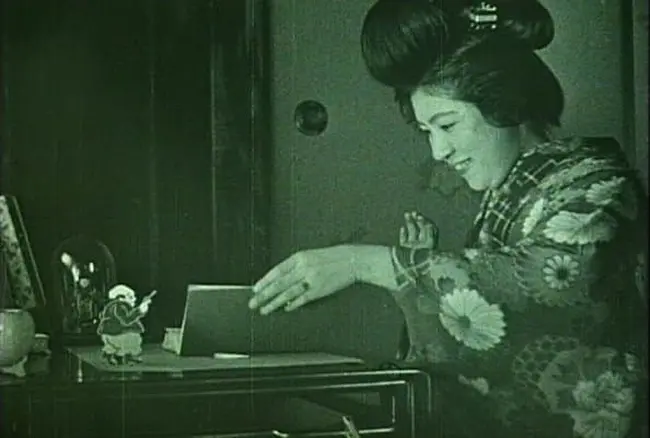
The film's central conceit—a tiny, animated cut-out man arguing with a live-action human actress about cigarettes—is inherently whimsical, yet it quickly veers into a surprisingly confrontational territory. This blending of live-action and animation, while rudimentary by today's standards, was a bold artistic choice at the time, predating many of the more famous attempts at such integration in Western cinema. It speaks to a playful, yet deeply experimental, approach to filmmaking that defined Ōfuji's career.
The surviving footage, though fragmented, reveals a narrative that feels both ahead of its time and firmly rooted in the societal norms of its era. The animated man’s escalating frustration, his aggressive use of smoke, and his eventual threat with a tiny gun, all build to a moment of what the plot summary terms 'mansplaining.' While this modern term wouldn't have existed then, the dynamic it describes—a diminutive male figure attempting to assert intellectual and moral superiority over a woman—is undeniably present, adding an unexpected layer of social commentary to what might otherwise be dismissed as a simple technical exercise.
The film’s abrupt ending, cutting off as the animated character launches into his lecture, only enhances its enigmatic quality. It leaves the viewer pondering not only what was lost, but also what Ōfuji intended to convey about gender dynamics, the act of smoking, and the very nature of argument itself. This incompleteness, while frustrating from a narrative perspective, ironically makes the film more compelling as a subject of academic study and critical interpretation.
At the heart of Kemurigusa monogatari's enduring appeal is its innovative use of cut-out animation. In an era dominated by cel animation or stop-motion with puppets, Ōfuji's choice to employ paper cut-outs was both practical and aesthetically distinct. This technique, while simpler to execute than traditional cel animation, allowed for a unique visual texture and a certain charming stiffness in movement that became a hallmark of his style.
The cut-out figure itself is rudimentary, yet its expressions and gestures are remarkably effective in conveying emotion. When the tiny man blows smoke or throws a tantrum, the animation, though jerky, communicates his escalating irritation with surprising clarity. This is a testament not just to Ōfuji's technical skill but also his understanding of character performance, even through the simplest means.
Compared to contemporaries like Winsor McCay's The Message of the Mouse or early stop-motion efforts, Ōfuji's approach feels distinctively handcrafted. It lacks the fluidity of drawn animation but gains a unique, almost theatrical presence. The static camera framing, a common constraint of early cinema, further emphasizes the theatricality of the desktop stage, making the animated figure's intrusion all the more pronounced.
The interaction between the live actress and the animated figure is where the film truly shines as a technical marvel for its time. While the compositing is simple, the illusion of a shared space, however brief and confrontational, is established. This early form of special effects work, achieved through careful staging and perhaps multiple exposures or in-camera tricks, laid groundwork for future generations of filmmakers who would more seamlessly blend disparate elements.
The 'acting' in Kemurigusa monogatari is a fascinating study in contrasts. The human actress, whose name is not readily available, provides a grounded, if somewhat understated, performance. Her reactions to the tiny man's provocations range from curiosity to mild annoyance, mirroring what a real person's response might be to such an absurd situation. She serves as the audience's anchor in the surreal environment Ōfuji creates.
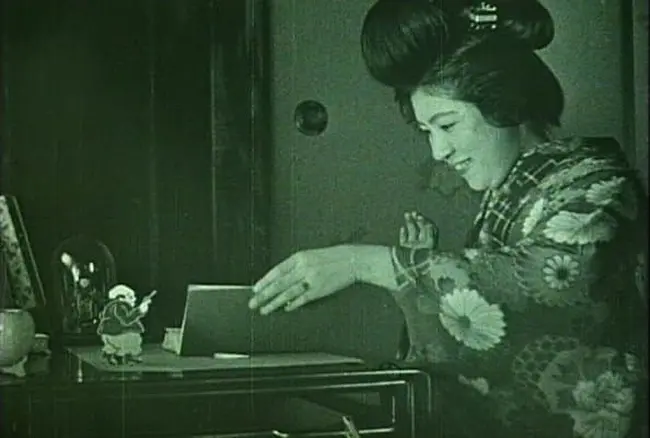
Her portrayal is crucial because it legitimizes the animated figure's presence. Without her believable reactions, the entire premise would fall flat. Consider, for instance, her subtle flinch when the smoke is blown at her; it’s a moment of understated realism that sells the interaction. This isn't grand theatrical acting, but rather a restrained, naturalistic approach that grounds the fantastical elements.
Ōfuji's direction, even within the confines of a short, experimental film, demonstrates a clear vision. He understands the power of scale and contrast. The deliberate choice to make the animated figure tiny amplifies his aggressive posturing and makes his threats, though comically small, feel disproportionately irritating. The pacing of the argument, from playful disagreement to outright hostility, is deftly handled, even if the ending feels unceremonious.
The tone shifts quite dramatically. It begins with a whimsical premise, quickly moves to an uncomfortable confrontation, and then ends on a note of intellectual condescension. This tonal dexterity, even in a few short minutes, is a testament to Ōfuji's nascent storytelling abilities. He doesn't shy away from making his tiny protagonist deeply unlikeable, which is a bold choice for an animated character in an era often characterized by more innocent, child-friendly fare.
The most poignant aspect of Kemurigusa monogatari is undoubtedly the 'lost footage.' The abrupt cut, just as the animated man launches into his 'mansplaining' about cigarettes, leaves a gaping hole in the narrative. It forces the viewer to confront the fragility of early cinema and the many stories that have vanished into the ether of time.
One can only speculate about what Ōfuji intended for the remainder of the film. Was it a straightforward lecture on the perils or pleasures of tobacco? Was it a satirical commentary on intellectual arrogance? Or perhaps it culminated in a resolution to the bizarre conflict, with the human actress eventually asserting her own agency? The absence of these answers adds a layer of mystery and academic intrigue to the film, making it a subject of endless 'what ifs.'
This missing piece fundamentally alters our perception of the film. What survives is a fascinating fragment, but it's impossible to judge its full artistic intent or narrative success without the complete picture. This is a crucial point for any critic approaching such a work: you are reviewing a ghost, a remnant, not a fully realized vision. It works. But it’s flawed by circumstances beyond its creator's control.
The film, in its current state, acts more as a historical document than a complete cinematic experience. It reminds us that even in the earliest days, filmmakers were experimenting with complex themes and pushing technical boundaries, often with limited resources and the looming threat of their work being lost to time. It’s a sobering thought, especially when considering the sheer volume of early cinema that no longer exists.
Beyond its technical innovations, Kemurigusa monogatari also offers a subtle, perhaps unintentional, commentary on the cultural landscape of its time. Tobacco, particularly cigarettes, held a different social standing in the early 20th century than it does today. It was often associated with sophistication, rebellion, or simply a commonplace habit, without the widespread health warnings we now take for granted.
The animated man's vehement arguments and condescending tone, even if just about cigarettes, tap into broader societal discussions about expertise, personal choice, and the dynamic between men and women. The 'mansplaining' aspect, though anachronistically termed, highlights a power imbalance that was pervasive. It’s a bold, if perhaps accidental, proto-feminist reading of a very early short.
Ōfuji might have simply intended a humorous argument, but the way the animated character exerts his will, through aggression and then intellectual superiority, resonates with deeper societal patterns. This makes the film surprisingly rich for interpretation, moving beyond a mere technical demonstration to touch upon human (and animated human) behavior.
It’s a bizarre, almost unsettling glimpse into a bygone era, where animation was still finding its voice, and social dynamics, however subtly portrayed, were already being dissected on screen.
Kemurigusa monogatari is less a film to be enjoyed in the traditional sense and more a vital piece of cinematic history to be studied and appreciated. Its enduring value lies in its pioneering spirit, its innovative blend of animation and live-action, and its surprising thematic depth, particularly concerning the power dynamics it subtly explores. Noburō Ōfuji’s early work here is a testament to the boundless creativity that defined the dawn of cinema.
While its incomplete nature is a lamentable flaw, it also adds to its mystique, inviting endless speculation about its original intent. It is a must-see for anyone serious about animation history or early film studies, offering a unique glimpse into the foundations upon which an entire art form was built. For others, it serves as a curious, brief, and historically rich oddity that highlights the experimental zeal of a bygone era. It's not a popcorn movie; it's a museum exhibit in motion. And it’s absolutely worth the visit for the right audience.
IMDb 6.5
1921
Community
Log in to comment.