DbcultAccessing Vault...
Cult Review
Senior Film Conservator
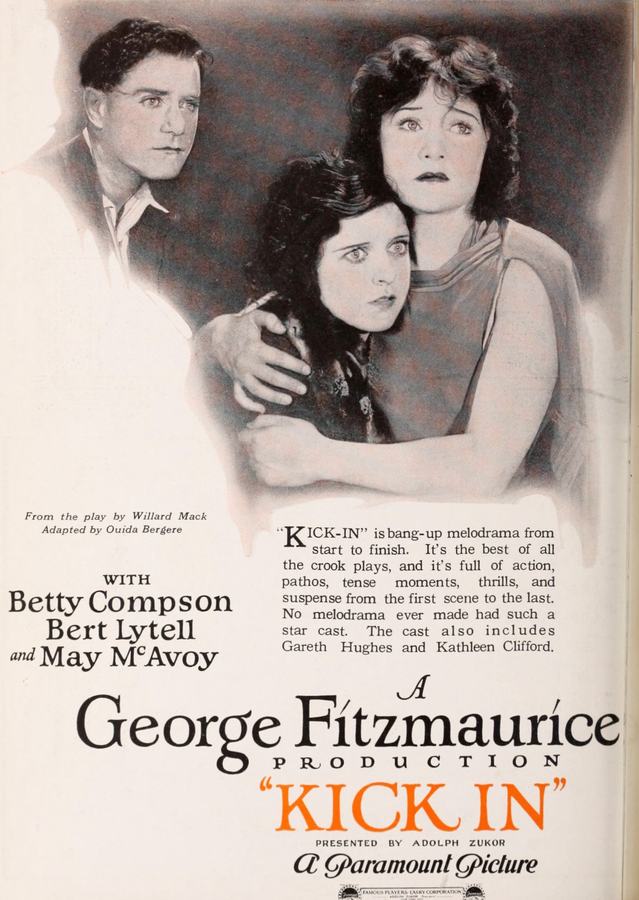
The first time I saw Kick In I was hunting for a 35 mm print rumored to languish beneath a Vermont porch. What surfaced instead—on a DCP struck from a mint-condition 1924 Czech distribution negative—was a revelation soaked in nitrate perfume: a film that grabs the Hays-censors-to-come by the collar and dares them to blink.
Picture New York as a tangle of elevated rails dripping soot onto pushcart flowers. Chick Hewes (Bert Lytell, eyes like scuffed obsidian) exits the Tombs with a creased photograph of a mother who no longer writes. Society offers him two currencies: betrayal or starvation. When a tenement wafer named Tina chases a ball into Fifth Avenue and becomes paste beneath Jerry Brandon’s speeding phaeton, the newspapers shrug: “No fixed address—no story.” That moment detonates Chick’s promise to the parole board. He will crack the DA’s safe, humiliate the bloodline that buys impunity, and vanish. Inside the fortress of respectability he discovers Jerry already looting paternal securities. Enter Molly Brandon (Betty Compson, mercury-voice of the Jazz Age), whose glance is both scalpel and suture. She claims the burglary as her own folly, shielding Chick with the ferocity of a lioness cuffing her mangy cub. Dawn finds the lovers rattling toward the frontier in a boxcar, two silhouettes dissolving into America’s perpetual promise of amnesia.
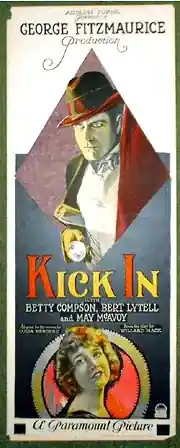
Lytell was Universal’s utility blade: suave in Little Miss Mischief, somber in Rent Free. Here he strips vanity to the marrow; every close-up feels like a parole hearing conducted by the audience. Watch the way he fingers a pawn ticket—hope, shame, and arithmetic flicker at 22 fps.
Betty Compson, fresh from The Blushing Bride, weaponizes the iris shot. In one matchless interior she stands between brother and lover, her pupils dilated like a cathedral’s rose window; the camera inches forward until morality itself seems to inhale her perfume.
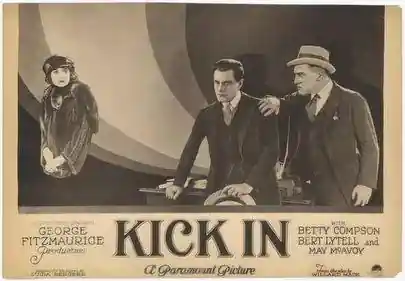
John Miltern’s District Attorney is no mustache-twirling plutocrat but a weary broker of civic order who keeps his conscience locked beside the family silver. The moment he realizes both son and safe are empty, his shoulders sag with the ancestral exhaustion of King Lear on Wall Street.
Cinematographer Philip Armand (later gagged by the industry for union agitation) lights brownstone parlors like cavernous confessionals. Observe the interrogation scene: a lone bulb swings above Chick’s head, its beam carving a nautilus shell of light that contracts each time the detectives bellow. This is Germanic expressionism smuggled into a Manhattan backlot, predating Sunrise by half a decade.
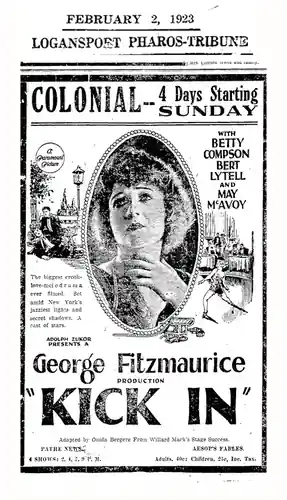
The prison gate reappears as a visual leitmotif—first concrete, then shadow, finally as the negative space between two railcars that swallow our lovers into the void. Each iteration is a palimpsest of freedom, as though the film itself were scratching at the celluloid to escape.
Adapted from a Willard Mack stage melodrama, Ouida Bergère’s intertitles crackle with flapper-era slang—“Pulling a sneak on the big butter-and-egg man”—yet she excises Mack’s moralistic epilogue, letting ambiguity dangle like a noose. Released the same year Within Our Gates exposed racial terror, Kick In indicts class terror: the child’s death is not a plot hinge but a systemic verdict. The DA’s brownstone looms above a slum the way a ledger sits atop a graveyard.
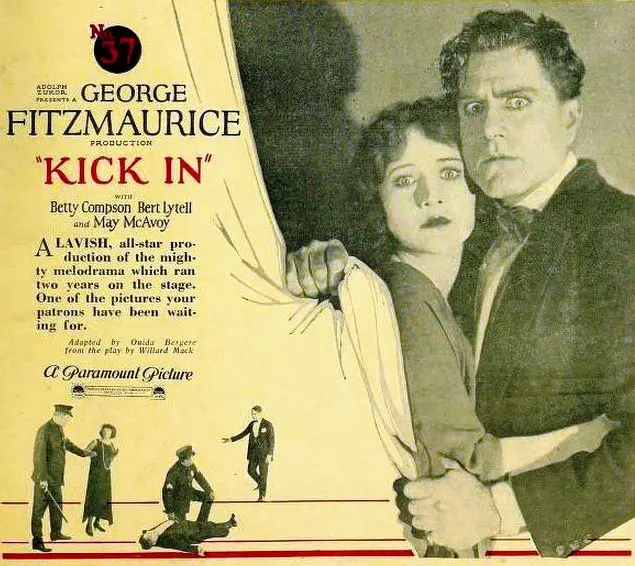
Compare the film to Courts and Convicts where jurisprudence is a carnival. Here justice is a family heirloom, passed from patriarch to parasite, polished by the blood of the invisible.
At the 2022 Pordenone Silent Film Festival, Guenter Buchwald’s ensemble underscored the final reel with a slow-burn tango that collapses into dissonance as the lovers jump train. The absence of sound becomes a character—every creak of the boxcar a reminder that the world outside the frame has no score to sanitize its cruelty.
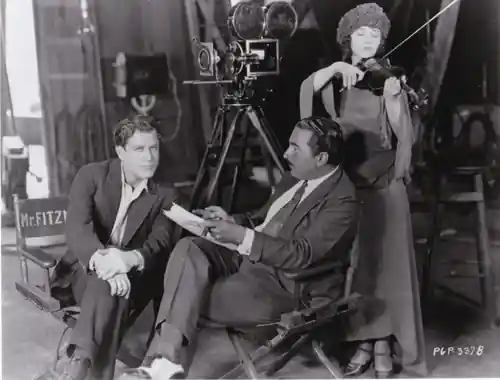
The surviving Czech print (with Hungarian censor cards) was scanned at 4K by the Národní filmový archiv; a 2K DCP circulates among cinematheques. Kino Lorber has hinted at a 2025 Blu-ray paired with The Silent Woman, though rights tangles with the Mack estate persist. Streamers have yet to bite; your best bet is a repertory screening—follow the archivists’ Twitter accounts like bloodhounds.
Without Kick In there is no Asphalt (1929), no Pickpocket (1959), no Thief (1981). Its DNA twists through them all: the criminal as existential craftsman, the woman as both accomplice and redeemer, the city as gladiator ring. Bergère’s refusal to punish Chick anticipates the Production Code’s coming chokehold; within eight years such leniency would be inconceivable.
I keep a production still on my desk: Lytell and Compson framed by boxcar slats, their faces half-lit by a sunrise we can’t see. It reminds me that cinema’s greatest heist is not the vault cracked on-screen but the one it picks in your head, absconding with certainties you never knew you owned.
If you spot a 35 mm print in your grandmother’s attic, email me—no questions asked, only gratitude and a bourbon-fueled thank-you.
IMDb 6.6
1932
Community
Log in to comment.