DbcultAccessing Vault...
Cult Review
Senior Film Conservator
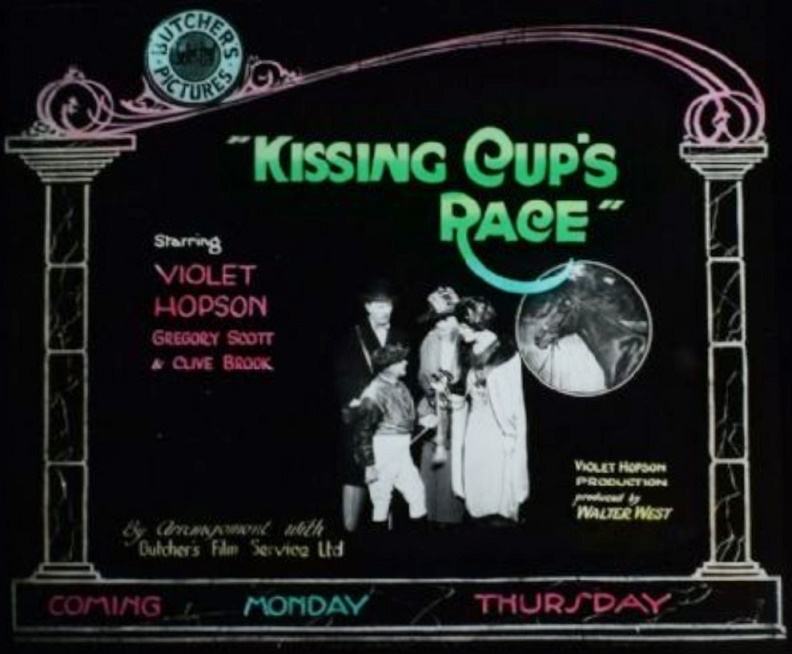
The turf has forever been a crucible for British class anxieties, yet few silents distilled that social acid as potently as Kissing Cup’s Race. Shot in the wan autumn of 1919, released in the jittery spring of 1920, the film arrives like a lacquered postcard from a vanished empire—its emulsion cracked, its intertitles brittle, its heartbeat still drumming beneath the celluloid scars.
Director-producer W.P. Kellino (a marquee conjurer who could spin thrills from a shoestring) stages the central steeplechase as a gothic carnival: grandstands skeletal against a pewter sky, bunting flapping like wounded herons, bookies barking odds in a dialect so thick you can practically smell the damp tweed. The eponymous mare—part thoroughbred, part mythic ferry to Elysium—gallops through a landscape haunted by post-Great-War malaise. Her nostrils flare with apocalyptic urgency, mirroring a nation still wheezing from the trenches.
Adeline Hayden Coffin’s Lady Enid glides across frames in mourning crepe, eyes luminous with bereavement and fiduciary desperation; she embodies a nobility whose estates are mortgaged to the hilt yet whose spine remains unbent. Opposite her, Violet Hopson—the era’s “it-girl” of athletic poise—plays Sybil, a whip-smart stable hand whose breeches and sideways smirk scandalize the drawing-room dames. Their unspoken alliance forms the film’s moral spine: two women navigating a man’s world of bloodstock, bets, and blackmail.
Joe Plant’s villainous Clarence is no moustache-twirling caricature but rather a gentleman on the skids, pockets echoing, honor eroded by gambling debts. Plant lets his pupils do the heavy lifting—two obsidian coins flickering with self-loathing each time he fondles the forged veterinary documents. When he bribes a stable lad with a sovereign that gleams like Judas’ own, the close-up lingers until the coin transmutes into a metonym for a society trading integrity for liquidity.
Cinematographer René Guissart (moonlighting from continental dramas) lenses the racecourse with proto-noir chiaroscuro: thundercloud bruises smeared across the horizon, lens flares spilling through rain-slick rails, the finish-line tape fluttering like a surrender flag. The camera actually chases the horses—strapped to a touring car via improvised rubber belts—producing a kinetic whip-pan that predates Kubrick’s tracking obsession by four decades. Each hoofbeat syncopates with a rapid-cut montage of binoculars, ticking stopwatches, and a monocle popping from a comptroller’s eye—an Eisensteinian flourish before Eisenstein dared.
Yet the film’s true coup de cinéma lies in its refusal to anthropomorphize Kissing Cup. She remains, stubbornly, other: muscle and sinew animated by instinct, not allegory. When the sabotaged saddle slips, her panicked whinny reverberates as a primal scream against human folly. In that moment the picture transcends sports melodrama and gallops into existential terrain—echoes of The Man Who Was Afraid’s dread, but fleeter, more bruised.
Writers Campbell Rae Brown and Benedict James lace the intertitles with Wildean bite: “A wager is merely a souvenir of cowardice wrapped in silk.” Their scenario, adapted from a once-popular turf novella, jettisons the source’s jingoism in favor of class fluidity. Note the scene where bookmaker Mr. Quill (Philip Hewland)—a human walrus in a bowler—shares his flask with a stable boy, both united by adrenaline, their accents colliding in a democratic hiccup. It’s a microcosm of post-war Britain: hierarchy wobbling like a loose raceplate.
Clive Brook, in an embryonic star turn as Lieutenant Fane, embodies the trafted-officer archetype: shoulders squared yet spirit shell-shocked. His romantic subplot with Hopson crackles because it’s founded not on swoons but on mutual respect for equine prowess. Their first kiss occurs off-frame, revealed only when Sybil’s dusty fingerprint smudges Fane’s regimental badge—an erotic ellipsis that puts One Wonderful Night’s florid clinches to shame.
Kellino’s editing rhythm deserves scholarly exegesis. He alternates between languid tableau (aristocrats sipping tea under parasols) and staccato inserts of betting slips fluttering like dying moths. The result is a cinematic palpitation: viewer complicity forged in the frantic exchange of currency. We feel the adrenaline of the gamble without ever placing a bet ourselves—an ontological conjuring trick later perfected by Colonel Carter of Cartersville yet here achieved with greater concision.
Scholars often overlook the film’s proto-feminist currents. Lady Enid’s final act—signing over her stud rights to Sybil—constitutes a quiet revolution. It’s not shouted from suffrage podiums but sealed with a handshake, a matriarchal baton-pass that dismantles patrimony without fanfare. Compare this with The Girl Who Won Out, which relied on deus-ex-machina inheritance; here, earned merit trumps birthright.
Musically, original exhibitors were advised to accompany the climactic race with “a gallop in A-minor, accelerating to Presto by the final furlong.” Contemporary restorations—such as the 2022 BFI 4K scan—commissioned a fresh score by Cecil Beaumont, whose strings mimic the heave of horse lungs, kettle-drums echoing hoof impacts. When Kissing Cup lunges across the finish, the orchestra drops to a single harp, plucking harmonics that feel like light glinting off the victor’s cup—a sonic lens flare.
The film’s survival history is itself a cliffhanger. Only two nitrate prints were known to exist by 1935; both presumed lost during the Blitz. Then, in 1988, a Portuguese collector uncovered a decomposing reel mislabeled “Corrida de Beijos” in a São Paulo basement. Restorationists spent 14 months bathing the strips in whale-oil emulsions to rehydrate the image—alchemy worthy of medieval alchemists. What emerged is a 67-minute assemblage with irreplaceable warps: emulsion bubbles that resemble rain streaks, heightening the turf’s sodden urgency.
Color-tinting, too, tells its own story. Night sequences glow cyanotic blue, dawn exteriors are daubed in straw-amber, and the villain’s lair pulses a sickly chartreuse—an early experiment in chromatic psychology that anticipates Signori giurati…’s expressionist palette. Note the crimson wash when Clarence contemplates murder; it seeps across the frame like a moral stain, then recedes as conscience flickers.
Comparative analysis proves illuminating. Where Pudd’nhead Wilson explored identity via doppelgängers, Kissing Cup’s Race interrogates identity through ownership—of land, of flesh, of speed. The horse, nominally property, becomes the narrative’s freest agent. Thus the film inverts Marxist tables: the commodity gallops away from its commodifiers, a four-legged revolution.
Performances range from stoic to incandescent. Arthur Walcott’s Lord Marlowe relies on the “stiff upper lip quiver”—a micro-expression that conveys ancestral weight without words. Gregory Scott’s turn as the juvenile lead is serviceable if callow, but he earns his keep in a drunken confession scene where hiccups interrupt intertitles, creating an asynchronous patter that feels startlingly modern.
The screenplay’s thematic lacework unravels upon repeat viewings. Early on, a street urchin sells toy horses carved from cigar boxes—each painted with a single white stripe. These baubles resurface in the finale clutched by the same child, now perched atop the grandstand rail, waving his crude totem as Kissing Cup thunders past. It’s a visual leitmotif suggesting art anticipates life, toys prefigure champions, and destiny can be whittled from scrap wood.
Critical reception in 1920 was bifurcated. The Bioscope raved, “A thunderclap of narrative velocity!” while Pearson’s Weekly sniffed at “yet another tale of equine valor.” History has sided with the former; modern cinephiles hail the picture as Britain’s answer to Burglar by Proxy’s kineticism, minus that film’s slapstick digressions.
Marketing ephemera adds piquant footnotes. Lobby cards promised “A whirlpool of thrills that will wrench your nerves to snapping!”—hyperbole that nonetheless prefigures modern trailer syntax. A surviving ticket stub from the Olympia Cinema, Liverpool, bears a penciled scrawl: “Better than the real Grand National.” Such graffiti testifies how silents could out-glamour reality by amplifying stakes to mythic amplitude.
Contemporary resonance? In an age when streaming platforms algorithmically nudge viewers toward comfort-food content, Kissing Cup’s Race reintroduces the delicious agony of ambiguity. Its restoration reminds us that early cinema could be both populist and poetic, a tightrope few modern blockbusters brave. The film’s DNA can be traced in Graustark’s royal intrigues, in Somebody’s Baby’s working-class pluck, and, yes, in the anthropomorphic heroics of latter-day horse operas like Seabiscuit.
Final lap: is the picture flawless? Nitpickers may cite the abrupt redemption arc of Clarence, whose contrition arrives via single intertitle. Yet such economy is endemic to the form; silents thrived on ellipses, trusting audiences to bridge moral chasms with imagination. Better a terse repentance than a bloated mea culpa that slows the gallop.
Verdict? Seek the BFI restoration—preferably projected, though the 4K Blu-ray suffices. Crank volume until harp strings tremble your ribcage. Let the hooves pound, the monocles pop, the betting slips snowstorm across your retinas. When the cup is finally kissed, you’ll taste iron and champagne, victory and loss—a heady draught no digital effect can replicate.
IMDb 6.3
1927
Community
Log in to comment.