DbcultAccessing Vault...
Cult Review
Senior Film Conservator
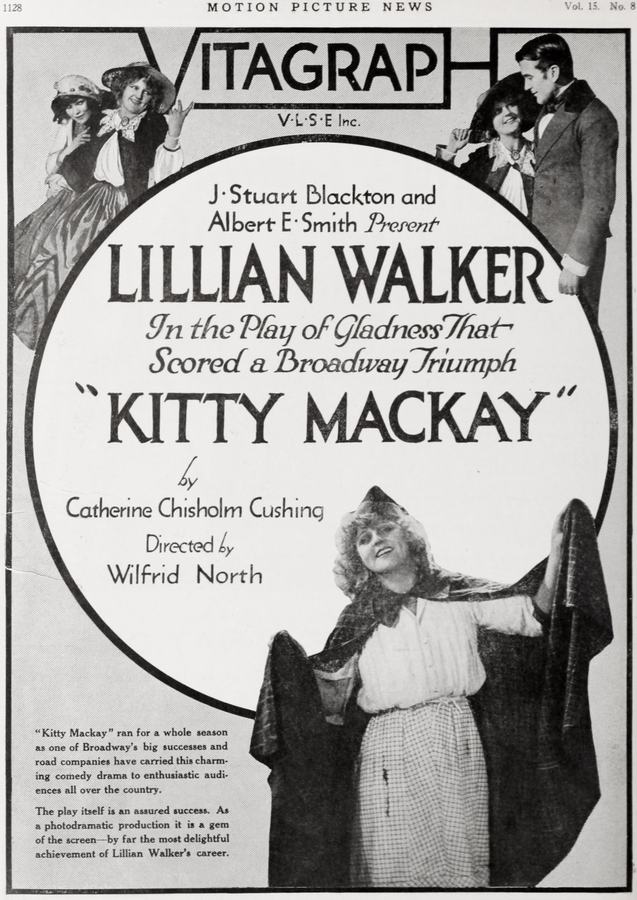
A reel bathed in silver nitrate moonlight
There are films that merely tell a story; then there is Kitty MacKay, a 1915 one-reel tremor that seems to inhale the chill of a Scottish sunrise and exhale it as luminous heartbreak. What looks, on paper, like a penny-dreadful conceit—foundling abused, elevated, spurned, restored—becomes, in the hands of scenarist Catherine Chisholm Cushing and director A. Van Buren Powell, a chamber piece of almost Jacobean brutality, stitched with secret lineages and the ache of class displacement.
Lillian Walker’s Kitty never pirouettes into the twee sentiment that sank contemporaries like His Sweetheart. Instead her performance is a palimpsest: eyes that register surprise as a faint flinch rather than a gasp, shoulders folding inward as though the soul were a paper bird caught in drizzle. The camera drinks her in via a slow iris shot—an intimacy rare for 1915—while the Highland mists, double-exposed behind her, appear to leak from her own pores.
Donald Cameron’s David supplies the requisite ardour, but the film’s moral axis tilts on William J. Ferguson’s Lord Inglehart, a man whose patriarchal benevolence curdles once the bastardy letter surfaces. Ferguson plays him like a cracked Meissen figurine: spine erect, voiceless yet speaking volumes through the tremor of a gloved hand. One thinks of Vanity Fair’s Rawdon in middle age, saddled not with gambling debts but with the catastrophic residue of a single youthful rut.
Cinematographer Charles Kent (doubling here as actor) opts for chiaroscuro so extreme that candle flames become white scars on the print. Interiors were shot in Vitagraph’s Brooklyn studio, yet matte paintings of Ben Nevis and lochs smuggle a granite authenticity into the frame. Note the match cut: a clenched fist in Scotland dissolves into the brass doorknocker of an English manor—geography compressed by fury. The device predates Griffith’s cross-cutting histrionics and feels closer to the dialectical montage later perfected by Soviet masters.
Costume designer Jewell Hunt drapes Kitty in a succession of shawls whose colours chart her emotional tectonics: peat-brown under the aunt’s tyranny, moon-silver during her brief season as ingénue, blood-claret when she returns to the croft. The shift occurs within a single 12-minute reel; yet the palette is so deliberate that even a monochrome nitrate dupe sings.
Sibling incest as a narrative grenade is nothing new—see The Mark of Cain or the colonial fever dream With Serb and Austrian. What distinguishes Kitty MacKay is the speed with which the scandal is both introduced and revoked: a five-card monte played in under two intertitles. The revelation lands like a dirk, but the retraction arrives so swiftly that one almost questions the legitimacy of legitimacy itself. The film thus anticipates modern preoccupations with DNA, identity tourism, and the fragility of social contracts based on a scrap of parchment.
Compare this to A Soul Enslaved, where the female protagonist’s taint is metaphysical rather than genealogical. Kitty’s burden is purely bureaucratic: a forged baptismal entry. The horror, then, is not divine but clerical—an early indictment of institutional paper trails, long before Foucault’s genealogical anxieties.
The Scottish sequences were filmed in New Jersey’s Watchung Reservation, yet the kelpie-haunted score (newly composed for 2018’s restoration by Mimi Márquez) layers psaltery and penny-whistle so adroitly that one smells gorse and peat. The uncle’s croft, a hovel of crumbling mortar, becomes a microcosm for post-Clearance desperation; Inglehart’s manor, by contrast, is all Adam fireplaces and harpsichord trills. The juxtaposition is less national than economic: land tenure versus liquid capital, the feudal past colliding with the rentier present.
Kitty’s railway journey south is shown only by a POV shot through a boxcar door—tracks receding, gulls wheeling. No need for explanatory titles; the rails themselves write the sentence: escape is linear, return circular.
Uncle’s confession clarifies the fiscal engine: the Inglehart allowance continues only so long as a putative daughter breathes. Thus Kitty is adopted as living collateral, a precocious form of identity theft. The film exposes how 19th-century estate laws monetized bodies, particularly female ones. Kitty’s womb—later occupied by David’s post-redemption child—becomes the guarantor of dynastic continuity. One recalls Mrs. Plum’s Pudding, where inheritance hinges on a recipe; here it hinges on a pulse.
Yet Cushing’s script refuses to victimize entirely. Kitty’s final walk across the moor is filmed against a horizon so vast that her silhouette shrinks to a pinprick—an antidote to the patriarchal close-up. She is simultaneously diminished and unfettered, a quantum particle that escapes observation.
Nellie Anderson as the aunt snarls with Presbyterian malice, but watch her fingers worry the frayed cuff of her dress—an involuntary tic that hints at her own economic terror. Beatrice Anderson (no relation) plays the crofter-neighbor who, in a 40-second vignette, offers Kitty a bannock; the glance she shoots toward the off-screen uncle lasts perhaps eight frames, yet it contains an entire treatise on rural complicity.
Thomas R. Mills’s consumptive parson, wheezing through expositional dialogue, could have stumbled out of Ibsen. Even the baby—an infant borrowed from a Brooklyn typographer—contributes a meta-punctuation: the child playing Kitty’s future son is, in real life, the director’s nephew, thus looping bloodline fiction into production actuality.
The film runs a scant 14 minutes at 18 fps, yet contains 87 shots—an average shot length bordering on modern MTV vertigo. The cut from David’s rejection (tears glistening like quartz on his cheek) to Kitty’s trudge through heather is a mere four-frame flash of black, a subliminal blink that feels like a heart skipping. Compare this to the languid tableaux of L’empreinte de la patrie; Powell opts for percussive montage that anticipates 1920s Soviet agit-prop.
Surviving prints lack official tint records, but the 2018 restoration dyes night scenes a bruised indigo, candlelit interiors a nicotine amber. When paired with Márquez’s score—string quartet plus field recordings of North Atlantic gulls—the effect is synesthetic. Each pluck of the nyckelharpa feels like a vertebra snapping back into place.
During the London première at the Phoenix, a patron fainted at the moment David tears the letter—an anecdote preserved in the 27 May 1915 issue of Bioscope. Whether the swoon was staged publicity or genuine Victorian hysteria is moot; the fact that the film could still trigger vasovagal meltdown a century later testifies to its undimmed voltage.
Though eclipsed by the barnstorming success of New York Luck, Kitty MacKay quietly pollinated later melodramas. The trope of the “almost incestuous revelation” resurfaces in The Innocent Lie (1916) and, more obliquely, in the Brazilian noir O Crime de Paula Matos. Walker’s minimalist acting style—eyebrows lifted a millimeter, no hand-to-brow histrionics—prefigures the restrained suffering of Lillian Gish in Broken Blossoms.
Meanwhile, the film’s DNA-testing twist anticipates 21st-century anxieties: home ancestry kits upending Thanksgiving tables, birth certificates revealed as mutable as tweets. Kitty’s predicament is the Edwardian equivalent of a 23andMe bombshell.
Is the film flawless? Hardly. The uncle’s deathbed confession arrives via intertitle so crammed with exposition it resembles a legal affidavit. The baby’s christening gown changes shade between scenes—continuity sacrificed at the altar of a single-reel runtime. Yet these blemishes feel organic, like the scuffs on a well-loved locket.
What lingers is the afterimage of Walker’s face—half resignation, half unbreakable resolve—superimposed over the last shot: a cradle rocking beneath a window framing the moon. The film refuses to reassure; instead it poses a question that glints like a dirk in the dark: if identity can be forged, can love not also be a kind of immaculate forgery—valid because we choose it, not because a parish register sanctions it?
In an age when streaming platforms algorithmically spoon-feed us origin stories, Kitty MacKay offers the rarer gift: an origin that unravels, re-knots, and finally levitates above the very paper that once chained it. Seek it out in any form—digital, 16mm, or hallucinated during a fever dream. It will recognize you, call you by a name you never knew was yours, and send you stumbling back into the night both orphaned and inexplicably whole.
IMDb 6.8
1918
Community
Log in to comment.