DbcultAccessing Vault...
Cult Review
Senior Film Conservator
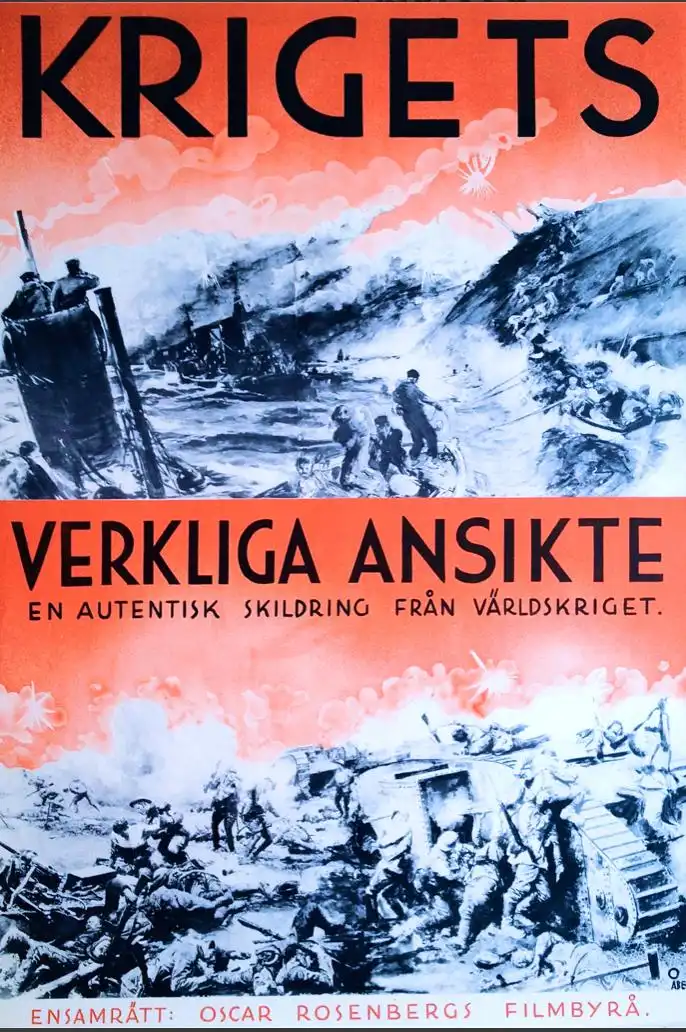
Alright, so if you're looking for a comfortable night in with popcorn and a traditional story, move along. Krigets verkliga ansikte (The Real Face of War) is *not* that. This is for the history buffs, the documentarians, anyone who really wants to feel the weight of early 20th-century cinema trying to grapple with something immense. If you appreciate a stark, unflinching look at reality, especially from a time so far removed from our own, this is absolutely worth seeing. But if you need plot, characters, or even sound (mostly, it's silent footage), you'll probably find it a slog.
What strikes you immediately is the sheer *age* of it all. These aren't reenactments. These are actual people, real battlefields. It's footage from World War I, cobbled together by Albert Wickman and Einar Krenchel to make a point: war is awful. And they make that point with an almost brutal simplicity.
There's this one sequence early on, I think, where you just see soldiers, covered in mud, trudging through what looks like a moonscape. No grand speeches, no dramatic music. Just endless, weary steps. The camera holds on their faces for a beat too long sometimes, catching that deep exhaustion, the kind you can almost feel in your bones even through the grainy black and white. It’s not elegant; it just *is*.
You can almost feel the filmmakers trying to shake the audience awake. They pile on the images: trenches overflowing, shattered trees, the ghostly silhouettes of destroyed buildings against a hazy sky. It’s less about information and more about overwhelming sensation. You see the horses, the machinery, the sheer scale of destruction, and it’s… a lot. Not in an over-the-top way, but in a relentless, quiet way.
It’s fascinating how they use juxtaposition. One moment you might see some almost mundane camp life, a soldier trying to light a cigarette in the wind, and then bam! A sudden cut to a shell exploding in the distance, or a pile of debris. The contrast hits harder because it’s not flashy. It’s just showing you the two sides, the quiet moments that *had* to exist, right next to the chaos.
There's a particular shot, it stuck with me, of what looks like a field hospital. Maybe. It's hard to tell for sure with the old footage quality, but you see figures moving with a kind of hushed urgency. It's not graphic, but the implication of suffering is heavy. The *intent* behind showing that, even without a voiceover telling you what to feel, is unmistakable. This is what war brings, they say, plain as day.
The pacing is… well, it’s not for modern audiences. It lingers. Sometimes the scenes go on about 10 seconds too long, and the silence starts to feel awkward rather than emotional. But maybe that's the point. Maybe that's how it felt. The endless waiting, the boredom punctuated by terror. It feels less like a carefully edited film and more like someone just laid out all the footage they had and said, "Look."
And you do look. Because these are real ghosts. These men, these landscapes, they all existed. And the film, despite its age and primitive techniques, manages to convey a powerful sense of *loss*. Not just of life, but of innocence, of peace. It's a heavy film, not one for casual viewing. But if you’re up for it, it really makes you think about what those early audiences must have felt, seeing this for the first time, maybe knowing someone who was *there*.
It’s an important document, really. A testament to how film, even in its infancy, could be used as a powerful tool for social commentary. It’s not perfect, certainly. Some of the cuts feel a bit clumsy, and without context, some segments are a little hard to grasp. But the core message, that raw, unvarnished plea for peace… that still comes through loud and clear, even without a spoken word. It's an experience, not just a movie. And that makes it worth seeking out, especially for those who care about film history and the echoes of a distant past. 🎞️
IMDb —
1922
Community
Log in to comment.