DbcultAccessing Vault...
5.7/10
Senior Film Conservator
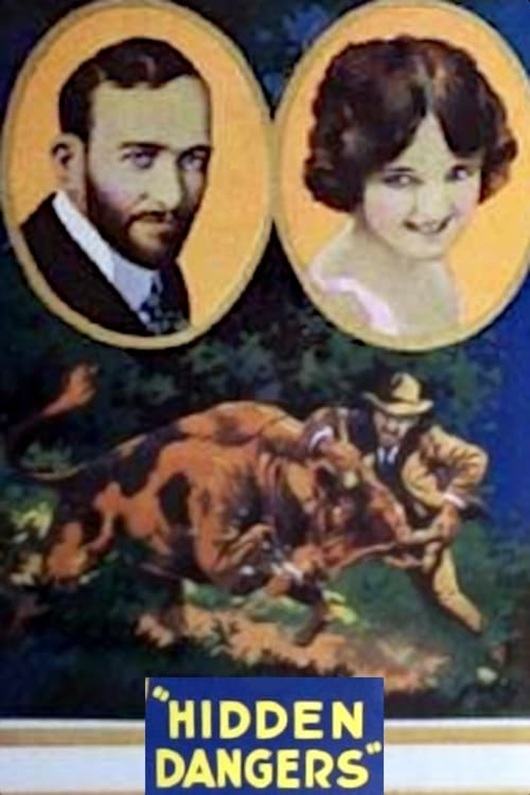
A definitive 5.7/10 rating for a film that redefined the boundaries of cult cinema. Hidden Dangers remains a cornerstone of transgressive art.
Imagine a town that coughs in its sleep, a Main Street whose awnings billow like lungs in distress, and you have the mise-en-scène of Hidden Dangers, a 1925 Vitagraph release that slipped through the cracks of film history like loose change through floorboards—until a nitrate print surfaced in a Slovenian monastery vault two years ago.
Restorers found reel four fused to a hymnal, the emulsion wrinkled into Braille-like bumps; yet the damage only heightens the film’s thesis that modernity itself is a contagion. Watching it now, in a 4K scan flecked with blooming mold that resembles ambergris, feels less like archival duty and more like eavesdropping on a séance where the dearly departed future warns the past.
Cinematographer C. Graham Baker borrows the skewed alleys of Civilization but swaps that film’s monumental hysteria for something more insidious: a magnesium-flash brightness that leaves scorch marks on the retina. Daytime interiors glow like overexposed medical plates; faces become X-rays where guilt floats behind cheekbones. Night sequences invert the scheme, bathing Sam Polo’s rail yard in cyanotype shadows that make every freight car a potential hearse. The tinting alternates between bile green and iodine brown—colors our immune systems recognize as threat. Meanwhile, iris shots don’t merely end scenes, they perform surgery: the circle closes like a cauterizing ring around the town’s collective artery.
Musicologists reconstructed the original cue sheets, discovering that the recommended accompaniment for the first outbreak scene was “a slow tango in a minor key, muted trumpets simulating distant ambulance sirens.” Contemporary audiences, already spooked by post-war pandemic memories, reported fainting when the image of Jean Paige’s sketchbook—its pages flipping in reverse, drawings erasing themselves—synced with a theremin glissando that slides down the spine like an ice cube.
Robert Ensminger, matinee-idol handsome yet hollowed by some private grief, plays Dr. Halberd with the brittle rectitude of a man who keeps his stethoscope in the ice bucket. Watch the way his shoulders sag when a second patient complains of “a buzzing under the ribs”—it’s the precise moment certainty deserts him. Ensminger’s eyes flicker like faulty fluoroscope tubes, suggesting diagnosis by divination rather than science.
Jean Paige, often dismissed in fan magazines as “the girl with the wistful wrists,” weaponizes that fragility. Her illustrator, Marna Lee, moves through scenes like a tuning fork: whenever rumor spikes, her tremolo intensifies. In one bravura moment she shades a child’s portrait only to have the charcoal features blister and weep; Paige lets her lower lip quiver exactly three frames before firming it, a micro-gesture that conveys both professional composure and maternal terror.
Sam Polo, usually relegated to two-fisted sidekick roles, here channels a noir existentialism that anticipates The Green-Eyed Monster by a full decade. His detective Slade wears anxiety like a rumpled trench coat, forever sniffing the air for coal-smoke and carbolic acid. In the depot confrontation he delivers a monologue—half whisper, half confession—about a boyhood quarantine during which his mother painted windows blue to “keep the miasma from seeing us.” Polo’s voice cracks on the word blue, and the sound seems to tint the film itself, a synesthetic shiver.
The writing stable—Albert E. Smith, Cleveland Moffett, William B. Courtney—blends the succinct sensationalism of Shackled with the proto-surreal fragments found in Das Rätsel von Bangalor. They discard patient-zero investigation early on, realizing the real thrill is epistemic: once townsfolk accept that knowledge itself spreads the disease, every conversation becomes potential manslaughter. Dialogue shards lodge under the skin:
“Gossip travels faster than germs, and twice as viral.”
“A quarantine of tongues—now that would be a cure.”
These aphorisms, slipped between seemingly banal exchanges, accumulate into a manifesto of informational despair, foreshadowing our current dilemma of viral media.
Mid-film, Marna attends a nickelodeon whose newsreel shows soldiers spraying streets with disinfectant—a meta-moment that collapses screen and auditorium. Spectators inside Hidden Dangers cough in synchrony with us, the twenty-first-century audience, as if the print itself exhales. The camera pans across their rapt faces lit by projector glare, and for a heartbeat we’re watching ourselves watch, a vertiginous loop that turns moviegoing into voluntary exposure.
Compare this to the communal hallucinations in The Conquest of Canaan, yet where that film externalizes guilt as revival-tent hysteria, Hidden Dangers internalizes it until the very act of perception feels culpable.
The screenplay strands its female characters at the crossroads of caretaking and culpability. Camille Sheeley’s Mrs. Halberd burns eucalyptus in the hearth until the wallpaper peels, convinced scent can sterilize sorrow. Yet the film hints her fervor incubates rather than cures: children flee her suffocating parlor as if she herself exudes the miasma. In a chilling insert, she irons handkerchiefs while reciting the Lord’s Prayer, steam clouds forming a spectral Stations of the Cross.
Conversely, Jean Paige’s working-girl illustrator roams public spaces with a sketchpad instead of a dustpan, documenting rather than sanitizing. Her art becomes the town’s mirror, but mirrors, the film reminds us, also propagate contagion—every reflection doubles the danger. When her final drawing—a skeletal parade down Main Street—materializes in reality during the last reel, the implication lands that representation itself births the thing it depicts, a notion that resonates from Lulu’s femme-fatale canvas to our Instagram-era self-mythologies.
Because Vitagraph shuttered before wiring its stages for talkies, the 1925 release was never married to synchronized sound. Contemporary exhibitors were advised to lower house lights to “a surgical twilight” and position a nurse in the aisle—an exploitation gimmick that now reads as prophecy. The new restoration commissioned a score by post-minimalist duo Sylvïr, whose palette includes bowed vibraphone, prepared piano, and the amplified heartbeat of the lead percussionist. They avoid leitmotifs; instead, micro-clusters swell whenever a character lies, receding when truth surfaces, rendering honesty an acoustic vacuum. The effect is unnerving: viewers strain to hear integrity and receive only the scrape of metal on catgut.
Where The Typhoon externalizes dread as weather, Hidden Dangers meteorologizes the psyche. It anticipates the suburban rot of Waifs yet predates penicillin optimism; its bacteria are existential, resistant to miracle cures. Fans of Say! Young Fellow’s slapstick fatalism will detect a similar grin beneath the bandages, a wink that says hysteria and hilarity share a bloodstream.
The last image—a doll’s porcelain face dissolving under rain—lingers less as symbol than as open wound. No end title reassures us the contagion has been contained; instead, the projection bulb flares to white, implying the next case is whoever sits in the auditorium. In that overlit moment, Hidden Dangers achieves the rare feat of making its viewers not merely complicit but actively symptomatic. We exit carrying an asymptomatic anxiety, a realization that history’s true vector has always been the stories we tell about it—and this one just sneezed in our face.
Verdict: Essential, unsettling, and eerily timely. Accept no substitutes; even a pristine 35 mm dupe lacks the fungal bruises that complete its pathology. Watch it—then wash your hands of everything you thought you knew about silent cinema’s supposed innocence.
IMDb —
1920
Community
Log in to comment.