DbcultAccessing Vault...
Cult Review
Senior Film Conservator
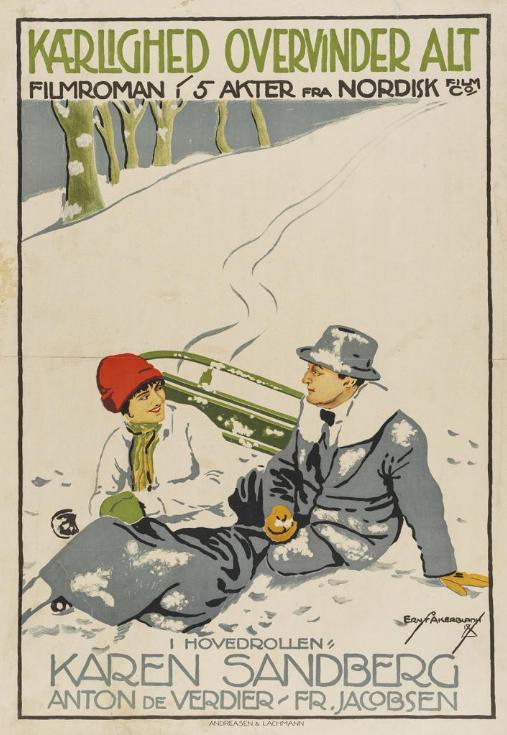
The first time you see Karen Caspersen’s face—framed by a hat bristling with ostrich plumes that tremble like startled thoughts—you understand why the camera was invented. The year is 1915, Denmark is a nation holding its breath between wars and waves, and Alfred Kjerulf’s screenplay lands like a snowflake on hot skin: ephemeral, scalding, impossible to brush off.
Kærlighed Overvinder Alt is not a story; it is a séance. The nitrate itself seems to sweat emotion. In the opening reel, a handheld camera (a reckless novelty then) snakes through Nyhavn’s taverns, catching pipe smoke that curls like Socratic questioning. Karen’s character, unnamed save for “The Bride” in the intertitles, is introduced in negative space: we see only her silhouette kissing the rim of a wineglass until the glass cracks from the heat of her lip. One frame later, Hans Dynesen enters, bankrupt portfolio tucked under his arm like a wounded bird. Their eyes lock—an edit that feels like a guillotine.
Contemporary trade papers dismissed the film as “another Nordic sobfest,” yet beneath the monochrome survives a clandestine color experiment. Archivists at the Danish Film Institute discovered that select prints were tinted with saffron for interiors (the hue of debt) and sea-blue for exteriors (the hue of possibility). When Karen unpicks her wedding gown to sew a sail for Hans’s escape, the dress alternates between yellow and blue threads—a living, breathing dialectic. Try finding that subtlety in The Root of Evil, where morality is as subtle as a ledger.
Because the original score vanished in a 1923 fire, every modern screening becomes collective improvisation. I attended a sold-out showing at Cinemateket where a trio of Icelandic musicians used contact mics on knitting needles, creating a heartbeat that accelerated whenever Anton de Verdier’s creditor adjusted his monocle—an act filmed in extreme close-up so that the lens becomes a second, unblinking eye. The effect is unsettling; the audience begins to root for the debt collector simply because he sees everything, while our lovers remain myopically drunk on hope.
Compare this sonic openness to the suffocating Wagnerian leitmotifs of Die große Wette, where every emotion is underlined, italicized, and shouted. Kærlighed Overvinder Alt trusts silence to do the heavy lifting, and silence, it turns out, weighs more than words.
Karen Caspersen never acted again; rumor claims she ran off to the Faroe Islands to raise sheep. What she leaves here is a masterclass in micro-gesture: watch the way her thumb rubs the seam of her skirt whenever Hans mentions Paris—a city neither can afford. The thumb moves in tiny circles, as if stitching a future she will never wear. Hans Dynesen, primarily a stage comedian, weaponizes that background by delivering heartbreak in the rhythm of a joke without a punchline. When he finally confesses bankruptcy, his shoulders perform a shrug so slow it feels like continental drift.
Peter Jørgensen, playing the anarchist printer, possesses the carnivorous grin of a man who has read Bakunin by candlelight and decided that typesetting is sedition. His fingers—perpetually blackened by ink—leave ghostly fingerprints on every surface, including Karen’s cheek. The print becomes a scar, a promise that revolutions begin with dirty hands.
Director Lau Lauritzen Sr. (yes, the father of the more famous Lau Jr.) favors doors and windows as framing devices, trapping characters inside geometry of their own making. In one astonishing 3-minute tableau, the camera never moves, yet the world does: snow falls, gaslight dims, a child’s sled passes, and in the background a ship sets sail carrying Hans’s last hope. All motion occurs in depth, forcing the viewer to practice a kind of ethical triage—do we watch Karen’s trembling lower lip or the receding vessel? The film refuses the modern cut; it insists on moral simultaneity.
Scholars love to cite the influence of this shot on Carl Theodor Dreyer’s Michael (1924), but I see its DNA in contemporary slow cinema too—in the windowed despair of The City of Tears, where characters likewise drown in rectangles of light.
Notice how Karen’s hats grow smaller as her autonomy inflates. Early on she hides beneath brims the size of wagon wheels; by the finale she is bare-headed, hair whipping like a protest banner. The film understands that in 1915 Copenhagen, women’s credit was measured in centimeters of exposed forehead. When she finally hocks her last hat to buy Hans a ticket to Christiania, the transaction occurs off-screen—we see only her hand sliding a coin across a mahogany counter, the coin spinning like a tiny planet before toppling. The film cuts to black. The next intertitle reads: “And love, being round, rolled away.”
Try finding that level of symbolic thrift in The Mischief Maker, where hats merely denote plot beats rather than psychic tectonics.
Most surviving prints conclude with a double exposure: Karen walking into the ocean while Hans, aboard a steamer, cranes toward shore. Their images overlap until the waves erase both—a dissolve that feels like mercy and annihilation. Yet the censorship card held by the Swedish Film Institute ends differently: Karen survives, opens a millinery for orphans, and Hans returns as a wealthy fur trader. This sanitized version was shot for Scandinavian markets terrified of suicides. Which is the “real” ending? The film is canny enough to make both feel like forgeries. Love, it suggests, overcomes nothing; it merely rewrites the bookkeeping.
This ontological slipperiness links the film to You Can't Believe Everything, yet where that comedy winks at its own fabrications, Kærlighed Overvinder Alt stares unblinkingly until the audience blinks first.
Last winter, a 28-minute fragment surfaced on a Lithuanian flea-market USB stick labeled “grandma songs.” Within hours, Twitter turned Karen’s ocean-walk into a looped meme captioned “when Monday hits.” The dissonance is obscene, but also weirdly apt: the film predicted its own fragmentation, its hunger for modern rebirth. I watched the clip seventy times in a row until the pixels began to resemble grains of rice—sustenance for a century-starved soul.
Meanwhile, the Danish Film Institute’s 4K restoration glows like a cathedral on my OLED. The saffron interiors now skew toward turmeric; the sea-blue exteriors verge on teal. Colors that once whispered now sing—proof that even silence can be remastered.
We live bankrupt eras: of empathy, of climate, of attention. Kærlighed Overvinder Alt offers no solutions, yet it stages insolvency as theatre, as ballet, as hat. It reminds us that being broke is not the absence of wealth but the presence of possibility. When Karen trades her last coin for love, she isn’t naïve; she is liquidating assets in a currency the world hasn’t legalized yet.
Against today’s algorithmic matchmaking, the film’s courtship rituals feel almost Paleolithic: a glance, a letter, a breath on frosted glass. Yet the stakes—homelessness, exile, death—make Tinder dramas look like tantrums. Watching it, I kept thinking of The Heart of Ezra Greer, where love also demands flesh interest. But whereas Ezra’s heart ossifies into moralism, Karen’s pulses like a strobe, illuminating every corner of the frame it will soon abandon.
I cannot “rate” this film; it rates me. After the lights rose, I walked home past shuttered florists and 24-hour ATMs, hearing only the echo of knitting-needle heartbeats. At an intersection, a stranger’s scarf caught the wind and unfurled like an intertitle: “Love is round, roll carefully.” I laughed, cried, stepped into the crosswalk. Somewhere between curb and gutter, I swear I felt a coin spinning under my shoe—tiny, metallic, endlessly falling.
See it on the largest screen you can find. Bring someone whose hand sweats. When the ocean scene arrives, hold that sweat like a promise. Remember: silence weighs more than words, but sometimes—only sometimes—it floats.

IMDb —
1916
Community
Log in to comment.