DbcultAccessing Vault...
Cult Review
Senior Film Conservator
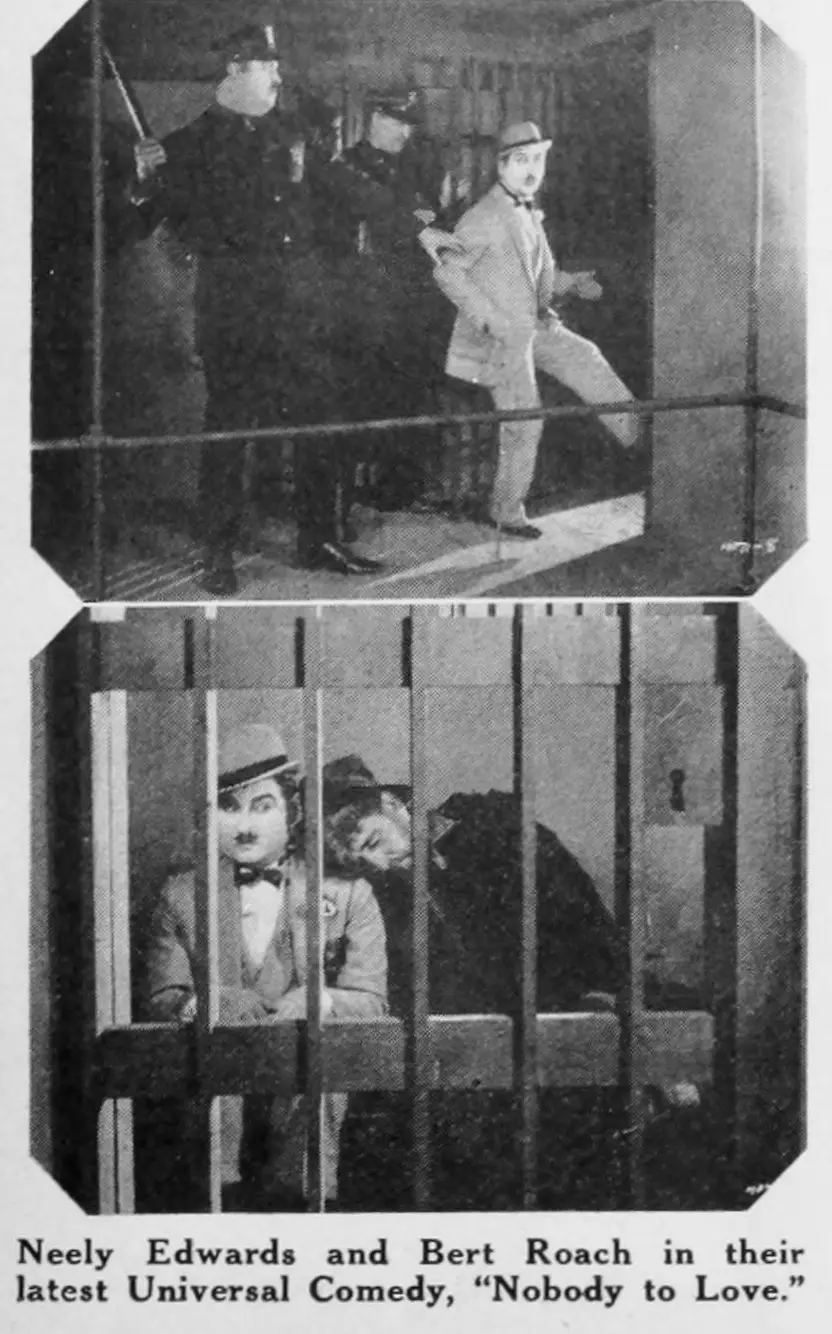
The cinematic landscape of the early 1920s often vacillated between the grandiose moralizing of features like The Morals of Hilda and the frantic, kinetic energy of the short-form comedy. Nobody to Love, a William Watson-directed vehicle starring the impeccably timed duo of Neely Edwards and Bert Roach, occupies a unique space within this dichotomy. It is a work that manages to distill the anxieties of post-war social reintegration into a series of rhythmic, escalating gags. The film eschews the sprawling epic nature of Christus, opting instead for a localized, almost claustrophobic exploration of the 'masher' trope—a social phenomenon that defined the era's fears regarding urban anonymity and gendered interactions.
The film’s opening frames establish a stark contrast between the box-car camaraderie of Ned and Brown and the looming specter of societal conformity. As former hoboes, their relationship is rooted in a shared rejection of the sedentary life, yet Brown’s sudden pivot toward the merits of matrimony signals a surrender to the very structures they once evaded. Unlike the stark survivalism depicted in Code of the Yukon, the struggle here is purely social. Brown acts as a dubious mentor, an architect of Ned’s eventual downfall, suggesting that the path to respectability begins with the acquisition of a wife. This catalyst is handled with a droll cynicism by writers William Watson and Scott Darling, who recognize that for men like Ned, 'respectability' is a costume that never quite fits.
The chemistry between Edwards and Roach is palpable, a precursor to the legendary double acts of the later sound era. Edwards, with his elastic facial expressions and a vulnerability that borders on the tragic, plays Ned as a man perpetually out of step with the world's shifting moral gears. Roach, conversely, embodies the jovial instigator, whose well-meaning advice carries the weight of a death sentence.
When Ned is encouraged to flirt with the first 'good-looker' he encounters, the film dives headlong into a critique of the period's policing of public spaces. In 1920, the 'masher' was a figure of intense public scrutiny—a man who dared to approach unaccompanied women with unsolicited advances. Where a film like A Factory Magdalen might treat such interactions with heavy-handed melodrama, Nobody to Love weaponizes them for comedy. Ned’s attempt at flirtation is clumsy, a performance of masculinity that is utterly devoid of the suave confidence required to succeed. His subsequent arrest is not merely a plot point; it is a commentary on the fragility of the social contract. The judicial system, represented here by the swift imposition of a fine, acts as a mechanical entity, disinterested in intent and focused solely on the preservation of a rigid, superficial decorum.
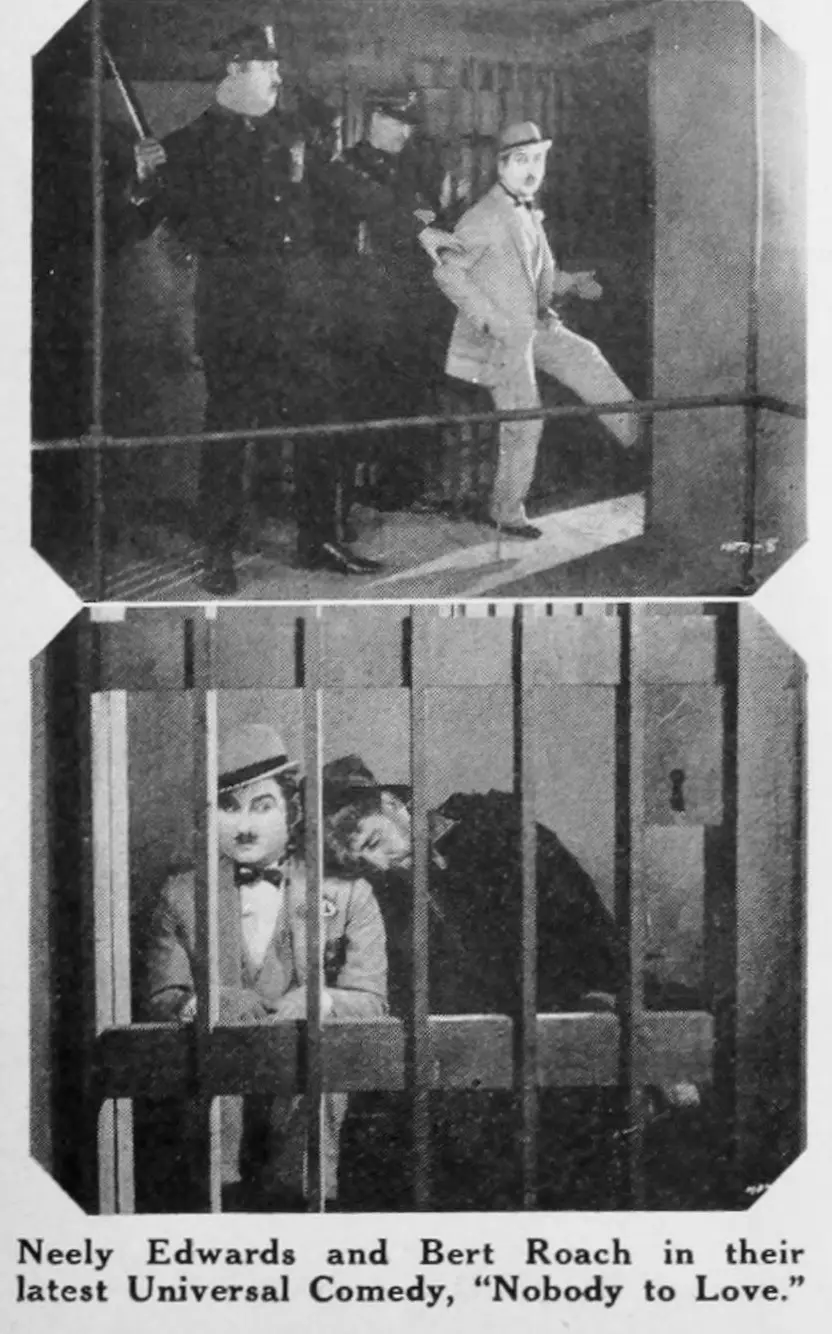
This sequence echoes the thematic concerns of The Hidden Law, where the invisible rules of society often prove more punitive than the written statutes. Ned’s fine, paid by the very man who encouraged the transgression, creates a recursive financial and moral debt that anchors the film’s narrative structure.
The pivot to Brown’s household marks the film’s transition from public farce to domestic nightmare. The revelation that the woman Ned 'mashed' is, in fact, Mrs. Brown, serves as the ultimate punchline to the hobo's attempt at assimilation. The house, which should represent a sanctuary of the middle class, becomes a theater of exposure. Mrs. Brown’s scream is the sonic (visualized through intertitles and exaggerated gesture) rupture that shatters Ned’s tenuous grip on his new life. In this moment, the film touches upon the same nerves as A World of Folly, where the past and present collide with devastating, albeit humorous, consequences.
The repetition of the arrest and the fine is a masterclass in comedic pacing. By the third iteration, the audience is no longer laughing at the novelty of the situation, but at the cosmic inevitability of it. Ned is caught in a loop of his own making, a victim of a society that demands he participate in its rituals while simultaneously punishing him for his lack of fluency in them. The direction by Watson is lean, focusing on the spatial relationships within the Brown household to emphasize Ned’s entrapment. The sea-blue hues of the cinematography (if we imagine the original tinting) would have likely emphasized the cold, clinical nature of the law compared to the warm, orange-tinted aspirations of the home.
William Watson’s direction in Nobody to Love is deceptively simple. He utilizes the frame not just to capture the slapstick, but to tell a story of social alienation. The editing is sharp, ensuring that the 'Rule of Three'—a staple of comedy—is executed with surgical precision. Scott Darling’s screenplay avoids the sentimentality found in The Reclamation, preferring a more cynical, street-wise humor that reflects the writers' deep understanding of the burlesque tradition. The film lacks the moralizing weight of The Crucible of Life, and it is better for it. It is a pure distillation of the 'buddy' dynamic, where the friendship itself is the source of both comfort and catastrophe.
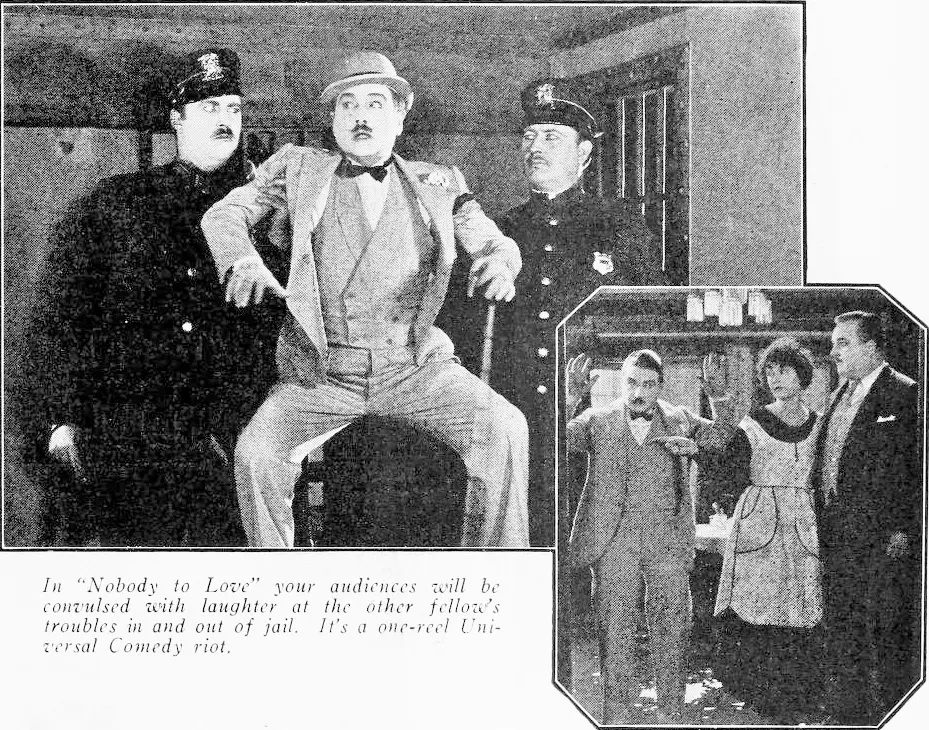
Comparing this to 'Twas Henry's Fault, one can see a clear evolution in how early silent shorts handled the concept of blame. In Nobody to Love, the blame is diffused across the entire social structure, from the peer pressure of the friend to the reactionary nature of the wife and the opportunistic greed of the legal system. It is a comprehensive ecosystem of failure.
While history often remembers the sweeping dramas like Sacred Silence or the patriotic fervor of The Birth of Patriotism, it is in these smaller, two-reel comedies that the true pulse of the era can be found. Nobody to Love is a testament to the versatility of Neely Edwards, whose career would see him transition through various iterations of the Everyman. Here, he is the Everyman as a casualty of progress. The film’s title itself is a cruel irony; Ned has 'nobody to love' because the very act of seeking love is what leads to his literal and metaphorical undoing.
In the broader context of 1920 cinema, including international efforts like Der Rächer von Davos, Watson's film stands out for its lack of pretension. It does not seek to redefine the medium, yet it perfects the language of visual storytelling through gesture and timing. The use of the box-car as a starting point is a brilliant narrative choice, grounding the characters in a transient reality that makes their subsequent attempts at 'settling down' feel all the more absurd. It is a theme that resonates even today, as we navigate our own complex web of social expectations and the digital equivalent of 'mashing'—the unsolicited interaction.
Ultimately, Nobody to Love is more than a relic of the silent era; it is a sharp-edged comedy that questions the cost of entry into polite society. It suggests that for some, the freedom of the open rail is a far safer bet than the perilous flirtations of the parlor. Like the protagonist in David Garrick, Ned is a man forced to play a role he doesn't fully understand, but unlike Garrick, his performance ends not in applause, but in the cold, hard reality of a jail cell and a depleted wallet.
Critic's Verdict: A robust, albeit cynical, exploration of the early 20th-century social landscape. Edwards and Roach provide a masterclass in comedic escalation that remains as biting today as it was a century ago. Do not overlook this short for its length; its thematic depth rivals the features of its time, such as Tainted Money or Fair But False.
IMDb 6.2
1937
Community
Log in to comment.