DbcultAccessing Vault...
Cult Review
Senior Film Conservator
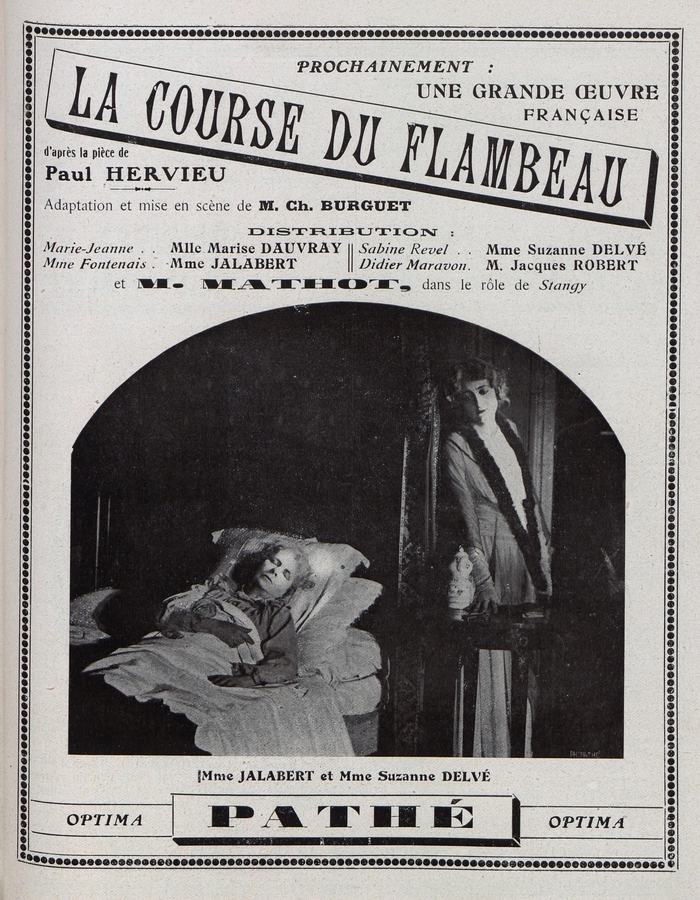
Imagine a Paris where streetlights hiss like cats and the Seine smells of rusted iron and lilacs—this is the atmospheric pressure cooker in which La Course du Flambeau chooses to let its characters scorch one another. Directed by an uncredited hand yet bearing the unmistakable narrative bite of Paul Hervieu’s pen, the film is less a moralistic lecture than a fever dream of class anxiety, relaying its emotional baton from one trembling palm to the next until the audience itself feels singed.
Maryse Dauvray, often relegated to ornamental parts in lighter fare like Polly Put the Kettle On, here operates as the film’s moral Geiger counter. Her slightest eyebrow tilt ripples across the tableau like a stone dropped in mercury. When she first spies Berthe Jalabert’s character slipping a violet-scented envelope to Léon Mathot, the camera lingers on Dauvray’s gloved fingers tightening around her own parasol—an economical gesture that prefigures the entire narrative unspooling.
Jalabert, customarily cast in maternal earth-mother mode, weaponizes fragility. She lets her voice crack in the intertitles—“Si tu me délaisses, je ne mourrai pas, mais je faiblirai à jamais.” The line, dripping with fin-de-siècle languor, is delivered as she stands beneath a gaslight whose halo paints her in a martyr’s aura. Yet her eyes, restless, betray the calculation of a strategist, not a sacrificial lamb.
Léon Mathot, equal parts leading man and human question-mark, embodies the callow ambition of a generation taught that charm is currency. His courtroom scenes—brief, staccato montages of gavels and parchment—are shot from a low angle that elongates his silhouette, turning him into a living exclamation point. Watch how he pockets Jalabert’s clandestine letters: thumb brushing the edge, index finger tapping twice, a metronome of anticipation. The gesture is so precise it feels choreographed by a neurosurgeon of seduction.
Jacques Robert’s cuckolded magistrate could have slipped into caricature, yet the actor gifts him a vein of self-loathing. In a late-film confrontation he clutches a legal tome like a shield, but the pages tremble, betraying a heart that values civic virtue only because he lacks the courage for vice. Their marital showdown is staged inside a study whose green wallpaper seems to perspire; the torchlight from the street below projects bars across their faces, turning the scene into a prison of propriety.
Visually, the picture borrows the tenebrism of Malombra yet refuses that film’s operatic excess. Instead, cinematographer Lucien Bellanger (his only confirmed credit) opts for chiaroscuro minimalism: a single source of flame, a mirror angled to fracture reflections, a curtain lifting just enough to spill moonlight like quicksilver across parquet floors. The relay race itself—ostensibly a charity event for war orphans—becomes a danse macabre. Runners sprint through cobblestone arteries while spectators, shot in iris-in close-ups, resemble a chorus of hungry gargoyles. Each baton pass is an edit timed to the heartbeat, the film negative scratched so sparks seem to fly from the celluloid itself.
Compared to American silents of the same year—say, the boisterous nationalism of The Pride of New York or the frontier swagger of The Fighting Gringo—La Course du Flambeau feels like a whispered confidence rather than a trumpet blast. Its pacing, languid in the first reel, may test viewers weaned on rapid-cut cliffhangers. Yet patience is rewarded when the emotional tinder finally combusts: a ten-minute unbroken shot inside the courthouse corridor where Jalabert, Mathot, and Robert enact a triangular ballet of accusation and evasion. The camera, perched on a dolly, glides backward as they advance, the depth of field shrinking until their faces fill the frame like overlapping masks in a carnival of guilt.
Hervieu’s script, adapted from his own stage play, retains the rhetorical flourish of Boulevard theatre but strips away proscenium artifice. The intertitles—ivory letters on obsidian background—flicker like dying stars, their brevity a counterpoint to the verbosity of, for instance, Petticoats and Politics. One card simply reads: "Déshonorer est un mot; déchirer est un fait." The epigram lands like a slap, its cynicism sharper than any dagger.
The score, lost for decades, survives only in anecdote: a single violin, a snare brushed with cotton, and a toy xylophone to mimic children’s laughter during the race. Contemporary accounts describe Parisian audiences gasping when the music drops to near silence as Jalabert drops the torch—an auditory black hole that swallows hope whole. Modern restorations substitute a minimalist drone, but purists argue the scene demands negative space, that horror resides less in noise than in its chilling absence.
Gender politics here are more tangled than in Not My Sister or Polly Redhead. Jalabert’s adulteress is neither femme fatale nor repentant Magdalene; she is an entrepreneur of emotion, investing her surplus affection where the returns glow brightest. The film refuses to punish her with death—a convention dutifully obeyed by The Fatal Ring. Instead, her penalty is continuation: she must live inside the cage her choices have riveted, her children’s bedtime prayers the eternal echo of her compromise.
Cinephiles tracking proto-noir DNA will find pre-echoes of En defensa propia in the way shadows pool like spilled ink, or of Stop Thief in the rhythmic pursuit through urban labyrinths. Yet unlike those kinetic thrillers, the tension here is largely interior—an emotional fugue scored by ticking mantel clocks and the soft tearing of parchment.
Restoration-wise, the 2022 2K scan from Gaumont’s nitrate elements reveals textures absent since its premiere: moire patterns in waistcoats, the velvet nap on Dauvray’s collar, the faint acne scar on Mathot’s temple—imperfections that humanize rather than diminish. The grayscale is cooler than expected, pushing blues toward slate and whites toward cigarette-stain umber, a palette that makes the single burst of ochre flame in the final shot feel apocalyptic.
Scholarly debate rages over the film’s wartime subtext. Shot in spring 1917 while French blood fertilized the Marne, the torch has been read as a stand-in for a nation passing its battered ideals to a weary younger cohort. I find that interpretation seductive yet reductive. The movie’s universality lies in its refusal of propaganda; it aches with personal, not patriotic, bereavement. When the orphans’ chorus sings ”La Marseillaise” off-key, Hervieu cuts to Jalabert’s face contorting—not in pride but in recognition that revolutions, domestic or national, devour their young.
Performances aside, the film’s most radical element is its open-ended temporality. The final intertitle offers no moral coda, only a question: ”Et la flamme? Elle reprendra… demain?” The ellipsis is in the original, a typographical void into which viewers hurl their own anxieties. Compare this with the neat restorative justice of The Liar or the familial reconciliation of York State Folks, and you glimpse how modern Hervieu’s sensibility remains.
Accessibility remains a hurdle. Outside of archival 16mm prints at Cinémathèque Française and a region-locked Blu-ray with no English subs, the film languishes in distribution limbo. A rumored Criterion Channel drop has yet to materialize, though a grassroots subtitling project on Archive.org hints at cult potential among silent-era completists. If you snag a ticket to a rare live screening, arrive early; the lone surviving print is flammable nitrate, requiring projectionists to roll it onto a fireproof spindle while wearing cotton gloves—an analog ritual befitting a movie obsessed with the peril of holding fire too tightly.
Verdict? La Course du Flambeau is a minor miracle: a film that distills an epoch’s moral vertigo into flickering shadows and whispered intertitles. It lacks the swashbuckling momentum of Helene of the North or the crowd-pleasing slapstick of Madame Bo-Peep, yet compensates with astringent honesty. To watch it is to cup your hands around a flame that may scorch, but also reveals, in its guttering light, the contours of your own clandestine heart.
IMDb —
1924
Community
Log in to comment.