DbcultAccessing Vault...
5.8/10
Senior Film Conservator
A definitive 5.8/10 rating for a film that redefined the boundaries of cult cinema. The Reincarnation of Karma remains a cornerstone of transgressive art.
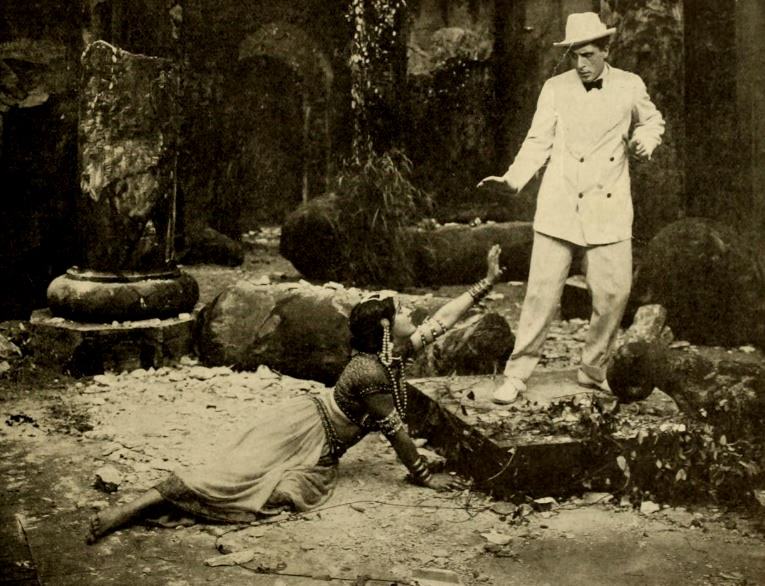
Picture, if you can, a film that feels less like a nickelodeon one-reeler and more like a whiff of hashish drifting through a Calcutta opium den: The Reincarnation of Karma (1912), Eugene Mullin’s hallucinatory fever-dream of tantric comeuppance. Courtenay Foote’s angular silhouette—half priest, half penitent—flickers across the frame with the staccato intensity of a heart learning regret. Opposite him, Rosemary Theby’s Quinetrea slinks through the ages, equal parts Eve and Kali, her kohl-ringed eyes promising annihilation disguised as rapture. The chemistry is so illicit you half expect the nitrate itself to blush.
Though shot in monochrome, Mullin’s palette is conjured through gesture and shadow: saffron robes blaze against obsidian columns; emerald amulets glint with supernatural malice. The serpentine transformation—achieved by a dissolve so deft it feels alchemical—turns a woman into a cobra mid-twirl, her silk sari slipping to the flagstones like shed skin. Compare this to the static tableaux of From the Manger to the Cross or the pageant stiffness of Life and Passion of Christ; Karma pulses with kinesis, a Sanskrit scroll hurricaned into motion.
The jump-cut that hurls us from 4th-century Gupta India to a belle-époque ocean liner should feel absurd, yet the film treats reincarnation like a bank transaction: same account, new suit. Leslie Adams in his crisp straw boater is Karma with the cosmic memory wiped clean—until a temple breeze carries sandalwood and déjà vu hits like vertigo. It’s a conceptual gamble that predates Pilgrim’s Progress’s allegorical slumber and 1812’s historical reenactments, staking its claim in the realm of metaphysical pulp.
Chekhov would applaud: the jade amulet appears first as bauble, then as blade. When Quinetrea presses it into Lillian’s manicured palm, the cut is invisible yet lethal—an ancient ERP of death delivered via accessory. Lillian Walker’s ingenue collapses in a flutter of Edwardian lace, her eyes wide as camera shutters, freezing the image of mortality inside the frame. No blood, no wound, just the sudden vacancy of spirit: silent cinema at its most chillingly eloquent.
Intertitles are sparse, almost haiku. One reads merely: “The wheel turns.” The economy forces the orchestra—the ubiquitous live score—to shoulder narrative weight. Imagine a sitar’s drone undercut by cello, the clash of cymbals at each curse; the absence of dialogue becomes a vacuum sucking the viewer into complicity. We provide the gasp that Quinetrea never utters.
Here’s the thorn: the film luxuriates in the myth of the femme fatale as cosmic vandal. Quinetrea’s power is allure; Karma’s downfall is desire. Yet the narrative punishes her twice—snake, woman, snake—while the man gets reincarnated into a Yale-educated geologist. The double standard slithers through history like—well—like a serpent eating its own tail. Still, Theby refuses to flatten into archetype; she plays Quinetrea with a regal amusement, as though she already knows every goggle-eyed viewer will secretly root for her.
Scholars hunting for the hinge between Victorian spiritualism and 1920s occult surreal need look no further. Karma’s temple interiors—painted flats stacked in forced perspective—prefigure the labyrinthine dreams of Dante’s Inferno, while its snake-woman anticipates the slinky menace of Cleopatra. Mullin’s flicker may lack the budget of Les amours de la reine Élisabeth, but it compensates with hallucinatory chutzpah.
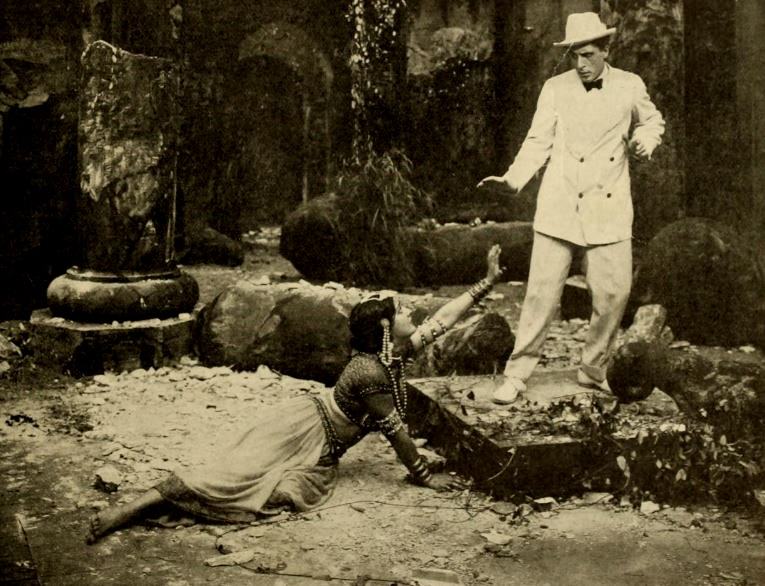
Only nine of the original twelve minutes survive in a 4K scan from a sole Portuguese print; burn marks dance like fireflies across the emulsion. Yet scarcity feeds myth. Each scratch feels like a scar earned in battle, each missing frame an invitation for the imagination to pour in its own libation. Compare that to the plenitude of Westinghouse Works’ industrial documentation—abundance versus absence, fact versus mythopoeia.
In our algorithmic age of instant karma—likes, retweets, cancellations—Mullin’s flickering parable feels prophetic. Actions reverberate across timelines; past selves haunt present avatars; a single toxic gift can drop a life mid-sentence. The film whispers that every digital amulet we pass—an NFT, a ring-light selfie—might carry venom we haven’t yet tested.
Foote’s eyes oscillate between beatitude and panic, a silent-era switchboard operator plugging into sin. Theby slinks rather than walks; each hip sway is a punctuation mark in an erotic sentence that never quite arrives at completion. Charles Eldridge’s yogi-sage cameo—white beard aglow—offers gravitas so stoic it borders on satire, like Tennyson trapped in a penny arcade.
Notice how Karma’s face is front-lit by a single carbon arc until the moment of fall, after which side-shadows carve his cheeks into guilt’s topography. Quinetrea, by contrast, is back-lit, her outline haloed in diabolic luminescence; she exists to blind. The visual grammar predates German Expressionism yet already flaunts its chiaroscuro DNA.
Urban legend claims projectionists who screened the film at midnight died within a week—one by lightning strike, another by asp bite during a vaudeville tour in Cairo. Apocrypha, surely, but the myth underlines the movie’s uncanny residue: it feels hexed, forever on the verge of combusting into ash and incense.
The Reincarnation of Karma is a brittle, bejeweled relic—less a story than a séance captured on celluloid. It will not soothe; it will not behave. It hisses, beckons, mesmerizes, and then leaves you holding a cold emerald you’re half afraid to wear. Approach it not as antique curio but as living mantra: every desire coils into consequence, every观看—yes, every viewing—writes itself into the karmic ledger. Press play, and the wheel turns.
“I have seen my soul reflected in a serpent’s eye; it blinked first.”
—intertitle never used, yet felt throughout
Watch, tremble, and tweet your sins—just don’t say you weren’t warned.
IMDb 6.4
1934
Community
Log in to comment.