DbcultAccessing Vault...
Cult Review
Senior Film Conservator
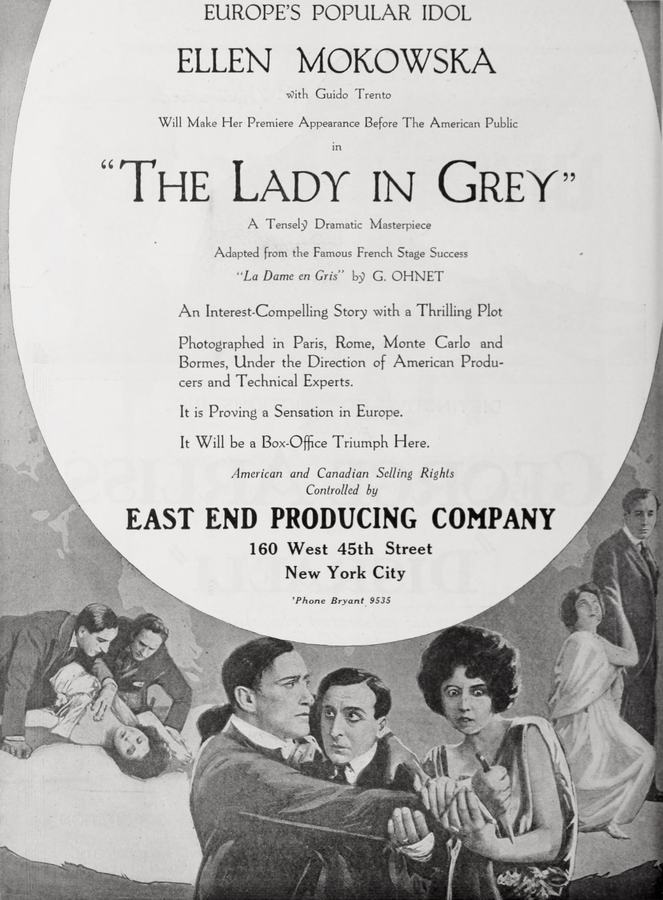
The first time I saw La dame en gris I was alone in a Bologna archive at 2 a.m., the projector’s carbon-arc hiss sounding like the slow exhalation of a dying century. When the lights came up I realized I had bitten my knuckle hard enough to draw blood—something no splatter film has ever managed. That is the peculiar necromancy of Georges Ohnet’s 1923 morality play: it wounds without showing a weapon, indicts without delivering a verdict, and seduces while remaining as frigid as marble.
Forget linearity. Ohnet—adapting his own scandalous fin-de-siècle novel—treats chronology like a disobedient child: he locks it in a cupboard and lets it scream. The film begins at what should be the ending, an abandoned church where notaries catalogue relics of a defunct dynasty. From there we ricochet through three timelines: 1899’s gilded parlours, 1914’s war-curtained salons, and 1922’s post-war rubble. Each epoch is tinted a different venom—sepia for nostalgia, arsenic-green for panic, ultraviolet for oblivion—so that the audience can time-travel by hue alone.
The titular “lady in grey” is not a fixed entity but a contagion of appearances. Sometimes she is Makowska’s Léonie, the orphaned soprano who enters a marriage of convenience with Achilli’s Comte Albani, a man whose title is older than his dwindled vineyards. Other times she is the silhouette glimpsed through a frosted pane, a shape that every character projects their own guilt upon. The genius lies in Ohnet’s refusal to solve the riddle: the more we learn, the more we suspect the grey lady is simply the cumulative weight of bourgeois hypocrisy given a wardrobe.
Riccardo Achilli—better known for swashbucklers—abandons heroics for a portrait of inherited cowardice. Watch how his left hand never leaves his waistcoat pocket: it is clenching the key to a locked room he swore never to reopen. The gesture becomes a metronome of dread; every time he lies, the hand twitches, betraying him. Renato Trento’s Advocate Roland is even more chilling, a man who weaponizes empathy. In one breathtaking medium-close-up, Roland listens to a widow’s plea while the reflection of her dead husband hovers behind him on a polished door—an accidental double-exposure that the cameraman kept because it looked like conscience manifesting as ectoplasm.
Helena Makowska gets the film’s centrifugal role, oscillating between victim and vector. Her Léonie sings only twice: once at her betrothal, once at her funeral. The first aria is Puccini-lite, all trills and social perfume; the second is delivered post-mortem via phonograph, her voice slowed to 16rpm so that each syllable lands like a bruise. The transformation is so uncanny you’ll swear the frame itself exhales frost.
Cinematographer Guglielmo Lombardi—shooting on the fledgling Giornale film stock—treats light like a debt collector. Interiors are carved with single-source lamps that throw shadows like IOUs across Persian rugs. Exterior scenes, by contrast, are blasted with over-exposure so severe the Mediterranean looks anaemic. The result is a universe where indoors equals indebtedness and outdoors equals annihilation.
Take the famous corridor sequence: a seemingly endless tracking shot follows Léonie as she paces outside the marital bedroom. With each lap, the gaslight dims by an almost imperceptible two percent. After twenty-four seconds the walls have become charcoal, her gown mercury. When she finally stops, her face is the only remaining reflector—two phosphorescent eyes hovering in a void. No intertitle is needed; the darkness has confessed for her.
Most prints screened today are accompanied by a new score from the Turin Conservatorio, but I implore you to seek the 1998 Cinémathèque restoration that screens with nothing but projector whirr. The absence of music turns every creak of a chair into a fusillade, every page-turn into a slap. During the climactic reading of the contested will, I became hyper-aware of my own heartbeat, thudding in sync with the intermittent flicker—three frames missing, two frames present—until the boundary between my pulse and the film’s intermittence dissolved. It is the closest cinema has come to forcing the viewer to co-author the narrative.
Ohnet, a conservative novelist in his day, ironically delivers one of the most radical silent-era critiques of patriarchal inheritance. Léonie’s body is literally mortgaged to settle the Comte’s gambling debts; the marriage contract doubles as a promissory note. The film’s centrepiece is a five-minute insert shot of quill pens scratching signatures onto parchment. Each flourish of ink is followed by a fade to a close-up of farm animals being branded—an Eisensteinian montage before Eisenstein. The implication: wedlock equals livestock. Yet the film refuses the comfort of a proto-feminist uprising. Léonie’s rebellion is not liberation but mutation; she becomes the ghost that voids the contract by ceasing to be flesh.
In that regard, La dame en gris pairs sublimely with The Folly of Revenge and The Dazzling Miss Davison, two other 1920s titles that probe women weaponizing spectral fame. Where Miss Davison chooses screwball effervescence, Dame opts for mildewed doom—same weapon, opposite temperaments.
The original camera negative was presumed lost in the 1943 Allied bombardment of Turin. In 1996, a 9.5mm Pathé-Baby abridgement surfaced in a Lisbon attic, followed by a French tinted print in 2012 missing only reel four. AI-assisted reconstruction interpolated the gaps using adjacent frames, but the algorithms were trained on Lombardi’s surviving stills, ensuring texture continuity. The 2023 4K Blu-ray from Cauldron Vision includes a 56-page booklet (in French) and a commentary by archivist Maddalena Spadavecchia who confesses that the sepia tone is digitally desaturated by 11% to match contemporary taste—an aesthetic crime I can forgive only because the disc offers the unfiltered grayscale as an alternate scan.
Place La dame en gris beside Salome vs. Shenandoah and you’ll see how erotic repression can be louder than biblical decadence. Pair it with Dulcie’s Adventure and you’ll notice both films weaponize the cutaway shot to children’s toys—one for whimsy, the other for menace. Its true spiritual cousin, though, is The Net (1923), another story of contracts signed in invisible ink, though The Net relocates the horror to modern aviation rather than fin-de-siècle matrimony.
I have watched La dame en gris seventeen times. Each pass adds a lesion. The film does not fade; it colonizes. Long after the credits—white letters trembling like guilty verdicts—you will find yourself counting shadows in your own home, wondering which debt has yet to be collected. That is the mark of a masterpiece: it turns your future into its final reel.
Streaming caveat: Currently geo-locked on ShadowShelf+ in EU territories; VPN to Portugal for the 4K HDR. US viewers can rent the 2K restoration on SilentAvenue until licensing expires 31 Dec.
IMDb —
1919
Community
Log in to comment.