DbcultAccessing Vault...
Cult Review
Senior Film Conservator
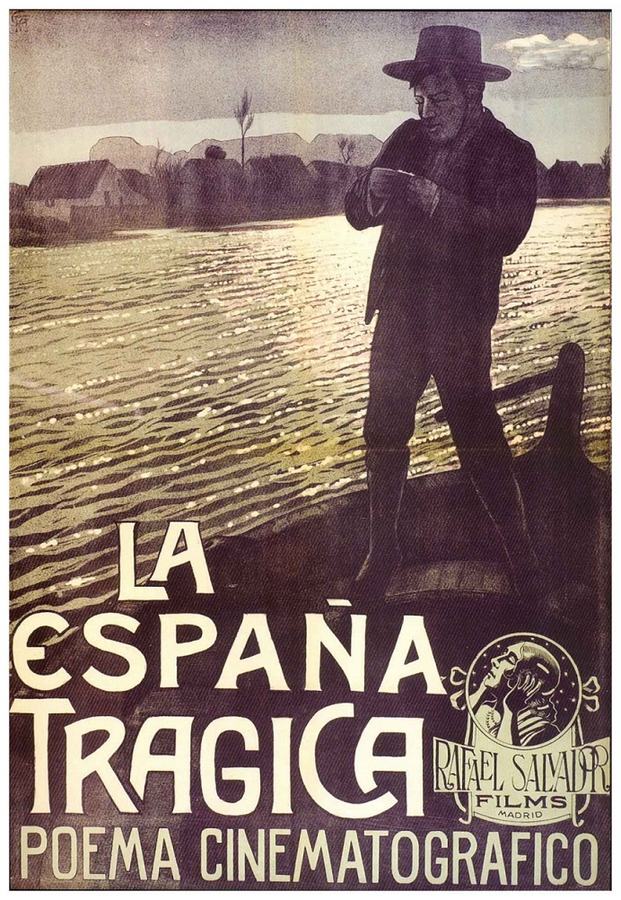
Nitrate ghosts do not scream; they smolder. Pedro de Repide’s suppressed 1917 fresco La España trágica o Tierra de sangre is a half-melted candle of a film, its tallow dripping with the molten wax of a country chewing its own limbs. Viewing it today—through a 4K glass-eye salvaged from a Salamandan archive—feels like inhaling cordite in a confession booth.
Repide, a pamphleteer turned cine-provocateur, refuses the tidy dialectics of The Romance of Elaine or the moral semaphore of The Woman in the Web. Instead, he grafts Goya’s Disasters of War onto Lumière grammar. The opening tableau—an iris-in on a child’s marble eyeball lying beside a shattered porcelain Virgin—announces the film’s thesis: sacred and profane share the same marrow.
Cinematographer José Durany (also acting here as a rheumy militia priest) shoots through cheesecloth soaked in vinegar, giving each frame the patina of a bruised reliquary. Shadows are not mere absence but presence—inkblot armies multiplying in the corners. Compare this chiaroscuro to the hygienic battlefields of Kaiser’s Finish; where that film polishes carnage into adventure, Repide grinds it back into shit, sulfur, and sacramental dread.
José Argelagués—known to pre-war theatregoers for comic entremeses—here reconfigures his rubber visage into a death mask of hollowed cheeks and flickering irises. His schoolteacher, identified only as Maestro, clutches a primer whose pages flutter like albino moths; every time he recites the alphabet, a letter is missing—shot, burned, or exiled. Argelagués modulates between whispered utopias and strangled sobs without ever collapsing into sentimental martyrdom; you sense he could just as easily turn executioner as martyr.
Fernando Viola’s printer Anselmo, wrapped in a waistcoat stitched from red-and-black anarchist flags, exudes the musk of turpentine and testosterone. Viola’s physical lexicon—fingers stained like communion wafers dipped in wine, a gait that seems to dislocate his hips—channels the revolutionary déclassé. His flirtation with Ángeles Rivas’s cabaret firebrand is staged in a boudoir lit by a solitary carbide lamp: the lovers’ silhouettes copulate on the cracked plaster, turning the wall into a Pompeian fresco of impending doom.
Angelita Ribas, as the charcoal burner’s consumptive daughter, has perhaps three minutes of screen time yet etches herself indelibly. When she coughs into a lace handkerchief, the blood blooms into the shape of the Iberian Peninsula—cartography as prognosis.
Being a silent production, the film weaponizes absence. Intertitles appear as laconic epitaphs: "The sun rose twice that day—once in the sky, once in the square." But Repide also embeds sonic suggestions visually: a close-up of a broken metronome, its pendulum frozen mid-tick, implies the hush after artillery. Contemporary exhibitors were instructed to accompany screenings with muffled drums and distant church bells, creating an olfactory-auditory hallucination; in modern revival houses, curators often scent the auditorium with burnt rosemary and orange peel, triggering ancestral Iberian memories among the spectators.
Archivists at Filmoteca Española discovered that several reels contain deliberate gouges—scratches shaped like crosses and sickles—made before development. Repide, it seems, collaborated with the lab technicians to scar the negative, so that when light pours through the projector, the image arrives pre-wounded. This material laceration predates the found-footage lacerations of later avant-gardes by half a century, positioning La España trágica as both historical document and meta-textual prophecy.
Unlike Her Great Match, which traffics in plucky ingénues, or Jess with its moral rehabilitation arc, Repide’s women are the battlefield. Their bodies host competing cartographies: nationalist rosaries coil like barbed wire around wrists; anarchist bandanas girdle menstruating loins. Rivas’s final close-up—hair shorn, scalp bleeding—recalls both monastery penitents and shaven collaborators, collapsing sinner and sainted into one tremulous icon.
Anselmo’s printing press is framed inside a derelict church; the typeset letters resemble miniature gravestones lined upon the altar. When he prints "No God, No Masters," the ink bleeds into the cracked fresco of San Sebastián, turning martyr arrows into anti-clerical exclamation points. Yet the film refuses atheist triumphalism: later, the Maestro, dying, clasps a bullet like a rosary bead and murmurs "Perdón"—to whom, Repide refuses to specify, leaving the spectator suspended in a fog of grace and guilt.
Chronology here is a shattered saucer reassembled with gaps sharp enough to slice fingers. Flash-forwards appear as negative inserts: white pupils, black snow. One startling montage overlays the 1808 Napoleonic occupation with the then-contemporary Rif War, suggesting Spain compulsively reruns its butchery on a Möbius strip. This temporal vertigo places La España trágica closer to The Fixer’s existential paranoia than to the linear melodrama of Life’s Whirlpool.
Where Oliver Twist aestheticizes poverty into Victorian baubles, Repide rubs our noses in the stench. The orphans here do not sing; they catalogue limbs lost to grenades. And unlike Scotland Forever with its bagpipe romanticism, La España trágica offers no pipe drones—only the wheeze of a dying accordion player whose last note flatlines into the dust.
Even Buñuel’s later Land Without Bread feels anthropological compared to this visceral immersion; Repide refuses the Brechtian shield of documentary distance. You taste the metallic tang of blood because the camera lens is practically inside the mouth of the cadaver.
Franco’s censors torched the majority of prints in 1939, yet clandestine 9.5mm copies circulated like samizdat in cigarette tins. In the 1970s, Spanish super-8 clubs reenacted scenes in abandoned metro tunnels, turning the film into living graffiti. Now, AI-upscaled snippets circulate on TikTok, colorized and speed-corrected, soundtracked by trap beats—an atrocity reborn as meme. Yet even compressed to ten pixels, Argelagués’s stare retains the power to derail your scrolling thumb.
Repide reportedly shot an alternate ending wherein the surviving children plant almond trees over mass graves, but he excised it for being "indecently hopeful." The released version closes with a dolly-out on a deserted railway siding: a woman’s shoe, a discarded crutch, a cloud shaped like a bull. No fade—just a hard cut to black, as if the very concept of after were an insult to the dead.
Watching La España trágica o Tierra de sangre is not catharsis; it is contamination. Days later you will taste grit in your coffee, hear phantom bells between traffic honks, realize your passport is a pious lie. The film doesn’t ask you to understand Spain’s autoimmune bloodletting; it demands you inhabit the wound. And once inhabited, you exit not enlightened but inflamed—carrying the microbial knowledge that every landscape, given enough fear, can be renamed Tierra de sangre.
Verdict: 10/10—A nitrate reliquary that burns holes in your retina and resurrects the screams your textbooks omitted.
IMDb 5.8
1921
Community
Log in to comment.