DbcultAccessing Vault...
Cult Review
Senior Film Conservator
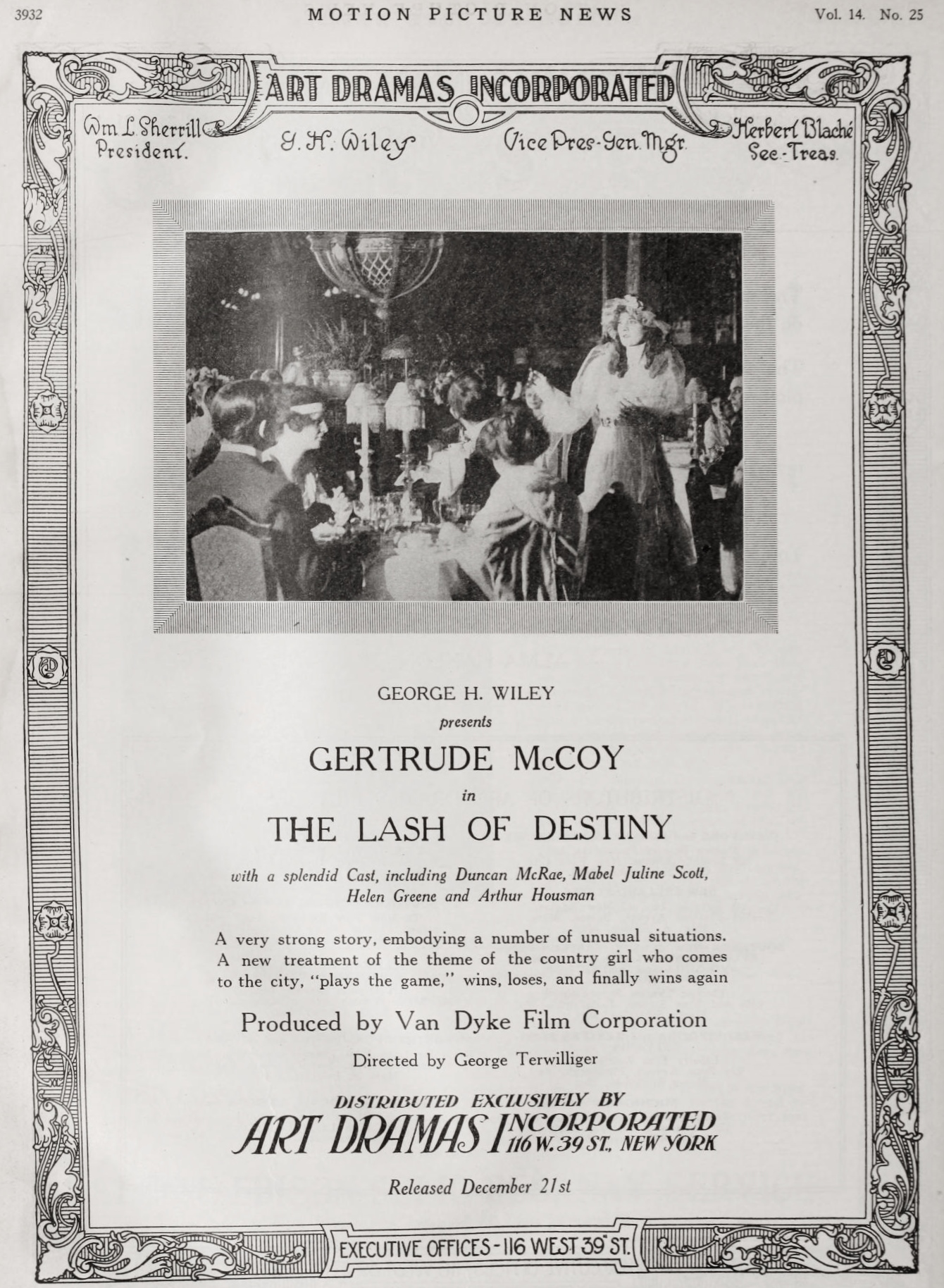
Destiny rarely arrives with trumpet blares; more often it cracks like a whip across the back of the unsuspecting. George Terwilliger’s 1923 curio The Lash of Destiny understands this axiom with an almost pagan reverence, staging its moral collisions inside flickering tenements and champagne-slick cabarets where every mirror is slightly askew. The resulting film—long buried beneath the sediment of more famous silent melodramas—emerges on the bench like a tarnished locket whose photograph still pulses with heat.
Myra Fielding begins life in a one-room schoolhouse that smells of cedar shavings and lye soap, her days measured in the squeak of chalk and the drone of distant threshers. Gertrude McCoy plays her with a downcast luminosity—eyes that seem always to be listening to some far-off music. When she boards the dawn train to the city, the camera lingers on her gloved hand pressed against the window, fogging the glass with the ghost of every suffocating expectation she leaves behind. That single shot, luminous with nitrate shimmer, foreshadows the film’s obsession with surfaces that vaporize under pressure.
Urban neon is not liberation; it is merely a louder cage. Myra’s job at the cabaret—part shimmy, part desperation—places her inside a gilded aquarium where predatory smiles reflect off sequins. Enter Al Wayne, played by Duncan McRae with the oily magnetism of a man who has learned that a well-cut tuxedo can launder almost any soul. Wayne’s wedding band is never in frame unless the narrative needs it to glint like a threat; Terwilliger’s blocking is that calculated. The $500 loan scene—ink flowering on a flimsy IOU—unfolds in a private booth upholstered in bruise-colored velvet. The visual rhyme between the signed paper and the earlier schoolhouse chalkboard is unmistakable: both are porous tablets where futures are mortgaged.
Chicago, when the film relocates there for its second hour, is rendered through rear-projection plates and exaggerated diagonals that predict German Expressionism’s American aftershocks. Wayne’s political ascendancy in a ward where every ballot costs a shot of whiskey feels like a cynical inversion of the village democracy Myra once taught in civics lessons. Meanwhile, Bert Temple—her discarded sweetheart—morphs into a crusading D.A. whose jawline seems carved from Plymouth Rock. Their reunion is staged in a cavernous courthouse corridor where double-exposed shadows crawl up the pillars like ivy, implying that jurisprudence itself is infested with ghosts.
What astounds is the film’s refusal to hinge redemption on romance. Temple’s eventual marriage to Edith, Wayne’s abandoned wife, is less a love match than a civic merger: two people pooling their scars to form a more durable scar tissue. Margaret Milne’s Edith carries herself with the brittle poise of a woman who has already died once and sees no glamour in a second funeral. When she pens the excoriating letter to Myra—paper crackling like distant artillery—her handwriting fills the intertitle in jagged strokes, as though the very alphabet were writhing.
The narrative hinge—Wayne’s wallet lifted by a pickpocket who dies under the wheels of a Pullman—owes obvious debt to pulp coincidence, yet Terwilliger stages the moment with such kinetic fatalism that skepticism is steamrolled. A match-cut links the dead thief’s shattered pocket-watch to the earlier image of Myra’s classroom clock: time, once again, confiscated from the innocent. Wayne’s decision to let the misidentification stand is less a plot convenience than a moral earthquake; he buries his name in the same act as he buries whatever residual conscience still flickered.
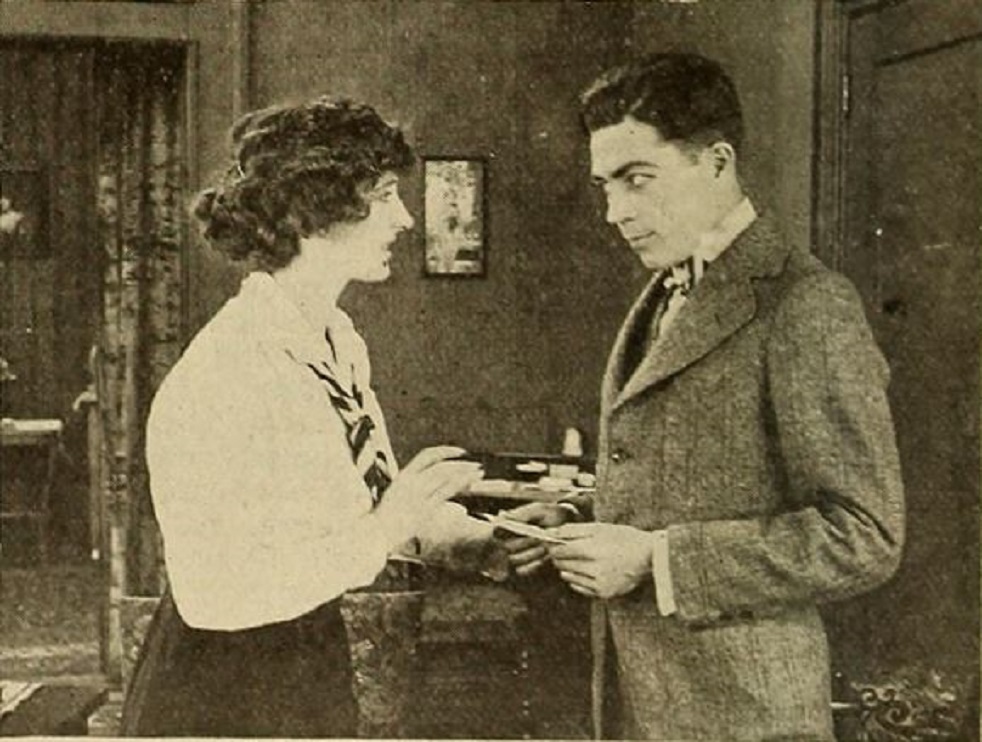
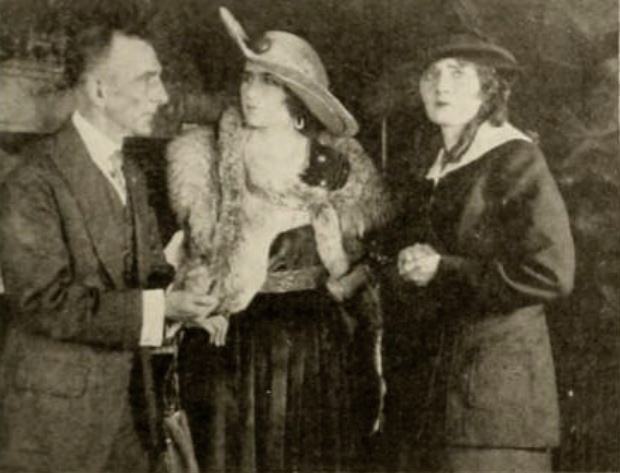
Back in the city, the IOU surfaces like a bad penny returned from the underworld. Edith confronts Myra inside a dressing room paneled with elongated mirrors, and the resulting tableau—three fractured reflections of the same woman at different stages of compromise—might be the film’s most painterly flourish. Myra’s promise to repay the money is delivered while she is still in greasepaint, her mouth a crimson gash against porcelain powder, suggesting that even penance has become part of the performance.
The climax—gunshot echoing off cheap wallpaper, a body slumped beneath a gas-jet—plays like a parody of bourgeois parlor dramas. But Terwilliger withholds catharsis: the dead man is not the narrative’s terminus, merely its pivot. When Myra emerges from concealment to shepherd Edith through the fire-escape’s iron lattice, the camera assumes a vertiginous high angle that dwarfs both women against brickwork canyon walls. Salvation is lateral, not upward; they climb out, but only into a rain-slick alley that smells of ash and cat urine.
Police lanterns invade the apartment moments later, throwing amber pools across Wayne’s supposedly lifeless form. The eventual revelation—that a second shooter, a betrayed ward-heeler, fired the fatal round—lands with almost comedic perversity. Myra’s readiness to sacrifice herself is rendered moot, yet the emotional ledger is not zeroed out. The film’s final shot—Myra exiting the courthouse into blinding daylight, blinking as though the sun itself were an interrogation lamp—leaves her branded by a guilt that the law cannot adjudicate.
McCoy’s acting style belongs to the transitional moment when broad pantomime was giving way to micro-gesture. Watch the way her fingers flutter when she first fingers the $500: the digits spider outward as though the bill were hot. It is a movement that would be superfluous in a talkie, but in the cathedral hush of a 1923 auditorium it reads like a soliloquy. Conversely, Arthur Housman’s turn as the pickpocket is all rubber-limbed slapstick until the instant his body ricochets off the rail-car; the abrupt switch from comic relief to corpse is so brutal it feels like an early experiment in cinematic cognitive dissonance.
Mabel Julienne Scott, as the cabaret’s predatory matron, deserves special mention. With a cigarette holder angled like a semaphore, she dispenses advice that curdles the moment it leaves her lips: “In this city, darling, innocence is just another costume—take it off before it strangles you.” The line, delivered in intertitle, is accompanied by a close-up of her eyes narrowing into dollar signs, a moment of proto-noir cynicism that anticipate The House of Lies by a full five years.
Cinematographer George W. Lane (unheralded, as most silent-era DPs were) carves chiaroscuro vistas that rival the contemporaneous work on Nurse Cavell. In one breathtaking insert, Myra stands at the foot of a tenement stairwell while a skylight throws bars across her body, literally imprisoning her in geometry. Another shot—Wayne’s silhouette looming over Edith’s shoulder as she signs over her inheritance—uses forced perspective to make his shadow swallow the entire wall, a visual prefiguration of the moral engulfment to come.
The palette, even in the faded prints that circulate among collectors, hints at tinting strategies: amber for interiors, viridian for exteriors, a sudden wash of crimson during the gunfire. These chromatic bursts serve as emotional accelerants, pushing the viewer’s pulse ahead of the narrative beats. One wishes for a restoration that could resurrect these hues; until then, imagination must color between the grain.
At its core, the film is a treatise on liquidity—how women in 1923 converted the only collateral they possessed (reputation) into negotiable currency, and how men hoarded the means of redemption. Myra’s IOU is not merely a plot coupon; it is a social contract stripped bare, exposing the era’s sexual economy with documentary frankness. When she finally earns enough to repay Edith, the bills are delivered in a plain envelope slipped under a theater door—no ceremony, no absolution. The moment recalls similar transactional undercurrents in The Upstart, yet Terwilliger refuses the triumphal uplift that film granted its male protagonist.
Edith’s eventual empowerment—choosing to confess to Temple rather than perpetuate blackmail—reads less as moral awakening than as systemic negotiation: she leverages matrimonial capital (a husband who is also the law) to annul prior marital debt. The triumvirate of women—Myra, Edith, even the cabaret matron—form a daisy-chain of obligation, each link forged by the same metallurgical mix of scarcity and desire.
Surviving exhibition notes suggest the original score relied heavily on cue sheets from the Belwin catalogue: “Agitato Pathetique” for chase sequences, “Melancholy Moderato” for Myra’s rural departure. Contemporary screenings—should you be lucky enough to catch one at, say, the George Eastman Museum—often commission new electro-accompaniments. The most haunting I’ve heard deployed a looped typewriter clack underneath Wayne’s political rallies, turning campaign speeches into autonomic gibberish and prefiguring the media-satire mode of How Molly Malone Made Good.
As of this writing, no streaming service hosts a restored print; your best bet is to petition the eye-wateringly niche DVD label that released a serviceable 2K scan culled from a Belgian print. Be warned: there are 7-minute gaps where the only extant material is a 9.5mm Pathé condensation, resulting in narrative ellipses that require leap-frogging logic. Yet even in fragmentary form, the film vibrates with a relevance that feels almost eerie: substitute OnlyFans for cabaret, crypto-wallet for railroad pickpocket, and the story’s arteries still pump.
For scholars stacking The Lash of Destiny against its 1923 contemporaries—The Dawn of Freedom’s patriotic bombast, The Seed of the Fathers’ hereditary determinism—the film’s moral relativism feels almost European. It lacks the didactic uplift of The Spartan Girl or the carnivalesque revenge in The Fool’s Revenge; instead it offers a secular purgatory where redemption is transactional and grace is taxed.
Great films often behave like geological faults: they absorb pressure, they shift, they leave strata that future eras can read. The Lash of Destiny is such a fault-line, its tectonic grind audible in every flicker of nitrate. It is not a relic to be dusted off and polite-clapped; it is a warning siren about the cost of wanting more world than the world wants to give you. Watch it—if you can find it—and feel the lash descend, not across Myra’s fragile shoulders, but across the century that thought it had outrun its own cruelties.
IMDb —
1912
Community
Log in to comment.