DbcultAccessing Vault...
Cult Review
Senior Film Conservator
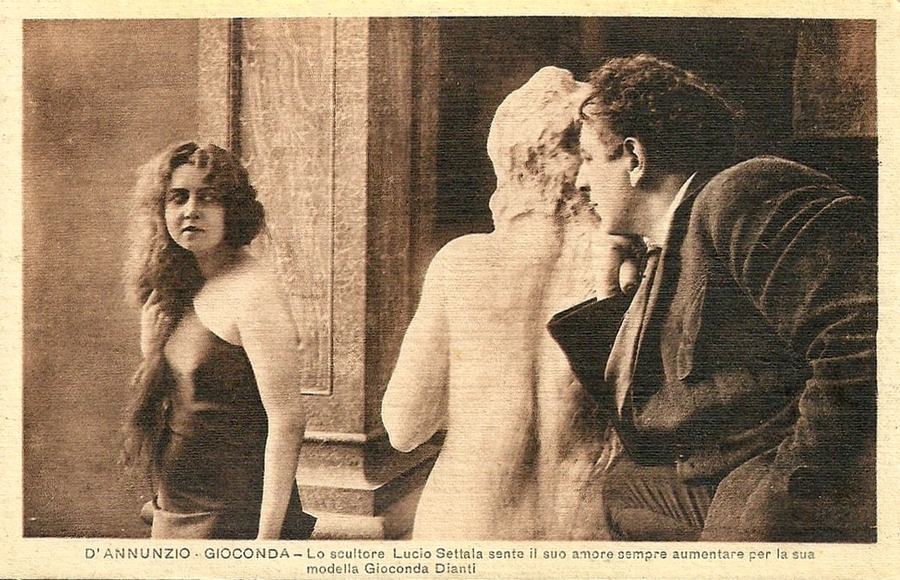
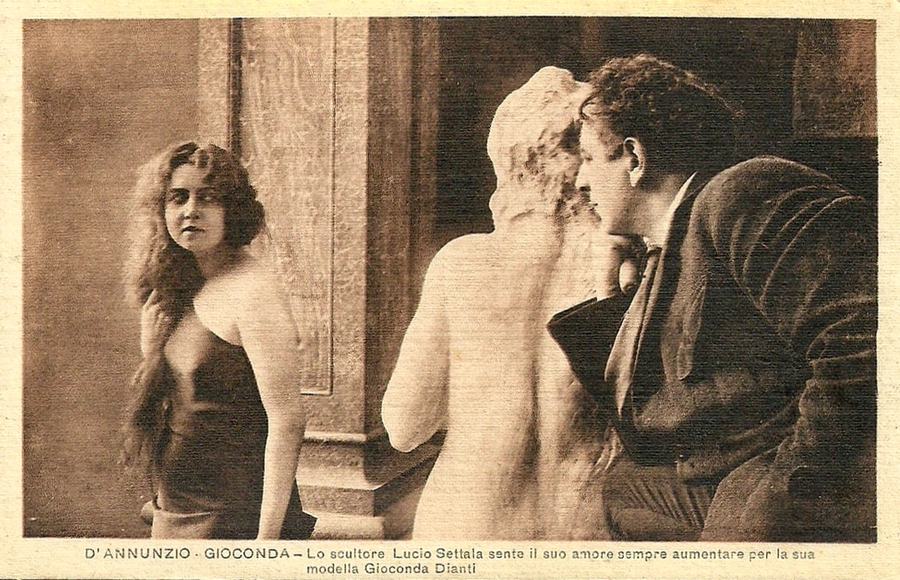
There is a moment—somewhere between the 12th and 13th minute—when the camera forgets to breathe. It lingers on Linda Pini’s shoulder blade as if the lens itself were a lover tracing the ridge of a scapula with the tip of a tongue. The shoulder is naked except for a ribbon of Venetian lace that behaves like liquid mercury, slipping toward the elbow, exposing a constellation of freckles that look suspiciously like the Pleiades. In that instant you realise La Gioconda is not a film about a painter who loses his wife; it is a film about a viewer who loses his moral footing. The shoulder blade is the first domino, and by the time the credits roll your entire ethical architecture lies horizontal, gasping like a fish on marble.
Gabriele D’Annunzio’s screenplay arrives steeped in fin-de-siècle formaldehyde: every intertitle drips with the musk of overripe peaches and the metallic tang of rusted keys. When Lucio Settala—played by Umberto Mozzato with the consumptive glamour of a poet who has swallowed too many sunsets—cracks his knuckles against a marble balustrade, the sound is not of bone but of Baroque stucco crumbling. The injury is never merely physical; it is the castration of the 19th-century male ego, the shattering of the myth that art can be wielded like a rapier. Bandaged like a mummy stitched with regret, Lucio becomes the spectator of his own dismantling, while Gioconda dances on the periphery, a phosphorescent predator humming arias from Thaïs under her breath.
Comparisons? If Assigned to His Wife treats marriage as a clerical error to be stamped and filed, La Gioconda treats it as a heretical manuscript to be illuminated with gold leaf and then burned. Where Manya, die Türkin exoticises the femme fatale by dressing her in Ottoman silks, D’Annunzio keeps Gioconda in Western black, the colour of plague velvet, the colour of absolution denied.
Silence in this film is not absence but a third character—more articulate than either spouse, more seductive than Gioconda herself. When Helena Makowska’s Anna watches her husband’s pupils dilate at the mere rustle of Gioconda’s train, the absence of diegetic sound forces you to hallucinate the noise: the whisper of taffeta like a scalpel unsheathed, the soft pop of a glove button giving way. Director Guido Brignone (father to Mercedes, who here plays the maid with the eyes of a Reni martyr) understands that the most obscene images are those the audience is forced to narrate for itself. The result is a kind of venereal feedback loop: every cutaway to Anna’s lace handkerchief becomes a Rorschach test for your own capacity for betrayal.
Cinematographer Alberto Carta shoots Milan as if it were an extension of Lucio’s bandaged hand: streetlamps smear across wet cobblestones like fingers dragged across fresh paint. Shadows possess the weight of iron. In one bravura sequence, Gioconda visits the studio at dusk; the camera tracks her silhouette in the polished lid of a grand piano, so that her reflection appears to stride across a lake of ink. The effect is not noir—noir is democratic, everyone gets a shadow—but Mannerist: only the sinner is elongated, only the serpent is lithe.
Colour temperature matters even in monochrome. Brignone and Carta achieve this by varying silver-nitrate density: scenes inside the marital bedroom glow with the tepid yellow of old parchment (Anna’s innocence), while Gioconda’s parlour is bathed in the chill cerulean of bruised flesh. You do not watch the film; you develop it in the darkroom of your own conscience.
Lucio’s canvases—never fully displayed, only hinted at in half-shadow—function like censored love letters. One painting, propped on an easel like a prisoner against a wall, shows a decapitated Saint John whose severed head is recognisably the artist’s own. The Baptist’s mouth is open mid-sentence, forever interrupted, forever accusing. Gioconda circles the easel, trails a finger along the gash where neck meets pedestal, and the paint is still wet; it clings to her glove like blood that has not yet decided whether to congeal. In that instant you understand the film’s thesis: creation and castration share the same arterial supply.
Contrast this with The Goddess, where the artist’s muse is elevated to beatific abstraction. D’Annunzio drags the muse down from the pedestal, strips her, hands her a stiletto, and instructs her to aim below the easel, straight at the family jewels.
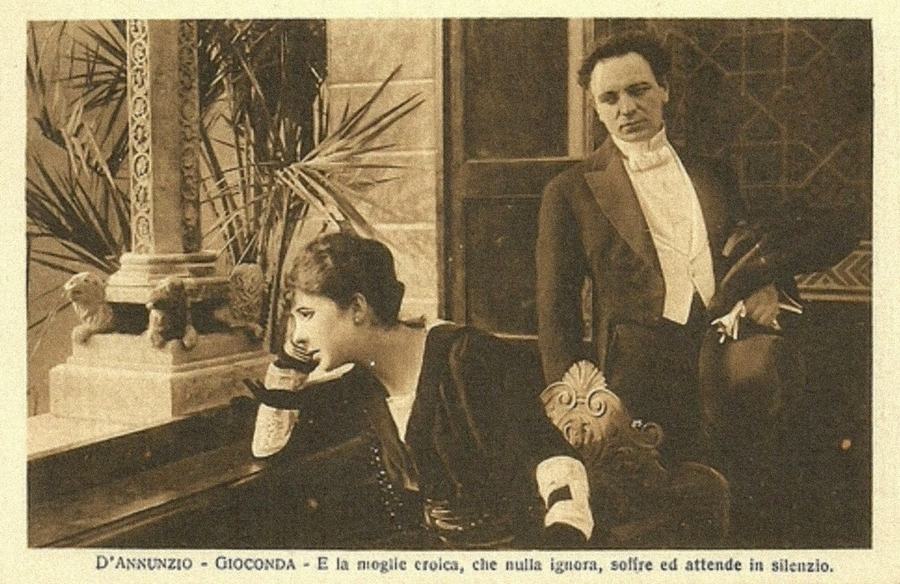
Anna’s tragedy is not that she is naïve but that she is fluent in the language of foreboding. She recognises Gioconda’s perfume—bergamot, iris, a whisper of opoponax—because it once lingered on her husband’s nightshirt years earlier. Makowska plays her like a woman listening to plaster crack during an earthquake: every micro-twitch of the lip is a fresco flaking off the wall. When she finally confronts Lucio, the scene is staged as an inverse Pietà: the wife holds the husband’s ruined hand in her lap, but instead of cradling him she bends the fingers backward, testing the brittleness of bone and vow alike. The camera hovers above them in a God-shot, and for a full five seconds neither blinks—an eternity in 1922 syntax.
Linda Pini’s performance is the distillation of every Italianate femme fatale from La Traviata to L’Avventura, yet she refuses the vamp’s cliché of arched eyebrow and bared clavicle. Her Gioconda smiles with the corner of her mouth while the eyes remain funeral-parlour still. She delivers entire monologues via the tilt of a pearl earring: when the earring swings forward, it is an invitation; when it swings back, a death sentence. The name itself—Gioconda—invokes da Vinci’s sitter, but D’Annunzio perverts the joke; here the “happy woman” is only happy when the canvas of marriage is slashed from sternum to groin.
Compare her to the Turkish temptress in Manya, die Türkin, whose exoticism is signalled by fez and cymbal. Gioconda’s foreignness is internal: she speaks the same language as her victims, only every syllable is conjugated in the past historic of betrayal.
Forgotten in most synopses is the couple’s infant son, a creature of maybe four years who wanders through frames clutching a wooden horse. He speaks no intertitles, yet he is the film’s moral Geiger counter. When Gioconda offers him a sugared almond, he refuses; the candy falls and rolls toward the parquet’s chevron pattern, resting exactly at the junction of two dark planks—an axis where innocence and experience intersect. Later, the child’s lullaby is heard only as a subtitle: “Mamma, the lady eats light.” It is the most terrifying line D’Annunzio ever wrote, because it literalises the vampiric economy upon which the entire narrative feeds.
By the time Lucio unwraps his bandages, the studio is already burning. The fire starts off-screen—perhaps a knocked-over kerosene lamp, perhaps spontaneous combustion of guilt—and spreads across canvases like plague across medieval maps. Brignone cuts between three planes: the child asleep upstairs beneath a fresco of cherubs; Anna on the staircase clutching the pearl earring she has ripped from Gioconda’s lobe; Gioconda herself at the piano, playing a waltz whose tempo accelerates as ceiling beams collapse. Flames lick the edges of the frame, turning the film itself into a deteriorating nitrate artifact. The last image is not a death but a suspension: Lucio reaches toward a self-portrait already curling into black petals, his restored hand finally able to grasp the brush, yet the canvas is ash. The screen irises out in a perfect circle, the silent-era equivalent of a guillotine blade, leaving the audience in darkness that smells of turpentine and burnt hair.
Premiering in Rome in January 1922, La Gioconda was met not with censorship but with an embarrassed hush, as if the bourgeoisie recognised its own reflection in the ash. Critics praised the “classical restraint” of the performances while politely ignoring the film’s thesis that monogamy is a canvas pre-primed for vivisection. It played two weeks and disappeared, relegated to the catacombs of cine-clubs until a 1978 Bologna retrospective resurrected it, at which point the nitrate was already turning to honey. What survives is a 1992 Cineteca Nazionale restoration, 8 minutes shorter, yet the gaps feel intentional—like missing teeth that only make the smile more ominous.
One hundred years on, the film’s sexual politics should feel antique; instead they feel premonitory. Gioconda’s weapon is not promiscuity but memory—she remembers what Lucio’s body craves before he does, the way a hacker remembers an unpatched server. In an age of algorithmic seduction, her tactics read as the analog prototype of data-mined desire. Meanwhile, Anna’s paralysis anticipates the performative composure of Instagram spouses smiling through cryptic captions. The burn scars may be digital now, but the smell of scorched vanity is identical.
If you stagger from The Virginian expecting frontier justice, or from Gypsy Love expecting Viennese froth, La Gioconda will feel like sipping absinthe after milk. It offers no moral, only a mirror in which every viewer must decide whether they are the hand, the brush, or the wound.
IMDb —
1927
Community
Log in to comment.