DbcultAccessing Vault...
6.4/10
Senior Film Conservator
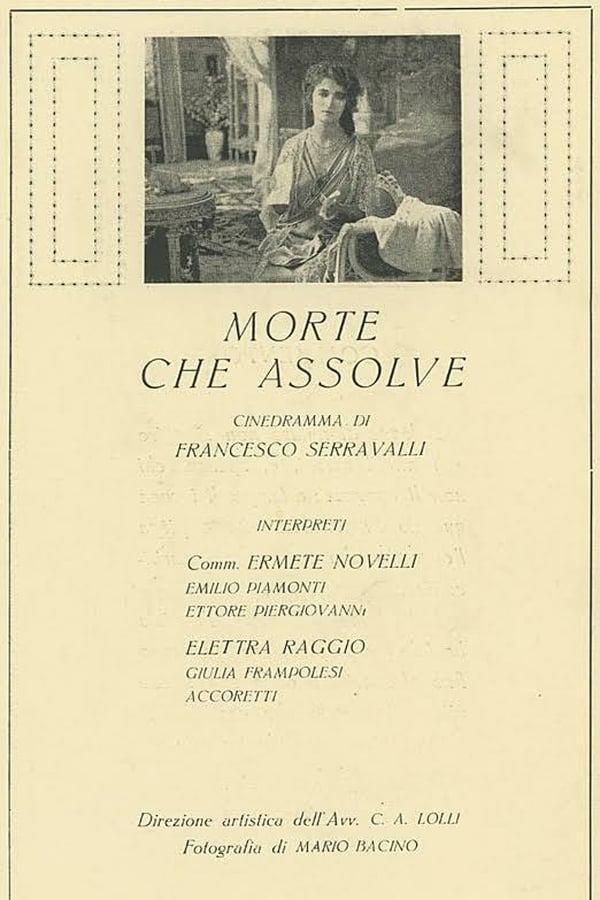
A definitive 6.4/10 rating for a film that redefined the boundaries of cult cinema. La morte che assolve remains a cornerstone of transgressive art.
Twin shadows share one heartbeat.
Francesco Serravalle’s La morte che assolve lands like a bruise on the immaculate skin of Italian silent cinema—an oozing, violet-black mark you can’t help pressing again and again. The title itself is a theological taunt: death as the lone magistrate who both sentences and absolves, a contradiction the film refuses to resolve. Set in the twilight years of pre-war Rome and the raw dawn of New York’s Lower East Side, the narrative braids two destinies so tightly that blood squeezes through the knot.
Maddalena—played by Elettra Raggio with the weary majesty of a crumbling statue—stands in the first reel as the unassailable Madonna of a tenement courtyard. Her husband Falco (Ermete Novelli, channeling a predatory calm later perfected by von Stroheim) is a shark in patent-leather shoes, trafficking debts the way peddlers hawk chestnuts. When Maddalena dares plead for a destitute neighbor, Falco brands her compassion as betrayal. Public scorn—rendered through whip-pans across sneering faces—becomes the scaffold on which her motherhood is executed. The film’s most lacerating image arrives early: Maddalena’s wedding ring tossed into the Tiber, sinking past the carcass of a drowned cat. Serravalle cuts from that subaqueous gloom to a close-up of Raggio’s eyes, pupils dilated like bullet holes; in the silent grammar, it reads as both funeral and foreshadowing.
Jump-cut to an Ellis Island warehouse where little Erica—also Raggio, now sprightly but preternaturally old—clutches a paper tag bearing the misspelled surname of an American patroness. The crossing, shown in flickering ship lanterns and a single, hallucinated splice of a tempest, functions as baptism by displacement. Yet exile is merely another creditor; it demands payment in identity. The grown Erica’s first words (rendered through intertitles styled like stained glass) are: “I no longer speak the language of pain—I invoice it.” By day she parades in lace, by night she tutors street urchins, a Robin Hood of literacy. The contradiction is intentional: she has inherited Falco’s ledger-book morality while wearing Maddalena’s martyred halo.
Cinematographer Emilio Piamonti sculpts darkness with a surgeon’s ardor. Interiors are pools of tar punctured by carbide lamps; exteriors bask in over-exposed noon that blinds like interrogation lamps. One sequence—Erica prowling a Bowery alley—unfurls almost entirely in silhouette, her outline haloed by sodium glare. The camera then pirouettes 180 degrees to reveal a wall plastered with WANTED posters; among them, Maddalena’s faded photograph. Spatially they occupy different continents, but the mise-en-abyme suggests one soul refracted through punitive geography.
Silent acting often risks semaphore exaggeration; Raggio instead opts for micro-tremors. As Maddalena, her shoulders sag millimetrically forward, as if carrying an invisible yoke. As Erica, vertebrae lengthen, chin tilts to predatory altitude. The dual role never feels gimmick—more like moral mitosis. Watch her courtroom scene (yes, the film detours into a spectacular tribunal reel where Erica, now attorney, defends an Italian immigrant): the camera dollies-in on Raggio’s face, half lit, half eclipsed. In that schism we read both accusation and self-absolution, matriarch and patricide.
Dialogue intertitles are chiseled like grave epitaphs: “Debt is the only crop that grows without rain.” “A mother’s love? A currency devalued by circulation.” Such aphorisms anticipate the staccato nihilism of later noir, yet they’re steeped in Catholic guilt. Serravalle, a defrocked seminarian according to production lore, injects ecclesiastical angst into every narrative vein. Confession booths become bankruptcy courts; rosaries morph into account ledgers. Even the film’s tinting—cyan for Rome nights, amber for New York days—feels sacramental, as though continents themselves receive different rites.
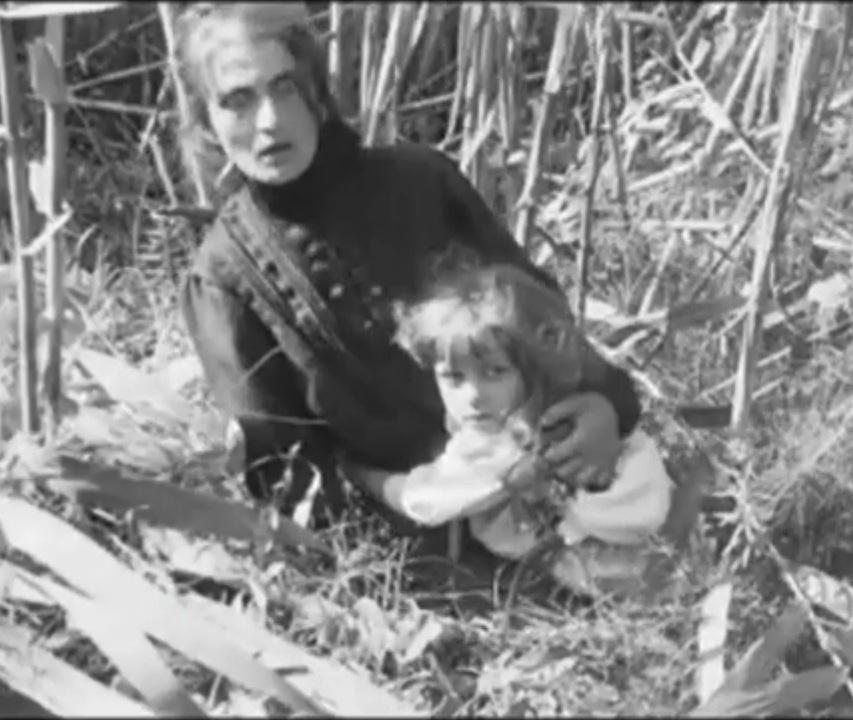
Connoisseurs of The Cold Deck will recognize a kinship in the fatalistic card-game metaphor, though Serravalle shuffles with bleaker fingers. Falco’s final comeuppance—cornered by former debtors beneath the arches of the Palazzo delle Esposizioni—plays out like an inverted Stations of the Cross. Each debtor demands a pound of spirit, not flesh. The usurer is forced to burn his promissory notes, flame reflected in his eyeballs like molten gold. Yet redemption curdles; the camera tilts skyward to reveal a tram cable snapping—random catastrophe nullifying moral arithmetic. No resurrection here, only the chill of cosmic double-entry bookkeeping.
Where Little Meena’s Romance drifts on bucolic innocence and Shifting Sands peddles pulp penitence, La morte che assolve prefers sulfur and sacrament. Its DNA contains strands of Hamlet’s paternal ghosting and Ramona’s racial exile, but the chromosome is distinctly Italo-Gothic. The film even anticipates the bureaucratic nightmare of De levende ladder, though Serravalle’s ladder leads not to heaven but to a ledger-lined purgatory.
Contemporary screenings often pair the film with a neo-Baroque trio: viola da gamba, accordion, and prepared piano. The percussive side employs typewriter hammers striking wooden blocks—an aural reminder that identity here is typed, carbon-copied, filed. Crescendos coincide with Raggio’s dual exposures, sonic palimpsests for visual doubles. When Maddalena’s silhouette dissolves into Erica’s stride, the musicians unleash a tremolo cluster that feels like sinew snapping.
One could read the film as a treatise on patriarchal capitalism: Falco commodifies kinship, the state sanctions motherhood’s erasure, America purchases the offspring at discount. Yet Serravelle complicates the feminist parable. Erica’s empowerment comes through replicating patriarchal violence—she becomes a foreclosure attorney, specializing in evicting widows. The final tableau shows her placing a rose on Maddalena’s unmarked Roman grave, then turning to accept a client whose chauffeur waits in a mahogany Daimler. The cycle is not broken; it is rebranded.
Cineteca di Bologna’s 2022 4K restoration excavates details previously mummified: the frayed hem of Maddalena’s petticoat; the watermark of an IOU bleeding through rice paper; the reflection of a priest’s collar in Falco’s boot. Grain structure resembles etched glass, lending each frame the tactile chill of tombstone rubbings. The tinting schema has been reinstated using chemical analysis of nitrate fragments—the blues now throb with bruise-like saturation, the yellows flare like sulphur.
Upon its 1917 Turin premiere, conservative press dismissed it as “anti-Italian cynicism,” while Il Popolo d’Italia hailed it as “the birth of our national noir.” A century later, academics cite it as proto-neorealism, though its expressionist shadows prefigure The City of Tears and even Scorsese’s Mean Streets. The loan-shark milieu resurfaces in Rule G, but Serravalle’s moral algebra remains colder, more Euclidean.
Do not consume this film as background ambience; it demands penitent attention. Watch at twilight, lights off, volume loud enough to feel the typewriter-percussion in your sternum. Keep a glass of neat amaro handy—sip each time an intertitle wounds. By the end you’ll taste the bitter dregs of absolution that never quite arrives, only circles back like unpaid interest.
La morte che assolve is less a story than a scar: fibrous, pale at the center, dark at the edges. It marries the social outrage of Joan of Plattsburg to the metaphysical dread of Molchi, grust… molchi, yet remains sui generis. Elettra Raggio’s dual incarnation is one of silent cinema’s unheralded miracles; Serravalle’s script a poisoned rosary. Seek it out, but prepare: this is the rare film that forgives nothing—and remembers everything.
IMDb 6.4
1933
Community
Log in to comment.