DbcultAccessing Vault...
5.2/10
Senior Film Conservator
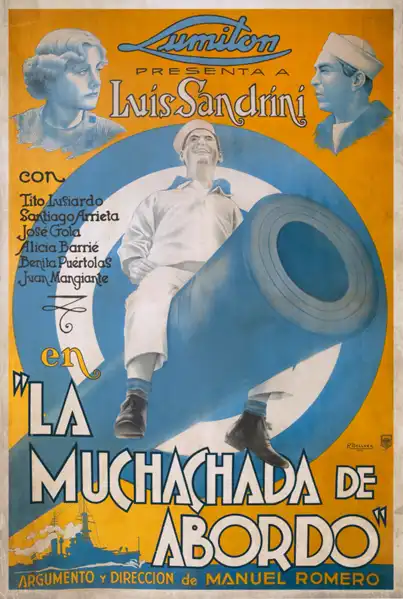
A definitive 5.2/10 rating for a film that redefined the boundaries of cult cinema. La muchachada de a bordo remains a cornerstone of transgressive art.
Alright, so ‘La muchachada de a bordo’ is definitely one for the old-school film buffs. If you enjoy digging into Argentine cinema from the 1930s, or just appreciate a simpler narrative, then yeah, give this a go. It’s a nice little time capsule. But if you’re hoping for quick cuts, loud action, or super complex characters, you might find yourself checking your watch. 🕰️
The story itself is pretty straightforward. You’ve got a young fella doing his mandatory military service in the navy. He’s just trying to get by, but then, wouldn’t you know it, a woman enters the picture. And *then*, his superior officer also takes an interest in her. Cue the drama! It's a setup as old as time, really.
What struck me first was the atmosphere of the ship. You really get a sense of the tight quarters and the rigid hierarchy. Santiago Arrieta plays the superior, and his presence is quite commanding. Not in an over-the-top way, more a quiet authority that just *sits* there. You can feel the tension in his scenes, even when no one’s shouting.
Luis Sandrini, always a charmer, plays the young recruit. He brings that earnest, slightly bewildered quality that makes his characters so relatable. There’s a scene where he’s trying to impress Alicia Barrié’s character, and it’s just this sweet, slightly awkward exchange. You can almost feel the movie trying to convince you this moment matters. 😊
The confrontation between Sandrini’s character and Arrieta’s isn't a huge, explosive fight. It’s more subtle, a battle of wills and unspoken rules. One particular moment, a simple exchange of glances across a crowded room, lingers. You can almost see the gears turning in their heads. It’s a very *polite* kind of rivalry, which feels distinctly old-school.
Benita Puértolas, as a supporting character, adds some nice texture to the background. Her reactions often tell a story without needing dialogue. It’s those small, often overlooked details that make these older films interesting to watch. Like, how someone shifts their weight, or just looks away. 👀
The pacing, for modern eyes, is definitely slower. Scenes are allowed to breathe, sometimes maybe a little too much. There’s a sequence of shore leave that feels like it goes on about 20 seconds too long. The silence starts to feel awkward rather than emotional after a bit. But it does give you time to just soak in the period details.
The set pieces, particularly the interiors of the naval base and the ship, are quite convincing for the era. They don't try to be flashy, just functional and real. It grounds the story. The costumes, too, look authentic – those naval uniforms are sharp. ⚓
Alicia Barrié's character is, as often happens in these older films, a bit of a plot device. She's the object of affection, the catalyst. But she carries herself with a certain elegance. Her smile is *genuinely* lovely, and you can see why two men might get tangled up over her.
It’s not a film that tries to be profound. It’s just a story about human emotions clashing with duty and hierarchy. No grand statements, just a personal struggle playing out. The simplicity is almost refreshing. Sometimes it's nice when a movie doesn't try to be everything. 👍
If you’re curious about how Argentinian cinema tackled these kinds of human dramas back in the day, or you’re a big fan of any of the actors, then ‘La muchachada de a bordo’ offers a decent glimpse. It’s a quiet film, for a quiet afternoon. Don't expect fireworks, but you might find a bit of charm. ✨
IMDb —
1918
Community
Log in to comment.