DbcultAccessing Vault...
Cult Review
Senior Film Conservator
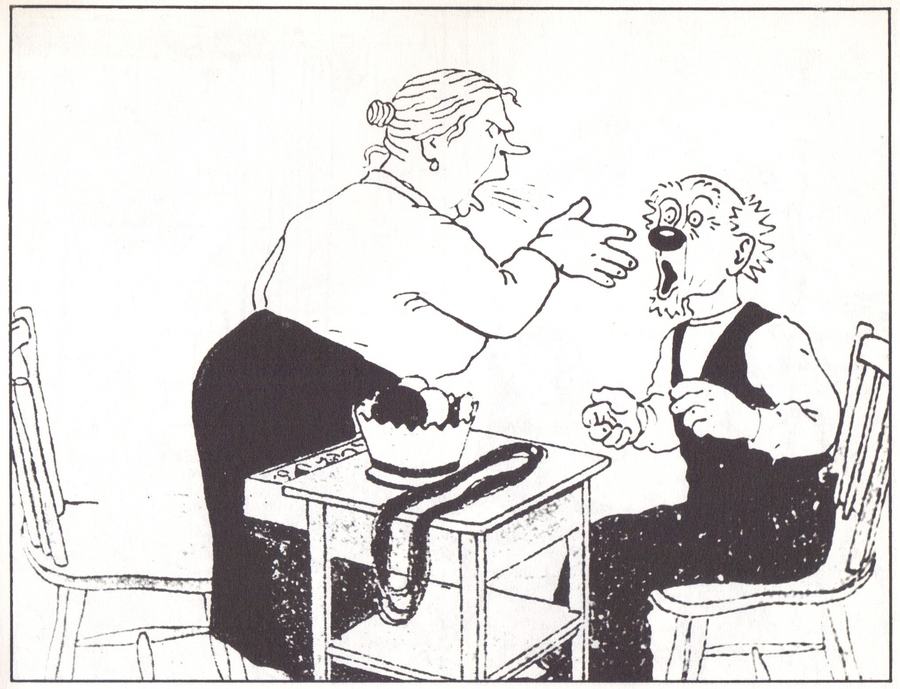
In the nascent epoch of cinematic animation, where the very fabric of moving pictures was still being woven, certain figures emerged as pivotal architects, shaping the visual language and narrative potential of this nascent art form. Among these pioneers, Victor Bergdahl stands as a towering, albeit sometimes overlooked, colossus in Swedish animation. His creation, Kapten Grogg, became an iconic figure, a boisterous, perpetually bewildered mariner whose escapades captivated audiences and cemented a unique style of humor. "Kapten Grogg och fru" (Captain Grogg and Wife), a delightful entry into this animated saga, offers more than mere slapstick; it presents a fascinating vignette into early character animation, marital dynamics, and the sheer ingenuity of its creator.
The film, a veritable masterclass in visual storytelling without the crutch of dialogue, opens not on the high seas, but within the cozy, yet clearly contentious, confines of the Grogg household. The initial scene is a beautifully rendered tableau of domesticity, albeit one frequently punctuated by the captain's characteristic bluster. Fru Grogg, a figure of quiet authority and long-suffering pragmatism, articulates a simple desire: a fresh fish for their evening meal. Her request, delivered with an almost imperceptible raise of an eyebrow, sets in motion a chain of events that rapidly spirals into delightful absurdity. Grogg, ever the man of grand pronouncements and minimal follow-through, puffs out his chest, declares his prowess as a fisherman, and sets off with an air of theatrical confidence. This initial setup is crucial; it establishes the core dynamic between the two protagonists, a relationship built on Grogg's bombastic incompetence and his wife's understated, yet ultimately superior, capability.
Bergdahl's animation in these early sequences is remarkably expressive. Grogg's swaggering walk, his exaggerated gestures, and the way his bushy mustache seems to convey a life of its own, all contribute to a character that is instantly recognizable and inherently comical. The details are subtle but effective: the way Fru Grogg's eyes narrow slightly, or the almost imperceptible sigh that escapes her as her husband embarks on his latest folly. These are not just drawings; they are personalities brought vividly to life through the animator's meticulous hand, demonstrating an early understanding of character acting that would become foundational for the art form. The anticipation of disaster is palpable, yet it's an anticipation laced with the joyous expectation of visual gags. This careful build-up, reminiscent of the pacing in contemporary live-action comedies like The Good for Nothing, allows the audience to fully invest in the impending chaos.
True to form, Grogg's fishing expedition is a spectacular failure. His attempts to cast a line are a masterclass in physical comedy, resulting in tangles, knots, and an almost poetic self-ensnarement. A particularly memorable sequence involves a mischievous seagull, rendered with delightful fluidity, repeatedly snatching Grogg's bait, much to the captain's escalating fury. The bird's smug expression and Grogg's apoplectic reactions are a testament to Bergdahl's ability to imbue even minor characters with distinct personalities. The sea itself, initially calm, begins to mirror Grogg's rising frustration, with subtle ripples giving way to more agitated waves. This anthropomorphic treatment of the environment is a recurring motif in early animation, allowing the setting to become an active participant in the comedic unfolding.
The turning point arrives when Fru Grogg, having observed her husband's escalating incompetence with a mixture of amusement and exasperation, attempts to offer some practical advice. Grogg, his ego bruised by his failures and his wife's unsolicited wisdom, dismisses her with a flourish and, in a fit of petulance, decides to take matters into his own hands – or rather, into a ridiculously small dinghy. This decision marks the transition from domestic farce to full-blown maritime adventure. The visual contrast between Grogg's grand intentions and the minuscule vessel he attempts to command is inherently hilarious, a classic comedic trope executed with precision. As he rows out, a sudden squall, seemingly conjured by his own mounting frustration, engulfs him. The animation of the storm is surprisingly dynamic for its era, with swirling lines and rapid shifts in perspective effectively conveying the chaos and danger. Grogg, despite his terror, manages to maintain a semblance of his blustery persona, even as he's tossed about like a cork.
The heart of "Kapten Grogg och fru" lies in its ingenious deployment of visual gags. During the storm, Grogg's attempts to bail water with a thimble-sized cup, or his valiant but futile efforts to steer the tiny boat with a spoon, are moments of pure comedic genius. The scene where he encounters a passing whale, mistaking its enormous spout for some colossal, elusive fish, is particularly memorable. His wide-eyed terror and subsequent comical attempts to 'reel it in' speak volumes about his character – a man whose imagination is as vast as his practical skills are limited. These are not merely isolated jokes; they are integral to the narrative, each gag building upon the last to escalate the absurdity of Grogg's predicament. This meticulous construction of humor is a hallmark of Bergdahl's work, distinguishing it from simpler, more episodic animated shorts of the period.
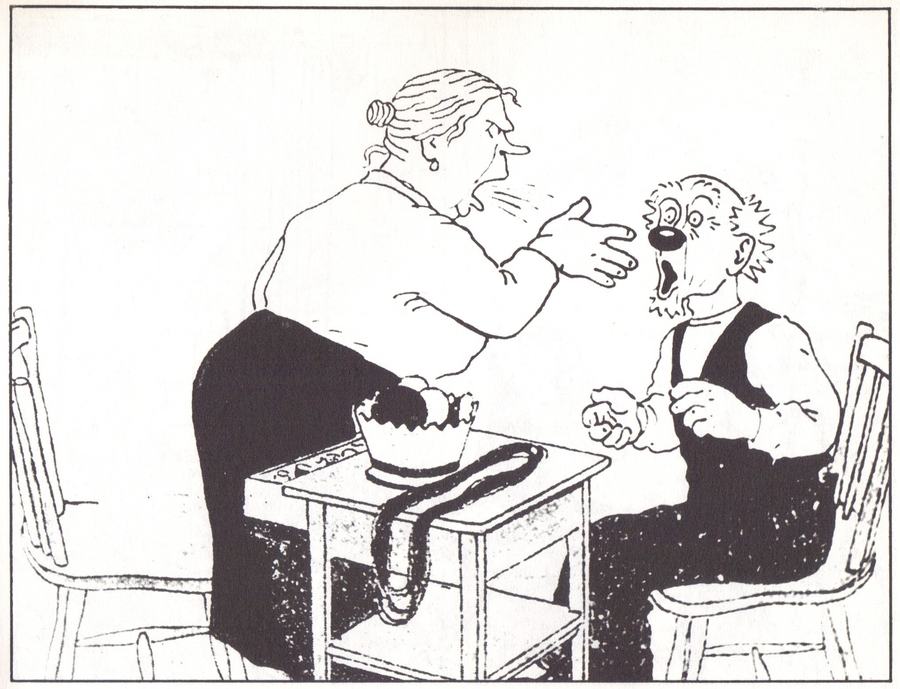
Meanwhile, Fru Grogg, far from being a passive observer, demonstrates her own brand of quiet heroism. From the shoreline, her expressions shift from exasperation to genuine concern, and then to a determined resourcefulness. She is not merely waiting; she is thinking, strategizing. Her eventual 'rescue' of Grogg, achieved not through daring acts but through clever manipulation of currents or perhaps a strategically placed signal, underscores her understated power in their relationship. It's a delightful subversion of traditional gender roles for the era, presenting the wife as the true anchor and intellectual force, even if her husband remains oblivious. This subtle character development, achieved entirely through visual cues, elevates the film beyond mere cartoon antics to a nuanced exploration of a marital partnership. One might even draw parallels to the complex dynamics in more dramatic narratives like Anna Karenina, not in terms of subject matter, but in the intricate portrayal of human relationships through non-verbal communication.
Victor Bergdahl's creative genius is evident in every frame of "Kapten Grogg och fru." His animation style is characterized by its fluid lines, energetic movement, and distinctive character designs. Grogg himself, with his bulbous nose, walrus mustache, and perpetually surprised or indignant expression, is a marvel of caricature. Bergdahl understood the power of exaggeration in animation, using it not just for comedic effect but also to convey emotion and character. The backgrounds, though often sparse, are rendered with enough detail to establish a sense of place, whether it's the quaint domestic setting or the turbulent open sea. The overall aesthetic is one of charming simplicity, yet beneath that simplicity lies a sophisticated understanding of animation principles.
The influence of Bergdahl and the Kapten Grogg series on early Swedish cinema and international animation cannot be overstated. While contemporary American animators like Winsor McCay were pushing boundaries with realism and complex narratives, Bergdahl carved out a niche for character-driven comedy, laying groundwork for future generations of animators focused on personality and humor. The Kapten Grogg films, including this one, served as a vital stepping stone, demonstrating that animation could sustain continuous characters and evolving narratives, rather than merely being a novelty act. The very directness of his approach, prioritizing clear visual storytelling over elaborate technical wizardry, is a lesson in efficacy that resonates even today.
The narrative reaches its crescendo with Grogg's eventual stranding on a minuscule island. This isn't a tropical paradise, but rather a barren rock, barely large enough to accommodate him, and populated by a surprisingly aggressive community of crabs. The animation of these crustaceans is delightful, their scuttling movements and menacing pincers adding another layer of physical comedy to Grogg's predicament. His attempts to fend them off, using his fishing rod as a makeshift weapon, are both pathetic and hilarious. The visual of a tiny, beleaguered captain surrounded by an army of scuttling crabs is an image that lingers long after the film concludes. This sequence, in particular, showcases Bergdahl's talent for creating dynamic, multi-character interactions within a limited frame.
The resolution, as with many of Grogg's adventures, is less about his own heroic efforts and more about the serendipitous intervention of fate, often guided by his wife's unseen influence. The film cleverly brings Grogg back to shore, not through an epic voyage of self-discovery, but through a series of comical mishaps that ultimately land him back in his wife's care. His return is met not with a hero's welcome, but with Fru Grogg's characteristic blend of relief and knowing exasperation. The final image, often of Grogg sheepishly accepting his fate and perhaps even a scolding, perfectly encapsulates the enduring, if tumultuous, nature of their bond. It’s a cyclical narrative, suggesting that for all his grand adventures, Grogg will always return to the domestic sphere, forever bound by the quiet authority of his wife. This cyclical nature of comic misfortune and domestic return echoes the enduring appeal of characters like Charlie Chaplin or Buster Keaton, whose cinematic personas were often defined by their repeated encounters with the absurd and their eventual, often humble, re-entry into societal norms.
"Kapten Grogg och fru" is more than just a historical curiosity; it is a vibrant, engaging piece of early animation that holds up remarkably well. Its humor is universal, its characters enduring, and its animation, though simple by modern standards, possesses an undeniable charm and vitality. Victor Bergdahl, as both the animator and implicitly the writer, demonstrates a profound understanding of comedic timing and character development. The film’s ability to tell a complete, engaging story without dialogue, relying solely on visual cues and the expressive power of his drawings, is a testament to its artistic merit. It's a reminder of the foundational principles of animation – motion, expression, and the careful choreography of absurd events.
Comparing it to other films of its era, one finds its distinctiveness. While films like Urteil des Arztes or Herregaards-Mysteriet delved into dramatic narratives and complex human emotions, "Kapten Grogg och fru" embraced the pure, unadulterated joy of visual comedy. It shares a spirit of lighthearted adventure with films like Giro d'Italia, albeit translated into the whimsical realm of animation. The sheer inventiveness of its gags and the consistent characterizations set it apart. It’s a film that speaks to the enduring appeal of the underdog, the blustering fool, and the quiet hero who truly holds everything together. For anyone interested in the origins of animation, the history of Swedish cinema, or simply in enjoying a good laugh, "Kapten Grogg och fru" remains an indispensable and thoroughly enjoyable experience. It is a miniature masterpiece, demonstrating that even in its infancy, animation possessed the power to craft compelling narratives and create characters that resonate across generations. The simple yet profound humor, the exquisite timing of the visual gags, and the endearing personalities of Grogg and his wife ensure its place as a cherished artifact of cinematic history, a beacon of creativity from a bygone era that still shines brightly today.
IMDb 6.6
1922
Community
Log in to comment.