DbcultAccessing Vault...
Cult Review
Senior Film Conservator
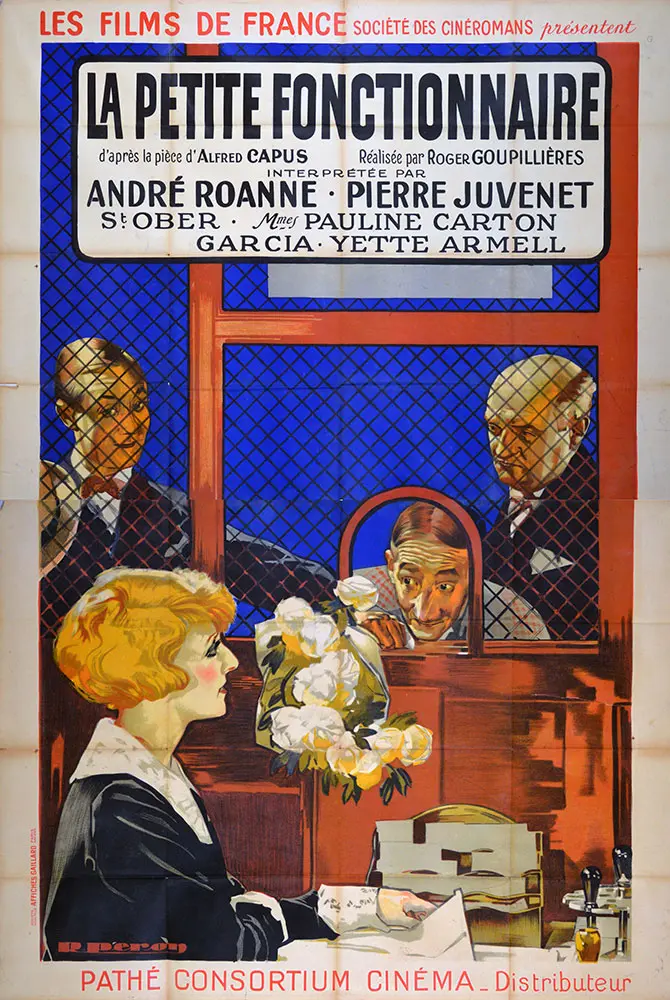
So, is 'La petite fonctionnaire' worth watching today? Short answer: yes, but with significant caveats. This rarely discussed French silent film offers a fascinating, if sometimes challenging, window into early 20th-century Parisian life and the societal constraints placed upon women, particularly those in the burgeoning civil service. It's a film for the patient cinephile, the historian, and anyone with a deep appreciation for the subtle art of silent era storytelling, but it will likely test the patience of those accustomed to modern pacing and overt narrative dramatics.
This film works because it commits wholeheartedly to its premise, delivering a remarkably understated performance from Angèle Decori that anchors the entire production. It fails because its deliberate pacing and reliance on visual nuance over overt action can feel glacial to contemporary audiences, and its ultimate resolution, while period-appropriate, might leave modern viewers wanting more assertive character arcs. You should watch it if you cherish historical authenticity, character-driven silent dramas, and the opportunity to witness a bygone era's social commentary. You should probably skip it if you require fast-moving plots, clear-cut heroes, or struggle with the inherent limitations of silent cinema.
Alfred Capus’s adaptation of his own work for the screen, even through the lens of a century, feels remarkably intimate. The plot, centered on Mademoiselle Anne Dubois, a 'petite fonctionnaire' – a little civil servant – is less about grand events and more about the interior landscape of a life lived on the margins of significance. Her daily routine, depicted with an almost documentary-like precision, becomes a character in itself: the endless paperwork, the rigid hierarchy, the stifling atmosphere of the office. It’s a compelling portrait of a woman whose dreams are perpetually just out of reach, overshadowed by the mundane.
The introduction of Monsieur Henri Dubois, a new colleague, serves as the catalyst, a ripple in Anne’s otherwise placid existence. Their budding romance, conveyed through stolen glances and hesitant smiles, is the film's emotional core. It's a testament to the power of silent cinema that such delicate emotions can be communicated without a single spoken word, relying instead on the actors' expressions and the director's careful framing. This is where the film truly shines, allowing the audience to project their own understanding onto these nascent feelings.
However, the narrative isn't without its tensions. Monsieur Giraud, Anne's superior, embodies the societal pressures of the time. His stern demeanor and conservative outlook represent the insurmountable obstacles that a woman like Anne faced when daring to dream beyond her prescribed role. The conflict isn't loud or explosive; it's a constant, low hum of disapproval, a subtle pressure that slowly erodes Anne's confidence. This subtlety is both the film's greatest strength and, for some, its most significant challenge.
The writing, credited to Alfred Capus, retains a theatrical sensibility, which is common for films of this era. One can almost feel the stage directions embedded in the intertitles. While this lends a certain elegance to the dialogue, it occasionally contributes to the somewhat static nature of certain scenes. Yet, it's also clear that Capus understood the power of visual storytelling, even in its nascent form, allowing the camera to linger on faces and environments to convey unspoken truths.
“The true drama of 'La petite fonctionnaire' lies not in external conflict, but in the quiet, internal battle for a shred of personal dignity and happiness within a suffocating system.”
Angèle Decori, as Anne Dubois, delivers a performance that feels both authentic and deeply moving. Her portrayal is a masterclass in silent acting, relying on nuanced facial expressions and restrained body language rather than exaggerated gestures. There's a particular scene where Anne, after a brief, hopeful encounter with Henri, returns to her desk, and Decori conveys a complex mixture of joy, apprehension, and a resigned awareness of her circumstances, all within a few frames. It’s a performance of quiet brilliance, and perhaps the single most compelling reason to seek out this film.
André Roanne, as Henri Dubois, provides the necessary charm and youthful energy to spark Anne's interest. His performance is less about grand romantic gestures and more about subtle flirtation and a genuine, if somewhat naive, affection. He represents the possibility of escape, a breath of fresh air in Anne's suffocating world. His interactions with Decori are believable, fostering a gentle chemistry that anchors the film's romantic subplot without ever becoming saccharine.
Pierre Juvenet's Monsieur Giraud is a formidable, if not overtly villainous, presence. He embodies the rigid authoritarianism of the period, his stern gaze and stiff posture speaking volumes about his character. Juvenet manages to make Giraud a symbol of institutional oppression without resorting to caricature, which is a credit to his subtle performance. He is not evil, but rather a product of his time, enforcing the rules he believes are necessary, making his opposition to Anne's happiness all the more frustrating.
Even the smaller roles contribute significantly to the film's texture. Pauline Carton, known for her comedic timing, likely brings a touch of much-needed levity or perhaps a knowing cynicism to her role, offering a contrast to Anne's earnestness. While specific details of her character are lost to time or require a viewing, her presence in the cast list suggests a deliberate inclusion to round out the ensemble. The ensemble, as a whole, creates a believable microcosm of Parisian society, each actor contributing to the overall atmosphere of the office and Anne's world.
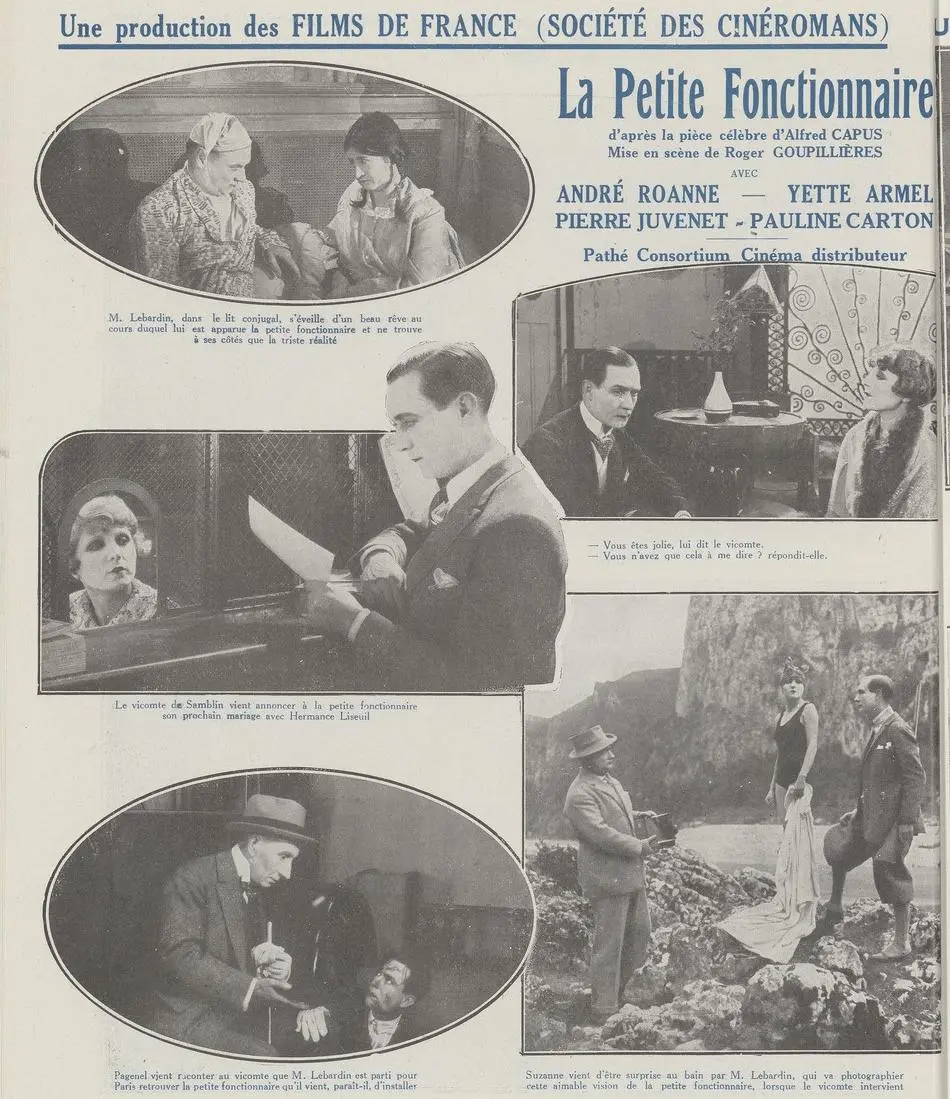
While 'La petite fonctionnaire' is credited to Alfred Capus as writer, the directorial choices – often uncredited or collectively attributed in early cinema – are crucial to its impact. The direction, whoever was at the helm, demonstrates a clear understanding of space and character. The office setting, for example, is not merely a backdrop but a character in itself, its high ceilings and rows of desks emphasizing Anne's smallness and insignificance within the bureaucratic machine. There's a particular shot early in the film that frames Anne almost swallowed by her workspace, a potent visual metaphor for her life.
However, this simplicity can also be a double-edged sword. While it fosters intimacy, it occasionally leads to a visual monotony that might challenge modern viewers accustomed to more dynamic camerawork. Unlike the playful experimentation seen in early animation like Feline Follies, 'La petite fonctionnaire' adheres to a more classical, theatrical approach to its visual storytelling. The lighting, too, is straightforward, often high-key, illuminating the faces and sets without much dramatic shadow play. This choice, while perhaps practical for the era, contributes to the film's overall understated aesthetic.
The use of intertitles is, as expected for a silent film, essential. They are concise and functional, providing necessary dialogue and exposition without overwhelming the visual narrative. A good silent film knows when to let the image speak, and 'La petite fonctionnaire' generally strikes this balance well, reserving its intertitles for moments where clarity is paramount. There's an art to crafting effective intertitles, and this film demonstrates a practiced hand in that regard, avoiding the verbose excesses sometimes found in other productions of the period.
The pacing of 'La petite fonctionnaire' is undeniably deliberate. It's a slow burn, unfolding with the measured cadence of a life lived in routine. This is not a film that rushes its narrative; instead, it allows moments to breathe, inviting the audience to immerse themselves in Anne's quiet world. For those unaccustomed to the rhythms of silent cinema, this can feel like a test of endurance. There are long stretches where the narrative progresses through subtle character interactions and environmental details rather than plot twists or rapid-fire events.
This measured pace, however, is integral to the film's tone. The overall tone is one of understated realism, tinged with a melancholic yearning. There are moments of gentle humor, likely provided by characters like Pauline Carton's, that offer brief respites from the pervasive sense of constraint. Yet, the overriding feeling is one of quiet struggle and the universal desire for connection and meaning in a world that often demands conformity. It’s a tone that resonates particularly well with the film's theme of a woman trying to find her place.
Compared to more overtly melodramatic silent films, such as perhaps South Sea Love or Dark Secrets, 'La petite fonctionnaire' opts for a more naturalistic approach. The drama is internal, the conflicts subtle. This choice makes the film feel remarkably modern in its emotional honesty, even if its narrative structure hails from a bygone era. It's a character study first and foremost, with plot mechanics serving to illuminate the protagonist's inner world rather than drive external action.
The film's ending, without revealing specifics, aligns perfectly with its established tone. It's not a grand, triumphant resolution, nor is it a crushing tragedy. Instead, it offers a reflection of the realities faced by women in that period, emphasizing the small victories and the enduring challenges. It's a thought-provoking conclusion that leaves the viewer to ponder Anne's future, rather than tying everything up neatly with a bow. This open-endedness is, in my opinion, one of its more sophisticated qualities, demonstrating a maturity in storytelling that transcends its age.
Absolutely, for the right audience. 'La petite fonctionnaire' offers a unique and valuable historical document, showcasing a particular style of French silent filmmaking that prioritized character and social observation over spectacle. Its subtle performances, particularly Angèle Decori's, are genuinely captivating and demonstrate the profound emotional depth achievable in the silent era.
It serves as a powerful reminder of how far cinematic storytelling has evolved, but also of the timeless nature of human desires and societal pressures. If you are a student of film history, a lover of character-driven dramas, or simply curious about the nuances of early 20th-century French culture, this film provides immense value. However, if your preference leans towards fast-paced narratives, explicit dialogue, or films with clear-cut resolutions, 'La petite fonctionnaire' may prove to be a test of patience rather than a rewarding experience. It demands an active, engaged viewer willing to meet it on its own terms.
'La petite fonctionnaire' is a film that rewards patience and a genuine interest in the history of cinema. It’s not a blockbuster, nor is it a forgotten masterpiece in the conventional sense. What it is, however, is a quietly profound character study, anchored by a superb performance that transcends the limitations of its era. It works. But it’s flawed. Its strengths lie in its humanistic approach and its ability to evoke a specific time and place with remarkable authenticity. While it may not appeal to everyone, those who venture into its understated world will find a film that resonates with timeless themes of individual longing against institutional constraint. It's a valuable piece of cinematic history that deserves a re-evaluation, not just as an artifact, but as a film with a beating heart. A recommended viewing for the discerning cinephile, but approach with an open mind and a willingness to embrace its unique, unhurried rhythm.
IMDb —
1925
Community
Log in to comment.