DbcultAccessing Vault...
Cult Review
Senior Film Conservator
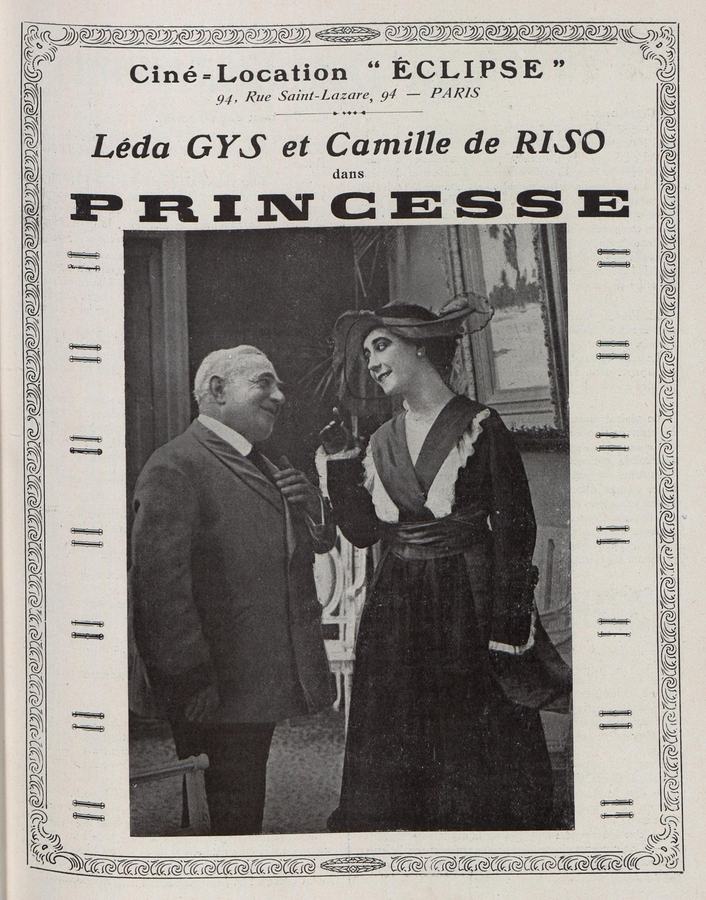
Camillo De Riso’s 1914 one-reeler, long buried beneath the avalanche of wartime newsreels, detonates like a hand-painted firework once the lights dim. The plot—ostensibly a corset-heaving melodrama—mutates into an anarchist pamphlet stitched with baroque lace. Every intertitle, lettered in tremulous italics, feels dipped in absinthe; every tableau reeks of saltwater and altar incense. The film’s very emulsion seems sweat-slicked, as though the Adriatic itself exhaled onto the negative.
While American contemporaries were busy polishing the bourgeois banality of The Marriage Market, Italian artisans hand-tinted each frame of La principessa with arsenic greens and Eucharistic purples. The result is a visual palimpsest: candlelit corridors flicker between saffron and bruise-blue, echoing the heroine’s oscillation between sanctity and subversion. Even the balloon sequence—rendered in amber-tinted monochrome—feels solar, as though Icarus had borrowed Medici gold to sew his wings.
Leda Gys, billed demurely as “the principessa,” has a face that silences auditoriums. Her glance contains the lethal languor of a bored archangel; when she lifts her veil, the lens seems to blush. Opposite her, Arnold Kent’s journalist is all kinetic anxiety—ink-stained cuffs, cigarette tremors, a gaze that keeps calculating escape vectors. Their chemistry ignites not in passionate clinches but in the exchange of forbidden pamphlets: a scrap of paper passes between their palms like contraband gunpowder.
Bracco, better known for symbolist plays, compresses entire acts of social revolt into single intertitles. One card reads: “La virtù è una moneta che l’uomo conia per non pagare il debito del desiderio.” The aphorism detonates louder than any 1914 cannonade. Compare this lethal concision to the verbose moralism of Dr. Rameau, where patriarchal redemption drags across three reels. Here, redemption is rejected outright; what remains is the acrid perfume of insurrection.
De Riso employs axial cuts to leap from ballroom to catacomb without narrative cushioning. A masked ball dissolves into a plague ward via a single match-cut: the glint of a chandelier becomes the gleam of a surgeon’s scalpel. Such ruthless elision anticipates Soviet montage by half a decade, predating even the dialectical collisions of The Dawn of Freedom. The effect is vertiginous: viewers tumble from silk into pus, from waltz into requiem.
Though mute, the film evokes sound through synesthetic imagery. A close-up of a rosary dropping onto marble conjures the clack of bone on bone; the balloon fire is painted crimson so violently one almost hears the hiss of hydrogen. These sensory ghost-tracks make Gelöste Ketten feel anaemic by comparison, its alpine redemption too chlorophyllically pristine.
The principessa’s transvestite escape is no Shakespearean gimmick. When she shears her hair with a shard of communion plate, the act reverberates across the Mediterranean: a secular annunciation that womanhood can be cast off like a chrysalis. Contrast this with La reina joven, where royal femininity remains incarcerated by bloodline. De Riso’s heroine refuses monarchy, marriage, even mourning; she manufactures her own sovereignty from paper, poison, and propaganda.
The hot-air balloon sequence prefigures the phantasmagorical ascensions in The Black Box, yet where the latter uses flight as metaphysical metaphor, La principessa keeps its boots mired in class warfare—every altitude gain is an affront to terrestrial tyrants. Likewise, the plague ward finale infects the viewer with civic terror, a tactic later weaponised by The Gates of Doom, though that film dilutes its contagion with moralistic saline.
Until recently, only a nitrate fragment in a Sicilian monastery attested to the film’s existence. A 4K restoration by Cineteca di Bologna—funded mysteriously by an anonymous female philanthropist—premiered at Il Cinema Ritrovato. Streaming rights are currently hostage among boutique platforms; however, a limited-region Blu-ray is rumored for autumn. Sign the petition, haunt the forums, bribe the archivists—whatever it takes. Missing this rebirth would be tantamount to sleeping through a comet.
At a scant thirty-eight minutes, La principessa compresses more fury, beauty, and ideological nitroglycerin than most trilogies manage in six hours. When the screen darkens and the heroine’s eyes become twin eclipses, you will taste metal on your tongue—an after-effect of cinema so potent it feels radioactive. This is not nostalgia; this is insurgency on celluloid. Let the Medici crest flutter into the Tiber; let the arch-duke’s corpse feed the catacombs; let every veil that ever muffled a woman’s mouth ignite like the balloon’s silk. And when the embers settle, remember: revolt, too, can be princess-born.
IMDb 5.2
1924
Community
Log in to comment.