DbcultAccessing Vault...
Cult Review
Senior Film Conservator
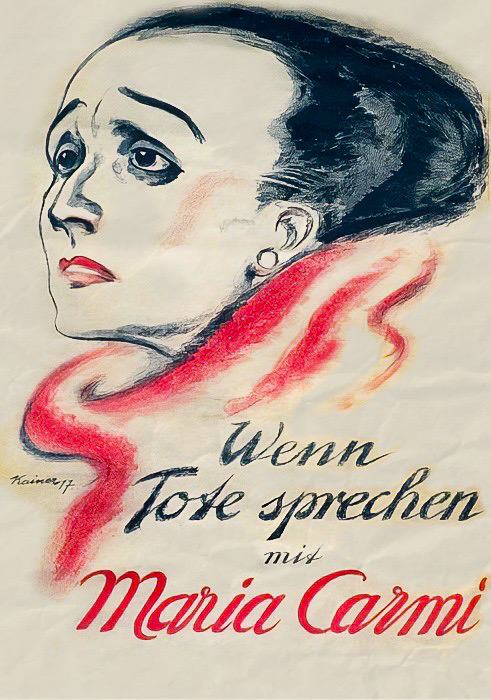
Stepping back into the hallowed, often shadowy, halls of early 20th-century cinema is always a peculiar pilgrimage. It's a journey into an era where narrative was forged not through dialogue, but through the eloquent contortions of the human face, the dramatic sweep of a camera, and the visceral power of suggestion. Robert Reinert’s Wenn Tote sprechen (When the Dead Speak), a cinematic artifact from a time when the very language of film was still being passionately invented, stands as a testament to this audacious spirit. It's a film that, even a century later, manages to burrow under the skin, not with cheap jump scares, but with a creeping, existential dread born from the finest traditions of German Expressionism and psychological drama. To truly appreciate its genius, one must shed the expectations of modern storytelling and surrender to its unique, silent cadence.
The film introduces us to Dr. Alaric Thorne, portrayed with an almost unbearable intensity by the inimitable Conrad Veidt. Veidt, an actor whose very presence on screen could convey entire novels of internal turmoil, is perfectly cast as a man teetering on the precipice of sanity. His Thorne is not merely grieving; he is consumed by it, a living embodiment of sorrow following the untimely death of his fiancée, Elara (Maria Carmi). Carmi, with her ethereal beauty and tragic fragility, becomes less a character and more a spectral muse, the catalyst for Thorne's harrowing descent. Her demise, initially ruled an accident, leaves an unfillable void in Thorne’s life, transforming his elegant Vienna apartment into a mausoleum of memory.
Reinert, a director known for his visually striking and often emotionally charged narratives, masterfully crafts an atmosphere of profound unease from the outset. The sets, though perhaps not as overtly stylized as those in The Cabinet of Dr. Caligari (a contemporary masterpiece often cited in discussions of Expressionism), nonetheless contribute to a sense of claustrophobia and mental imprisonment. Shadows cling to corners, distorting familiar objects, hinting at a reality far more sinister than the eye perceives. Thorne, isolated by his grief, begins to experience phenomena that defy rational explanation: whispered words carried on phantom breezes, objects subtly displaced, and fleeting, almost translucent apparitions of Elara herself. These are not merely the manifestations of a haunted house but the insidious tendrils of a mind unraveling, convinced that the dead are attempting to communicate, to reveal a truth obscured by tragedy.
The spectral messages coalesce into a chilling accusation, pointing an invisible finger at Baron Von Kroll (Carl de Vogt), a figure of considerable influence and questionable ethics, who had previously vied for Elara’s affection. De Vogt, with his imposing stature and often sinister gaze, embodies the perfect antagonist, a man whose polished exterior belies a potentially corrupt interior. Thorne’s initial skepticism gives way to a fervent, almost pathological obsession. He ceases to be a detached man of science and transforms into a tormented detective, convinced that Elara's spirit is guiding him towards a hidden murder. This narrative turn, while common in later thrillers, feels remarkably fresh and potent in the silent era, relying entirely on visual cues and the actors' profound ability to convey complex emotional states without a single uttered word.
The film’s pacing, initially deliberate and atmospheric, quickens as Thorne’s investigation deepens. He confronts Von Kroll, a scene charged with unspoken tension, where the Baron's calm denials only serve to fuel Thorne’s growing paranoia. Society, observing Thorne's increasingly erratic behavior, begins to brand him as mad, isolating him further. This societal judgment is a common thread in films exploring psychological distress, seen in various forms across cinematic history, from the misunderstood protagonists of early dramas like The Dead Secret to more modern explorations of mental health. Yet, in Wenn Tote sprechen, it’s not merely a plot device; it's an amplification of Thorne's internal torment, a reflection of his own disintegrating grip on reality.
It is impossible to discuss Wenn Tote sprechen without dedicating significant attention to Conrad Veidt's performance. Veidt, a luminary of German Expressionism, had an uncanny ability to externalize internal conflict. His gaunt features, piercing eyes, and elongated frame were perfectly suited to conveying characters haunted by inner demons or otherworldly forces. Here, he embodies Thorne's grief with such raw authenticity that it becomes almost palpable. His movements are precise, yet imbued with a nervous energy; his expressions shift from profound sorrow to manic conviction, then to utter despair, all without the aid of dialogue. This is acting of the highest order, a masterclass in non-verbal communication that few have ever rivaled. One could draw parallels to his later iconic roles, such as Cesare in The Cabinet of Dr. Caligari, where he similarly portrays a character manipulated by unseen forces, or even his more nuanced performances in films like The Man Who Laughs, where his face, though grotesquely altered, still conveys profound pathos. Veidt’s Thorne is a character etched in the memory long after the final frame, a testament to his profound artistry.
Maria Carmi, though given less screen time, leaves a powerful impression. Her Elara is not just a victim but a spectral presence, her beauty and fragility forming the emotional core of Thorne’s obsession. Her performance, often appearing in dream sequences or spectral visions, is delicate yet impactful, serving as a constant reminder of what Thorne has lost and what he believes he must reclaim. Carl de Vogt, as the enigmatic Baron, provides a compelling foil. His measured performance, a stark contrast to Veidt's frenetic energy, creates a believable antagonist, one whose subtle menace is all the more chilling for its understated delivery.
Reinert’s direction relies heavily on visual metaphors and the expressive potential of the silent medium. The use of superimposition to depict Elara’s ghost, the distortion of reality through Thorne’s increasingly unreliable perspective, and the dramatic lighting choices all contribute to the film’s unique aesthetic. The cinematography, though rudimentary by today's standards, is incredibly effective in creating mood and conveying psychological states. Close-ups on Veidt’s face become windows into his tormented soul, while wider shots emphasize his isolation within vast, empty spaces. This visual language is profoundly influential, laying groundwork for future psychological thrillers and horror films, much like how The Stolen Voice explored the loss of identity through visual narrative or Masks and Faces delved into the duality of public and private personas.
The central theme of Wenn Tote sprechen is not merely a ghost story, but a profound exploration of grief, guilt, and the fragile nature of the human mind. The film masterfully builds towards its devastating climax, where the supernatural explanation is meticulously peeled away to reveal a far more terrifying, human truth. The 'dead' are indeed speaking, but their voice is not an external echo from the afterlife; it is the internal monologue of a conscience desperately trying to externalize an unbearable truth. Thorne’s elaborate construction of a supernatural conspiracy is, in fact, a defense mechanism, a desperate attempt by his mind to shield itself from the horrifying reality of his own accidental culpability in Elara’s death. This twist, delivered with a chilling precision that resonates deeply, elevates the film from a mere mystery to a profound psychological tragedy.
While perhaps not as widely known as some of its more celebrated Expressionist contemporaries, Wenn Tote sprechen holds a significant place in the annals of cinematic history. It showcases the burgeoning sophistication of silent film, demonstrating its capacity for complex psychological narratives and profound emotional depth. The film's influence can be subtly traced through later works that explore themes of unreliable narration, psychological trauma, and the blurred lines between reality and delusion. One might even see echoes of its thematic concerns in films like The Curse of Greed, where internal failings rather than external forces drive the tragedy, or Man and Beast, which delved into the darker aspects of human nature.
The enduring power of Wenn Tote sprechen lies in its ability to transcend its technological limitations. It speaks to universal human experiences: the agony of loss, the burden of guilt, and the terrifying fragility of the mind when confronted with unbearable truths. Robert Reinert, through his thoughtful direction and the unparalleled artistry of his cast, particularly Conrad Veidt, crafted a film that remains compelling, disturbing, and deeply moving. It reminds us that sometimes, the most terrifying voices are not those from beyond the grave, but the ones echoing within our own troubled consciousness. It’s a film that demands patience and a willingness to engage with its unique cinematic language, but for those who make the effort, the rewards are immense. It's a haunting masterpiece, a silent symphony of sorrow and psychological unraveling that continues to resonate with chilling clarity.
In an era when film was still discovering its voice, Wenn Tote sprechen proved that silence could be louder, more profound, and infinitely more terrifying than any spoken word. It's a film that truly makes the dead speak, not through supernatural theatrics, but through the enduring, torturous echoes of a human heart. Its narrative complexity, combined with the raw, visceral performances, especially from Veidt, secures its place as a significant, albeit sometimes overlooked, gem in the crown of early German cinema. It compels viewers to look inward, to question the reliability of perception, and to confront the inner demons that can be far more formidable than any external apparition. A true journey into the abyss of the human psyche, it leaves an indelible mark, prompting reflection on the very nature of truth and delusion.
IMDb —
1922
Community
Log in to comment.