DbcultAccessing Vault...
Cult Review
Senior Film Conservator
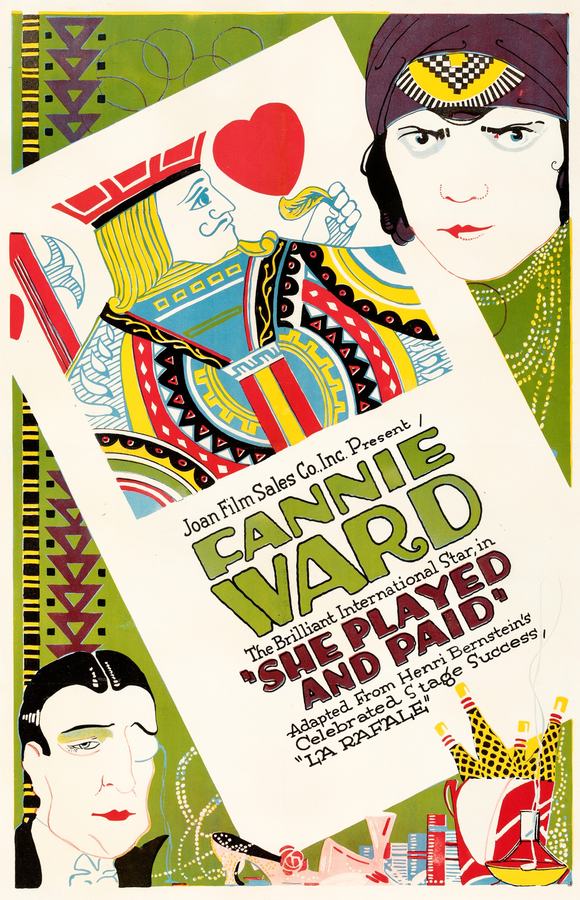
They say silence amplifies guilt; La rafale wagers the opposite—that silence is guilt’s accomplice, a velvet glove pressed over the mouth of a woman who has just sold the only thing she still owns. When the intertitles finally confess “Il est mort à six heures”, the letters do not scream; they exhale, like a cigarette ember dropped onto satin. Henri Bernstein’s 1920 film—adapted from his own scandal-hit stage play—understands that the most harrowing suicides happen off-screen, timed to the municipal clock whose chimes we never hear but feel in the vertebrae.
Set decorator Jean Croué drapes every boudoir in bruised lilacs and tarnished gilt, so even the flowers look like they need a line of credit. Into this boudoir steps Yvette Andréyor as the Baronne le Bourge, a woman whose pearls weigh more than her options. Andréyor’s face—angular, almost starved—carries the same luminosity later demanded by Carl Theodor Dreyer, yet here it is mortgaged to a plot that refuses transcendence. Watch her in the pawn-shop sequence: the camera lingers on her glove hesitating above the glass counter, and in that hesitation whole novels of class anxiety unspool. She cannot sign the receipt without a husband’s consent, and the quiver of her wrist is the quiver of an entire social order.
Opposite her, Jean Dax plays Robert de Chaceroy like a man who has already dreamt his own funeral. Dax eschews the matinée-idol swagger then fashionable; instead he gives us a crumbling façade, eyes flickering between the roulette wheel and the exit as if calculating which will grant the quicker absolution. His descent is not the operatic plunge of The Craving’s morphine-addicted doctor; it is a bureaucratic avalanche—one forged voucher, one bad tip at Longchamp, one pistol in a desk drawer.
The film’s true predator is neither Baron le Bourge (a magnificently obtuse Saturnin Fabre, puffing on cigars like a locomotive) nor the vulture-like moneylender Bragelin, but Jean Dupree, the hack journalist portrayed by Gabriel Signoret. Signoret, gaunt and carnivorous, enters scenes as though he has been reading everyone’s diary backstage. His proposition to the Baronne—cash for one night—echoes the transactional rot at the heart of The Velvet Hand, yet Bernstein refuses to film it as simple villainy. Dupree’s office walls are plastered with yellowing press clippings; he literally lives off other people’s shame. When he leans toward the Baronne and whispers “Vous serez mon papier-cuisson”, the line is both threat and confession: she will be the parchment onto which he bakes tomorrow’s headline.
Cinematographer Henri Janvier shoots Paris as a labyrinth of antechambers: gambling salons curtained in cigar smoke, embassy corridors paneled with the faces of unpaid creditors, boudoirs where mirrors reflect nothing but debt. The camera rarely ventures into daylight; when it does—during the ill-fated horse race—the overexposure feels punitive, as if the sun itself has come to collect. Janvier’s chiaroscuro anticipates the noirs of the coming decade, but his real coup is the clock motif: timepieces loom in half-lit close-ups, their hands advancing in jump-cuts that foreshadow the fatal 6 p.m. deadline. Viewers coming from the pastoral glow of The Heart of Youth will find themselves bludgeoned by a temporal anxiety that feels almost modernist.
Musicologists still quarrel over the original score, lost in the Pathé fire of 1929. Contemporary critics praised a “musique de cor de chasse” that undercut the melodrama with militaristic snare, reminding audiences that the film’s real battlefield is fiscal. Today’s restorations often substitute Camille Saint-Saëns’ ‘Danse Macabre’, a choice that weaponises violin trills against the Baronne’s ticking pearls. Either way, the absence of human voices turns every footstep into a metronome of doom; you will find yourself counting beats until the pistol shot.
“Bernstein’s thesis is brutal: honour among the aristocracy is a promissory note drawn on an empty vault, while love—poor, deluded love—accepts post-dated collateral.”
Compared to the continent-crossing follies of Reaching for the Moon, La rafale’s geography is claustrophobic: five interiors, one racetrack, a morgue. Yet within these cramped quarters, Bernstein stages a merciless anatomy of la dette—debt as both moral and erotic solvent. The Baronne’s jewels, the Baron’s titles, Chaceroy’s commission: all are liquidated until nothing remains but flesh, and even that must be inventoried. The film’s final irony is that the money arrives on time; the suicide was never about punctuality but about the impossibility of living indebted—financially, sexually, emotionally.
Viewers attuned to feminist reclamations may bristle at the Baronne’s sacrifice, yet Andréyor’s performance complicates victimhood. In the moment she signs Dupree’s contract, her pupils dilate not with defeat but with a terrible lucidity: she is purchasing the right to remain human, even if the price is her body. The film refuses to punish her with the sordid fate of When It Strikes Home’s fallen governess; instead the punishment is existential—the knowledge that her rescue arrived sixty minutes too late. The last close-up, a freeze-frame on her eyes reflected in the morgue’s polished tile, is a dagger aimed at the audience: you, too, arrive perpetually after the fact.
Restoration aficionados should seek out the 2018 Cinémathèque française 2K scan; the nitrate damage—blooming like frost across the final reel—mirrors the moral corrosion on screen. Be warned: the tinting is aggressive—cyan for night scenes, ochre for interiors—yet the palette serves Bernstein’s design: money is always amber, flesh always cyan, death always vermilion. Streaming copies on lesser platforms suffer from PAL speed-up, turning the Baron’s waddle into farce and the suicide into slapstick; avoid anything under 4 GB.
In the echo chamber of early silent melodrama, La rafale occupies a singular frequency between Eugène Sue’s urban mysteries and the nascent psychological realism of G.W. Pabst. It is less a morality play than a post-mortem on a social class that has already mortgaged its future. The film’s true horror lies not in the gunshot we hear but in the rustle of banknotes we don’t. Ninety minutes later, when the projector stops, you will check your own watch—and wonder what you owe.
As of 2024, the only legitimate Blu-ray is the French Éditions Potemkine with English subs burned-in; the slipcase boasts a crimson foil horse head that scuffs if you breathe on it. Region-free players essential. Digital rights are tangled in Bernstein estate litigation; occasional DCP screenings pop up at BFI Southbank and MoMA. Bootleg DVDs on auction sites are sourced from 1980s VHS—avoid the sepia-tinged fog.
There is no catharsis here, only compound interest compounding grief. La rafale does not ask you to pity its lovers; it asks you to audit your own collateral—and to recognise the hour hand already crawling toward six.
IMDb 6.1
1932
Community
Log in to comment.