DbcultAccessing Vault...
Cult Review
Senior Film Conservator
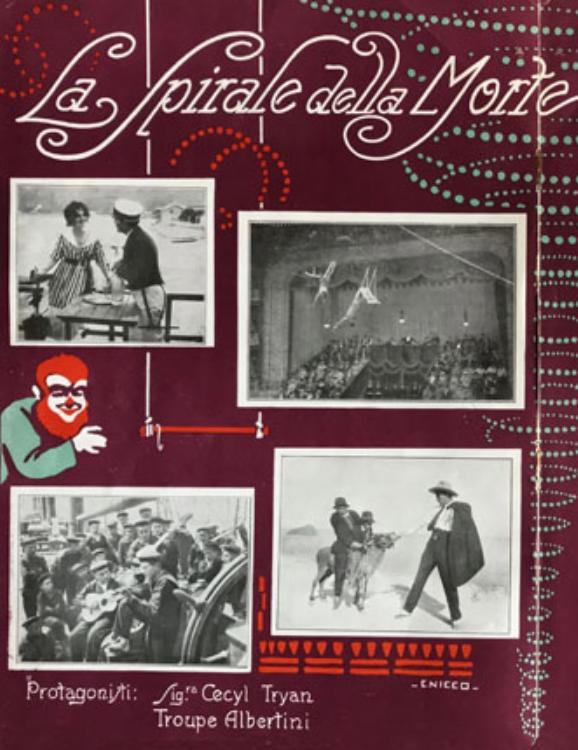
Forget linearity; La spirale della morte treats chronology the way a cat treats a gift-wrapped canary—pawing, tasting, then losing interest. The film’s central motif, a decrepit pleasure-wheel, is not mere set dressing but a karmic turbine: every revolution scrapes another layer of skin off the past. Director-photographer Alfredo Boccolini (pulling triple duty as the hulking strong-man) cranks the handlebars of his own fate, biceps glistening like wet terracotta while Linda Albertini’s ex-circus queen clings to the opposite carriage, her mascara a star-map of regret.
Their objective—catch the fabled twelfth turn when the mechanism allegedly hiccups backward—feels like betting against a rigged slot machine in a crypt. Yet the conviction on their faces sells the absurdity; silent cinema excels when eyes must semaphore what dialogue cannot, and Boccolini’s pupils radiate the dull ache of a man who has lifted the world so long he no longer recalls where his body ends and the burden begins.
Watch the periphery of any frame and you’ll spot blurred figures wearing the same clothes across three purported eras. They are not continuity errors but the film’s whispered thesis: history’s supporting cast is condemned to recycle their bit-part until the spotlight deigns to notice. This device predates the medieval pageant ghosts of Richard III by a couple of reels, yet feels eerily akin to the faceless commuters in modern films like American Methods.
“We are not punished for our sins, but by them,” reads an intertitle superimposed over a spinning zoetrope—an image so self-reflexive it threatens to pop the celluloid bubble.
The diminutive Mimi, played by the director’s own daughter, utters not a single signed or intertitle word. Her muteness metastasizes into the film’s most aural presence: every time she appears, the accompanying score—originally a live orchestra—drops to a single heartbeat-like tympani, suggesting absence can be louder than strings. Try comparing that to the verbose guilt trips in The Little Liar; here omission carries more gravitas than confession.
Shot on highly combustible 35 mm, the movie’s very medium mirrors its theme: beauty forever on the cusp of self-immolation. Boccolini reportedly stored reels in a stone olive press overnight; legend claims temperature shifts created chemical eddies that produced the ghostly double-exposures we see when Linda’s trapeze swings across a superimposed battlefield. Happy accident or proto–optical printing? Either way, the result rivals the phantasmal superimpositions in The Secret of the Storm Country.
Though marketed as monochrome, several festival prints were hand-tinted cobalt and umber for key sequences—only those fragments survive. The cobalt of Mimi’s marble, the umber of the wheel’s spokes, the arterial orange of a blood moon: three hues that now feel prophetic of the film’s own mutilated survival. Like the amber-locked mosquito in Jurassic Park, these tinting strokes preserve DNA for future resurrection.
Alfredo Boccolini’s physique is a silent opera—every tendon a note of penitence. In one prolonged medium shot he hoists the wheel’s broken axle onto his shoulder and staggers uphill; the camera lingers until sweat darkens his waistband, turning labour into liturgy. Compare that brute physicality to the cerebral stillness of Henriette Bonard’s society dilettante, who watches from a velvet rococo chair dragged absurdly to the quarry’s edge. Their acting styles clash like vinegar and honey, yet within the film’s dream-o-matic logic the dissonance feels predestined.
When Linda finally confronts the mirror-wheel—literally a mirrored hubcap nailed to the ride’s center—her reflection fractures into seven shards, each shard freezing at a different age. The shot lasts maybe four seconds, but the actress modulates micro-expressions so minutely you can map her career’s arc from ingenue to ingénue-gone-to-seed without a single title card. The moment anticipates the shattered-self montage of Bergman half a century later.
Editor Ercole Vaser employs match-cuts not on motion but on moral stasis: a 1913 handshake segues into a 1943 fascist salute via the mere act of palm rotation. The ideological whiplash lands harder than any battlefield montage. Contemporary reviewers dismissed it as “gimmickry”; modern eyes recognize a proto-Godardian rupture that makes Giving Becky a Chance look editorially quaint.
Most intertitles appear superimposed over chimney plumes, so words literally dissolve as you read them. The effect is maddening—like trying to pin a confession to cumulus—but it forces the viewer to graft meaning onto the image before language evaporates. In an era when silent films spoon-fed exposition, such evanescence feels punk rock.
Last year the Cineteca di Bologna commissioned a new score by industrial duo Nulla Osta: bowed railway tracks, detuned harpsichord, and the heartbeat of an 1890s fairground organ salvaged from the same province. Played at 70 dB—loud enough to vibrate your ribcage—the music converts the film’s theoretical fatalism into something bodily. If you get the chance, hear it in a rotunda; the acoustics turn each creak of the on-screen wheel into tectonic movement.
Where The Scarlet Car chases moral comeuppance through vehicular momentum, Spirale traps its sinners in centrifugal stasis. Where Colonel Carter leans on Southern chivalry, this film strips chivalry to its rusted gears. And while Dick Whittington rewards upward mobility, Boccolini’s carousel only trades altitude for vertigo.
Christopher Nolan’s rotating hallway in Inception and the palindromic trauma of Tenet owe more to this obscure Italian curio than either filmmaker will admit. Ditto for the karmic loop in Arrival—the notion that foreknowledge of pain does not exempt you from embracing it.
Only 42 of the original 78 minutes survive—four reels scattered from Turin to São Paulo. The gap-toothed print turns viewing into séance: you’re forever aware of phantom limbs. Yet absence is the film’s native tongue; to complain about missing footage is like faulting a ghost for lacking mass. What remains is enough to certify that, had the complete version endured, we might today speak of Boccolini in the same breath as Murnau or Vertov.
Currently streaming via Criterion Channel in a 2K restoration that stabilizes the hand-tinted flashes without ironing out the gate judder. A Blu-ray with Nulla Osta score drops this October; pre-order proceeds fund further excavation in the Apennine foothills where Reel #5—reportedly the blood-moon sequence—was last rumored buried beneath a vineyard.
Because history is a wheel we board blindfolded, convinced the next turn will reveal the exit. Because silent cinema is not a primitive stepping-stone but a parallel galaxy whose physics we have forgotten how to breathe. Because La spirale della morte reminds us that every revolution, political or personal, ends where it began—only heavier, rustier, haunted by the squeal of unpaid fares.
So take the ride. Just don’t expect to disembark the same person, or even the same species. The wheel keeps whatever flesh you leave behind.
IMDb —
1920
Community
Log in to comment.