DbcultAccessing Vault...
5.4/10
Senior Film Conservator
A definitive 5.4/10 rating for a film that redefined the boundaries of cult cinema. La tierra de los toros remains a cornerstone of transgressive art.
To speak of La tierra de los toros is to speak of the intersection where the French avant-garde collided headlong with the rugged, atavistic soul of the Iberian Peninsula. Musidora, born Jeanne Roques, was already a legend by 1924, having immortalized the 'vamp' archetype in the serials of Louis Feuillade. Yet, in this self-directed excursion into the heart of Spain, she sheds the black silk of Irma Vep for the sun-bleached textures of a filmmaker in search of something more elusive than mere melodrama. This film is a fascinating relic, a semi-documentary hybrid that predates the meta-fictions of the French New Wave by decades, yet it remains anchored in the shimmering, silent aesthetic of its time.
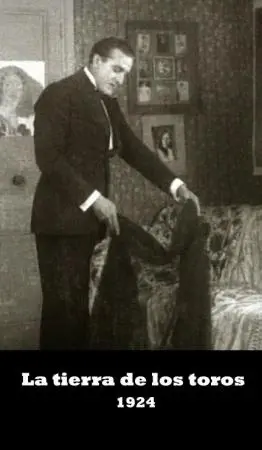
The premise of the film is deceptively simple, yet layered with a sophisticated self-awareness. Musidora travels to Spain, not merely as an actress, but as a creator seeking a muse. She finds him in the form of a young toreador, a man whose grace in the face of death is undeniable, but whose reluctance to perform for the lens provides the central tension of the work. Unlike the protagonists of A Yankee Go-Getter, who navigate their worlds with a distinctly American brand of kinetic hustle, the toreador in Musidora’s vision is a figure of stillness and resistance. He represents a world that the camera has not yet fully conquered—a world of blood, sand, and genuine stakes that mock the choreographed fictions of Hollywood.
Musidora’s presence in the film is both as an observer and a catalyst. She moves through the Spanish landscape with a predatory grace, her eyes—those famous, kohl-rimmed orbs—scanning the horizon for a spark of the 'real.' When she finds it in the bullfighter, the film shifts from a travelogue into a complex study of the gaze. She wants to capture his essence, but the act of capturing it inherently alters it. This is a theme that resonates through her earlier work like Les frères corses, where the duality of identity is explored through more traditional narrative means. Here, the duality is between the filmmaker and the subject, the artist and the raw material.
Visually, La tierra de los toros is a triumph of location shooting. At a time when many productions were retreating into the controlled environments of the studio, Musidora takes us into the blinding light of the Spanish afternoon. The cinematography captures the harsh contrast between the deep, ink-black shadows of the tavern and the bleached white of the arena walls. This isn't the romanticized Spain of Bizet’s Carmen; it is a place of grit and heat. One can almost feel the dust rising from the hooves of the bulls, a sensory immersion that rivals the outdoor ruggedness of John Ford’s Bucking Broadway, though Musidora’s lens is far more interested in the poetic than the procedural.
The editing of the bullfighting sequences is particularly noteworthy. There is a rhythmic intensity to these scenes that avoids the frantic pacing of contemporary shorts like Jumping Beans. Instead, Musidora lingers on the preparation—the tightening of the sash, the prayer before the icon, the heavy silence of the crowd. When the bull enters, the camera doesn't shy away, but it remains focused on the human element, the toreador’s face, and his internal conflict about being watched by two audiences: the one in the stands and the one behind the glass lens.
The toreador’s reluctance is the film’s most modern touch. In an era where cinema was becoming a global obsession, the idea of a character who refuses the spotlight is fascinating. He isn't seeking fame like the characters in A Flirt There Was; he is protective of his dignity. This creates a fascinating dynamic with Musidora’s persona. She is the ultimate creature of the screen, a woman who lived her life in the public eye, yet here she is, humbled by a man who finds her medium trivial. It’s a subversion of the typical 'vamp' narrative where the woman destroys the man; here, the woman is challenged by the man’s refusal to be 'consumed' by her art.
This resistance mirrors the struggles of characters in more grounded dramas like The Brute Breaker, where the environment dictates the morality of the men who inhabit it. The toreador is a product of the Spanish earth—the 'tierra' of the title—and he cannot be easily uprooted and transplanted into the artificial soil of the movie set. Musidora’s genius lies in her ability to film this very struggle, making the film's 'making-of' nature its primary engine.
While many silent films of the mid-20s were leaning toward the slapstick of Why Smith Left Home or the escapism of Join the Circus, Musidora was pushing toward a form of cinematic truth that wouldn't be fully realized until the advent of Italian Neorealism. There is a starkness here, a willingness to let the camera sit with a character in a moment of quiet contemplation. Even the more traditionally dramatic elements—the romantic tensions, the cultural misunderstandings—are handled with a restraint that is rare for the period. It lacks the melodramatic flourishes of The Discard, opting instead for a more observational, almost ethnographical tone.
One cannot ignore the feminist undertones of the production. Musidora was one of the few women of her era to exert total creative control over her projects. By placing herself in the role of the director/seeker, she flips the script on the male-dominated industry. She is the one with the power, the one with the camera, and the one who ultimately decides how the story will end. In this sense, La tierra de los toros is a manifesto of independence. It is a declaration that a woman’s gaze is just as capable of capturing the 'primitive' and the 'virile' as any man’s lens.
The use of natural lighting in the Spanish sequences is nothing short of revolutionary. There is a sequence where Musidora watches the toreador from a balcony; the way the light catches the lace of her mantilla while leaving her face in partial shadow is a masterclass in silent era composition. It evokes the psychological depth of Iwami Jûtarô, yet with a distinctly European sensibility. The film doesn't rely on the high-flying stunts of Up in the Air or the speed of The Blue Streak. Its power is found in the slow burn of its gaze, the way it allows the viewer to inhabit the space between the characters.
Even the interludes, which some might find slow, serve a purpose. They build the atmosphere of a land where time moves differently. This is a film that demands patience, much like the process of taming a bull or a reluctant actor. It is a film about the work of art, not just the finished product. In this way, it shares a certain DNA with the experimental spirit of Soviet cinema, such as Dzhymmi Hihhins, though it remains firmly rooted in the personal and the poetic rather than the political.
In the grand tapestry of silent cinema, La tierra de los toros often gets lost behind Musidora’s more famous collaborations with Feuillade. This is a profound injustice. The film is a vital piece of cinematic history that shows an artist at the height of her powers, grappling with the very nature of her medium. It is a beautiful, sun-drenched, and occasionally haunting work that bridges the gap between the 19th-century traditions of Spain and the 20th-century machinery of the motion picture. It is as much a documentary of a disappearing world as it is a fictional narrative, and it deserves to be seen by anyone who appreciates the power of the silent image.
Whether you are drawn to it for the historical curiosity of seeing Musidora in her prime, or for the breathtaking footage of the bullring, the film leaves an indelible mark. It is a reminder that cinema, at its best, is a journey into the unknown—a quest for a truth that can only be found when we step away from the comforts of the studio and into the blinding light of the world. It is a far cry from the lighthearted antics of Beach Nuts or the generic tropes of Boots. It is a singular, idiosyncratic, and deeply moving piece of art that continues to pulsate with life a century after its creation.

IMDb —
1928
Community
Log in to comment.