DbcultAccessing Vault...
Cult Review
Senior Film Conservator
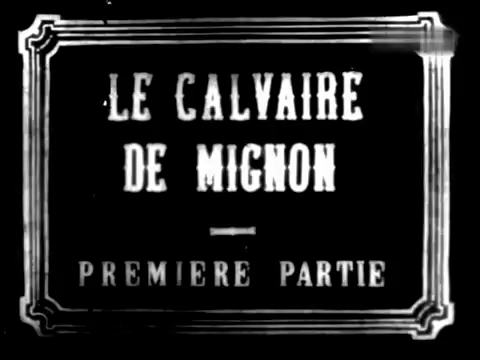
Director Georges Tréville treats chiaroscuro like a pickpocket treats moonlight: he needs only a sliver to slit your purse of empathy. Notice how the opening tableau dissolves from a stone gargoyle’s eye straight into Mignon’s pupil—an optical rhyme that announces the film’s thesis: devotion and damnation share one iris. Candle flames are never mere props; they oscillate between sacrament and interrogation lamp, wax pooling like slow guilt across the mise-en-scène.
Toulout carries the patrician fatigue of a man who has read his own epitaph in the ledger books. Watch the way his gloved hand hovers a fatal inch above Mignon’s waist—never touching, yet claiming ownership through negative space. Silent-film acting can age into mime, but Toulout’s micro-gestures—the left eyelid fluttering when the word mortgage is uttered—hurl the viewer straight into the character’s marrow of dread.
Pascal performs innocence not as static virginity but as a hairline fracture in Sevres porcelain: beautiful because catastrophe is scripted into the glaze. Her body folds inward during the second-act ball scene, shoulders grazing earlobes, as if the air itself were stitched with creditors’ signatures. When she finally lifts her gaze to the camera, the tear isn’t timed for maximal schmaltz; it escapes like a prisoner who knows the wall is too high.
Feval, heir to his father’s swashbuckling pedigree, here trades cloaks for psychological scalpels. Dialogue intertitles arrive sparingly, but each is a ricin pellet: "A promise is just a corpse that refuses to lie down" reads one card, flashed right after a wedding veil is lifted. The narrative architecture is Dickensian—coincidences pile like corpses in a plague pit—yet the emotional logic feels inexorable, the way a nightmare obeys no map yet always knows your address.
Though technically mute, the film orchestrates an illusion of resonance. Listen—metaphorically—to how the montage of dripping water in the dungeon syncs with the cut to Mignon’s blood-dotting needle. Your brain supplies the plink-plink, and suddenly the absence of a score becomes an accomplice.
Place it beside Your Girl and Mine and you’ll see both weaponize female suffering for social critique, yet where the American film marches toward the ballot box, Tréville’s film crawls toward the scaffold. Pair it with Ghosts and note how Ibsen’s hereditary guilt migrates across the Channel, metastasizing into French Catholic masochism. Meanwhile, the proto-noir deceits of Gold and the Woman look almost jocular next to Mignon’s sacramental despair.
Cross-cutting here doesn’t just build suspense; it builds theology. A shot of Mignon lighting a votive candle slam-cuts to the Comte extinguishing a gambling debt with the same match. The splice implies a zero-sum economy of grace: every flicker of her salvation purchases his perdition.
Restoration has tinted night scenes in bruise-violet and dawn sequences in septic green—choices that would feel expressionist in Les Vampires but here serve to spiritualize rot. The palette argues that sin, once confessed, doesn’t vanish; it simply changes hue.
Notice the recurring metaphor of ledgers written on skin: Raoul blackmails Mignon with a ledger he claims is tattooed on her fiancé’s back—an obscene fusion of commerce and carnality. The film comprehends marriage as a transference of ledger lines from parchment to epidermis, a concept that makes even The Law of Nature seem G-rated.
Tréville repeatedly frames Mignon within doorframes that resemble pillory stocks. The threshold becomes both sanctuary and spectacle; she is perpetually on trial in the court of masculine gazes. When she finally crosses a doorway unescorted in the penultimate reel, the camera tilts five degrees—not enough to cause seasickness, just enough to intimate that the world itself has slipped off moral plumb.
DNA from this film replicates in Hitchcock’s Vertigo and in the clammy Catholicism of Buñuel’s Viridiana. Even the sapphic panic of Betty in Search of a Thrill owes a debt to Mignon’s conflation of eros and doom. Yet unlike those descendants, Tréville refuses catharsis; the final iris-in feels less like closure and more like a coffin lid sealing.
As of this month, the only circulating print is a 2K restoration housed at the Cinémathèque Française, digitized for festival streaming. Lobby your local arthouse; this is not a relic but a landmine. The themes—debt peonage, reputation annihilation, the commodification of female virtue—map perfectly onto today’s influencer-cancel-culture economy. Substitute Instagram stories for ink-and-parchment love-letters and you’re there.
Because it lacks the serial-kink of Les Vampires or the muscle-mythology of Marvelous Maciste, Le Calvaire de Mignon gets relegated to footnotes. That is a curatorial crime. This is the film that proves melodrama can out-thrill thrillers and out-noir noir, all while wearing lace gloves soaked in holy water.

IMDb 5.6
1932
Community
Log in to comment.